


Bawden, Pottery Making at Poole.
Pottery Making at Poole.
[Plaistow, Newham], Printed at The Curwen Press, no year [c.1925]. Small Octavo (10 cm wide x 15.8 cm high). 12 pages (including printed wrappers). Original, printed card-wrappers (sewn binding). Unusually excellent condition with only minor signs of wear and no tears. Interior very bright. Extremely Rare !
This extremely scarce piece of Ephemera was one of the first commissions of Edward Bawden’s wonderful career as illustrator and graphic artist. The little pamphlet was printed at The Curwen Press. In the important reference work by Bryan Webb, on Eric Ravilious and Edward Bawden, Webb writes about “Pottery Making at Poole”:
″Harold Stabler, a director at Poole Potteries, became an early Patron [of Bawden]. Bawden designed booklets and maps for the firm which in turn led to a long term association with Harold Curwen at The Curwen Press….″
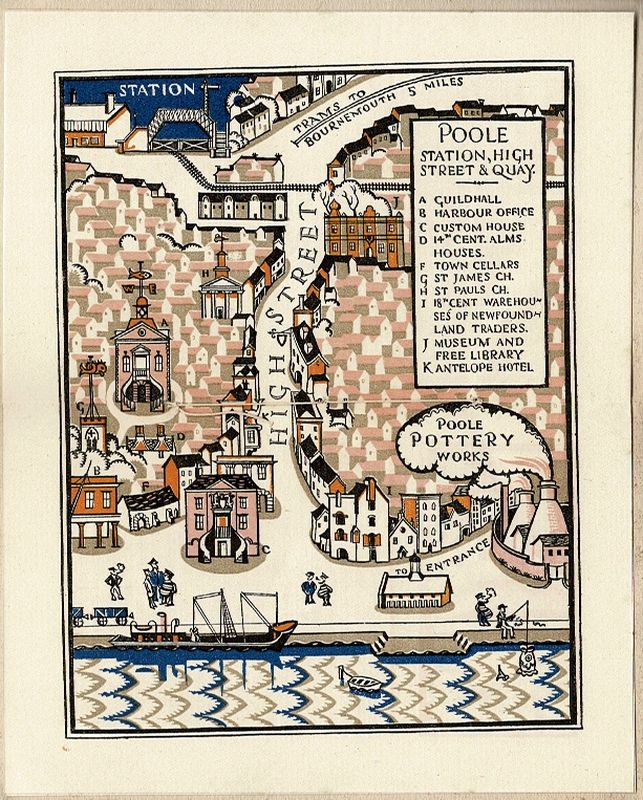
The booklet includes a wonderful, graphically designed map of Poole (see image). Essays in the booklet include: “Throwing on the wheel”; “Placing Pots in Kilns”; “Firing the Kiln” – illustrated throughout with Bawden’s designs.
______________________________________________________________
The Curwen Press was founded by the Reverend John Curwen in 1863 to publish sheet music for the “tonic sol-fa” system. The Press was based in Plaistow, Newham, east London, England, where Curwen was a pastor from 1844.
The Curwen Press is best known for its work in the period 1919–1939. The Press’s output included books, advertising posters and published ephemera which typically used three interrelated elements: typography, decoration, and publicity which together give the Press a unique and memorable style. The work of the Press provides important evidence that the fine printing of the interwar years was not confined to private presses.
The Curwen Press, under the management of Harold Curwen, John’s grandson, was at the vanguard of the design revolution that saw expression in British printing in the early 20th century. An underlying ethos of the Curwen Press was that its craftsmanship could and should take both craftsman and consumer on an emotional and aesthetic voyage. Harold Curwen considered that using contemporary independent artists would significantly enhance printed matter for publicity purposes. His belief was that the imaginative skills of an artist could not be acquired through training and gave an artist an advantage in their design work. In return that applied artist-designer would acquire something from their commercial practice to take back into their fine art.
Decoration was largely in the hands of Harold Curwen who encouraged artists such as Claud Lovat Fraser, Paul Nash, and latterly Eric Ravilious, Edward Bawden, Barnett Freedman and Enid Marx, from the same year of the Royal College of Art, to undertake work for the Press. Commissions included pattern papers, vignettes, and borders as well as illustration. While the mechanical method of printing was the way forward, Curwen believed that the imaginative artist should exert some control over how their design was being replicated and so encouraged artists to work alongside printers to learn the technical processes of illustration, particularly lithography. In this way, how the work of artists could be most effectively reproduced was balanced by how artists might render their work more sympathetic to the reproduction process. What artists themselves clearly appreciated was the preservation by Curwen of the harmony and resonance of their designs. In 1934 Curwen authored a book on processes of graphic reproduction.
Typography:
A book produced to the design, and choice of material, of typographer Oliver Simon, and executed by Harold Curwen’s technical team, made use of margins, typeface, spacing and materials produced a distinctive appearance associated with good quality. In 1945 Simon authored a book on his principles of typography. Simon also edited and published Signature magazine. Subtitled a Quadrimestrial of typography and the graphic arts, Signature was published between 1935–1940 and 1946–1954 (new series). Printed by the Press, Signature featured original and formative graphic work and writings by relatively new artists such as Graham Sutherland, John Piper and Eric Ravilious. it has been said that ‘no journal can make a greater claim to have stimulated the taste that became Neo-Romanticism,’ a term applied to the imaginative and often quite abstract landscape- based painting of Paul Nash, Graham Sutherland, John Piper and others in the late 1930s and 1940s. It was Simon, though Signature, who published Sutherland’s new style of painting first, and the first series provided a sustained support and exposure for certain artists, most notably Sutherland, Piper, Freedman, Ravilious and Bawden. (Wikipedia)
_____________________________________________________________________________________
Edward Bawden, CBE RA (10 March 1903 – 21 November 1989) was an English painter, illustrator and graphic artist, known for his prints, book covers, posters, and garden metalwork furniture. Bawden taught at the Royal College of Art, where he had been a student, worked as a commercial artist and served as a war artist in World War II. He was a fine watercolour painter but worked in many different media. He illustrated several books and painted murals in both the 1930s and 1960s. He was admired by Edward Gorey, David Gentleman and other graphic artists, and his work and career is often associated with that of his contemporary Eric Ravilious.
Edward Bawden was married to the potter and artist, Charlotte Bawden (née Epton). Together they were principal members of the Great Bardfield Artists, a community of artists influential in the art scene of England during the mid-20th century.
Edward Bawden was born on 10 March 1903 at Braintree, Essex, the only child of Edward Bawden, an ironmonger, and Eleanor Bawden (née Game). His parents were Methodist Christians. A solitary child, he spent much time drawing or wandering with butterfly-net and microscope. At the age of seven he was enrolled at Braintree High School, and began studying or copying drawings of cats by Louis Wain, illustrations in boys’ and girls’ magazines, and Burne Jones’ illustrations of Malory’s Morte d’Arthur. Later his parents paid for him to attend the Friends’ School at Saffron Walden, and there, when he was fifteen, the headmaster recommended him to study for one day a week at Cambridge School of Art.
Upon leaving school in 1919, he attended Cambridge School of Art full-time from 1919 to 1921. There he became interested in calligraphy and in the work of Aubrey Beardsley, Richard Doyle, William Morris and other Victorians. This was followed in 1922 by a scholarship to the Royal College of Art School of Design in London, where he took a diploma in illustration until 1925. Here he met his fellow student and future collaborator Eric Ravilious; the pair were described by their teacher Paul Nash as “an extraordinary outbreak of talent”.
It was during this period that Bawden produced the tiles for the London Underground that were exhibited at the International Building Trades Exhibition at Olympia in April 1928.
In 1928, Bawden was commissioned by Sir Joseph Duveen, at the rate of £1 per day, to create a mural for the Refectory at Morley College, London along with Ravilious and Charles Mahoney. The mural was unveiled in 1930 by former Prime Minister Stanley Baldwin, who was at the time Leader of the Opposition.
By 1930, Bawden was working one day a week for the Curwen Press, as was Ravilious and their former tutor, Nash, producing illustrations for leading companies at the time such as London Transport, Westminster Bank, Twinings, Poole Potteries, Shell-Mex & BP, the Folio Society, Chatto & Windus and Penguin Books. In the early 1930s he was discovered by the Stuart Advertising Agency, owned by H. Stuart Menzies and Marcus Brumwell. Around this time Bawden produced some of his most humorous and innovative work for Fortnum & Mason and Imperial Airways. He also worked for The Listener.
In 1932, Bawden married Charlotte Epton, a successful potter, who had been a fellow-student at the Royal College. They had two children, Joanna and Richard, both of whom would become artists. At first the couple lived in a flat in Hammersmith, but soon moved to a Georgian house in Great Bardfield, Essex, only a few miles from Braintree, where Bawden had been born. Following his move to the country he began to paint more, in addition to his commercial design work, developing his watercolour technique. Most of his subjects were of scenes around Great Bardfield. He held an exhibition of his Essex watercolours at the Zwemmer Gallery in 1934, and another show of his paintings was held at the Leicester Galleries in 1938. According to the Fry Gallery, “Charlotte Bawden was at the centre of all the artistic and social activity in Great Bardfield through four decades, providing generous hospitality, organisation, and support for Edward in his extensive output and teaching.″
In 1938, Bawden collaborated with John Aldridge, who also lived in the village, on a range of wallpapers that they intended to be printed commercially, but from lino blocks handcut by the designers. The project left little other time for other work during the year, and war intervened before the papers could go into production.
One of Bawden’s most familiar designs from this era was the ‘Puzzled Lion and Startled Unicorn’ Observer masthead, which was created around 1939 and remained in use by the national newspaper until 1989.
Bawden bequeathed about 3,000 of his works to The Higgins Art Gallery & Museum, Bedford.
His work can be seen in many major collections and is shown regularly at the Fry Art Gallery, Saffron Walden and at the Higgins. His notable surviving public works include a tile depicting a foot ferry on the River Lea, commissioned by London Underground and located on the Victoria line platform at Tottenham Hale tube station. Bawden also produced the cameo-like silhouette of Queen Victoria located at Victoria tube station. An early map, produced in 1931 for Scarborough’s Pavilion Hotel and presented to Scarborough Library when the hotel was sold, was recently restored and rehung in the library.
The original Morley College mural that Bawden created in the 1930s was destroyed during a wartime bombing raid; however the rebuilt and relocated college on the South Bank contains a fine surviving mural by him. In 1965 Bawden completed a mural for Queen’s University, Belfast and his last major commission, completed in 1972, was for an historical mural inside Blackwell’s bookshop in Oxford. (Wikipedia)
- Keywords: Art · Art – Rare · Book Design · Book Illustrator · Books on Books Rare · Catalogue Four – International Art · Curwen Press · Edward Bawden (Illustrator) · Ephemera · Ephemera – Rare · Illustrated Books · Illustrated Books Rare · Poole Pottery · Pottery · Pressendruck · Private Press · Private Press – Books & Pamphlets · Private Press – Printing · Private Press – Typography · Typography · Typography Rare · Woodcut · Woodcuts
- Language: English
- Inventory Number: 32105AB
EUR 750,--

We ship per DHL Express


Contact
Inanna Rare Books Ltd.
Woodley House
Castletownshend Road
P81 D262 Skibbereen, County Cork
Ireland
Phone: ++353 - (0) 87 - 102 5412
E-Mail: info@inannararebooks.com
Internet: https://www.inannararebooks.com
Online Bookshop specialized in rare
and secondhand books.
Newsletter and E-Catalogue Sign Up
Payment Options


© 2026 Inanna Rare Books Ltd. | Powered by HESCOM-Software

