


Brown, Lectures on The Philosophy of the Human Mind - With a Memoir of the Autho
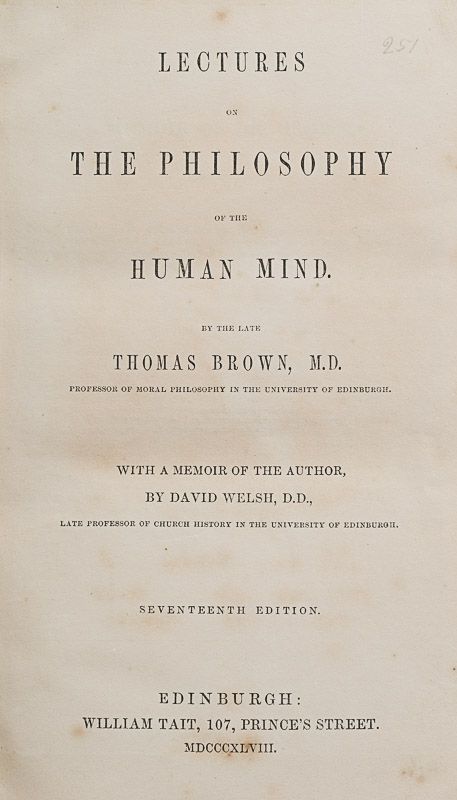
Lectures on The Philosophy of the Human Mind – With a Memoir of the Author, by David Welsh.
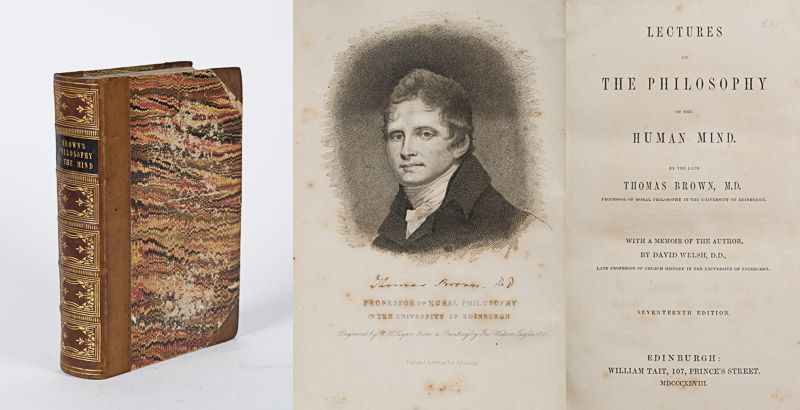
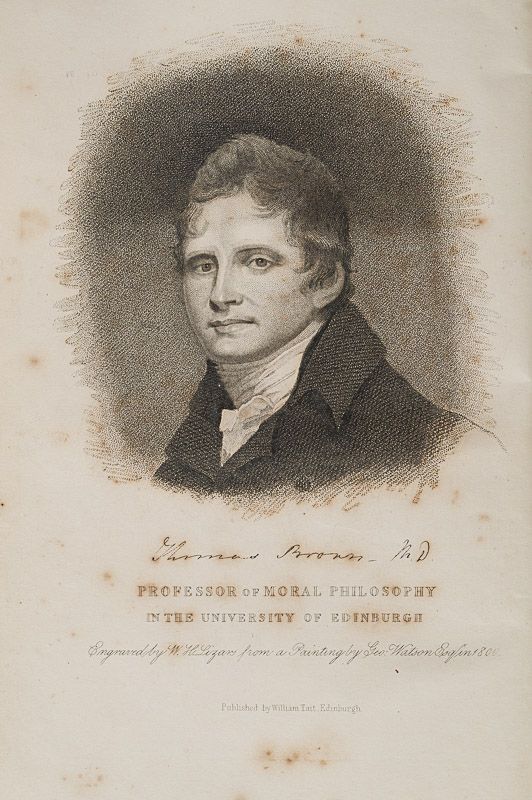
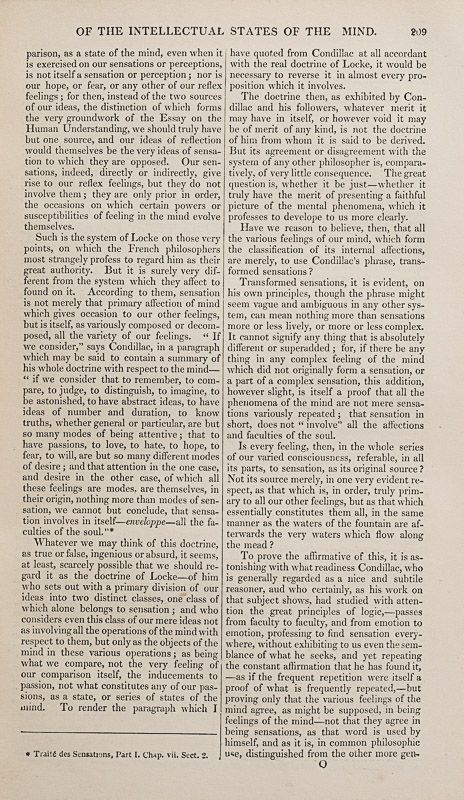
Seventeenth Edition. Edinburgh, William Tait, 1848. Octavo (14.5 cm wide x 22 cm high). Portrait-Frontispiece of Thomas Browne, XXXI, 692 pages. Hardcover / Original, very decorative full leather with gilt lettering and ornament on spine. Very good and firm condition with only minor signs of wear. The Portrait with the original tissue-guard. Very minor signs of foxing only.
Thomas Brown FRSE (9 January 1778 – 2 April 1820) was a Scottish physician, philosopher, and poet. Renowned as a physician for his structured thinking, diagnostic skills, and prodigious memory, Brown went on to hold the Chair of Moral Philosophy at Edinburgh University from 1810 to 1820; where, “rather than pronouncing how he found things to be, [Brown] taught [his students] how to go about thinking about things.″
Brown was born at Kirkmabreck, Kirkcudbrightshire, the son of Rev. Samuel Brown (died 1779) (minister of Kirkmabreck and Kirkdale) and Mary Smith.
Their son was a wide reader and an eager student. Educated at several schools in London, he went to the University of Edinburgh in 1792, where he attended Dugald Stewart’s moral philosophy class, but does not appear to have completed his course. After studying law for a time he took up medicine; his graduation thesis De Somno was well received. But his strength lay in metaphysical analysis.
Brown set an answer to the objections raised against the appointment of Sir John Leslie to the mathematical professorship (1805). Leslie, a follower of David Hume, was attacked by the clerical party as a sceptic and an infidel, and Brown took the opportunity to defend Hume’s doctrine of causality as in no way inimical to religion. His defence, at first only a pamphlet, became in its third edition a lengthy treatise entitled Inquiry into the Relation of Cause and Effect, and is a fine specimen of Brown’s analytical faculty.
In 1806, Brown became a medical practitioner in partnership with James Gregory (1753–1821), but, though successful, preferred literature and philosophy. After twice failing to gain a professorship in the university, he was invited, during an illness of Dugald Stewart in the session of 1808–1809, to act as his substitute, and during the following session he undertook much of Stewart’s work. The students received him with enthusiasm, due partly to his splendid rhetoric and partly to the novelty and ingenuity of his views. In 1810 he was appointed as colleague to Stewart, a position which he held for the rest of his life. Brown was elected a member of the American Antiquarian Society in 1815. He wrote his lectures at high pressure, and devoted much time to the editing and publication of the numerous poems which he had written at various times during his life. He was also preparing an abstract of his lectures as a handbook for his class. His health, never strong, gave way under the strain of his work.
He was advised to take a trip to London, where he died in 1820 aged 42. His body was returned to Kirkmabreck for burial.
One of Brown’s notable works included a critique of Erasmus Darwin’s theory of transmutation. The philosopher published it in the form of a detailed study Observations on the zoonomia of Erasmus Darwin (1798), which was recognized as a mature work of criticism.
Noteworthy, Brown’s criticism of the Darwinian thesis, like that of Rudolf Virchow, did not come from any religious feeling. In fact, Brown’s critique bears an uncanny resemblance to Thomas Robert Malthus’s Essay on the Principle of Population (1798) in which Malthus’s main objection against Darwin’s thesis, like that of Brown, was epistemological rather than religious.
According to Mike Dacey (2015, p. 35), “Brown’s unique philosophy results from his historical place at the intersection of the associationists and the Scottish school”: and, “characteristic of the Scottish school, Brown refuse[d] to speculate on physical or physiological correlates to psychological phenomena”:
“Two of [Brown’s] ideas stand out as particularly important in later formulations of associationism. He first proposed secondary laws of association, which determine which specific feeling will follow in any particular case. He also introduced the idea that the latter of two successive feelings need not replace the former, but the former could continue in a virtual coexistence with it. He calls it ‘virtual’ because, in his view, the mind can only be in one state at a time and mental states do not have parts, so there cannot literally be two ideas in mind at once. Virtual coexistence brings complex ideas together without ‘connecting’ them as literal parts of a whole. A new complex idea is formed when a suggesting idea remains, virtually, to coexist with the idea suggested. — Mike Dacey (2015, p. 35).″
Later criticism of Brown’s philosophy lessened its popularity, a severe attack being made by Sir William Hamilton, 9th Baronet in his Discussions and Lectures on Metaphysics. A high estimate of his merits was shown in John Stuart Mill’s Examination of Hamilton. Also, in David Welsh’s Account of the Life and Writings (1825) and James McCosh’s Scottish Philosophy (1874). Friedrich Eduard Beneke, who found in him anticipations of some of his own doctrines. (Wikipedia)
- Keywords: Altphilologie · Catalogue Greek History & Philosophy · Classical Literature · Classical Literature – Rare · Classical Philology · Classical Studies · Classical Studies – Rare · Classics · Greek History · Greek Philosophy · Philologie · Philology
- Language: English
- Inventory Number: 32431AB
EUR 275,--

We ship per DHL Express


Contact
Inanna Rare Books Ltd.
Woodley House
Castletownshend Road
P81 D262 Skibbereen, County Cork
Ireland
Phone: ++353 - (0) 87 - 102 5412
E-Mail: info@inannararebooks.com
Internet: https://www.inannararebooks.com
Online Bookshop specialized in rare
and secondhand books.
Newsletter and E-Catalogue Sign Up
Payment Options


© 2026 Inanna Rare Books Ltd. | Powered by HESCOM-Software

