



[Fox, Memoirs of the Latter Years of the Honourable Charles James Fox [with a le
Memoirs of the Latter Years of the Honourable Charles James Fox [with a lengthy report on a meeting with Irish Revolutionary Arthur O’Connor in Calais].
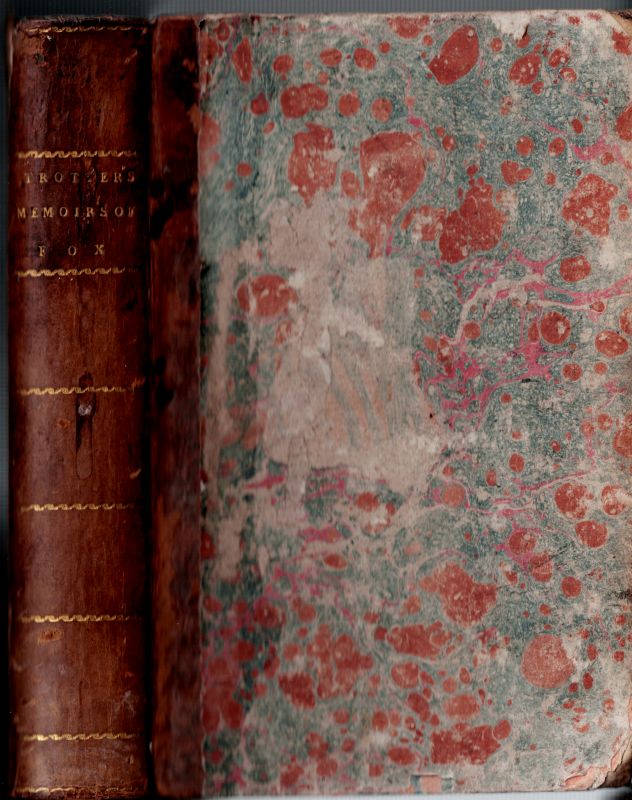
Third Edition. London, Printed for Richard Phillips, 1811. Octavo (13.6 cm wide x 21.3 cm high). XXXIX, 552 pages. Hardcover / Original, very decorative half-leather with gilt lettering and ornament on spine. Binding a bit rubbed but overall in a firm and very good condition with only minor signs of wear. The interior in bright and excellent condition. From the library of Richard Meade (Ballymartle), with his Exlibris / Bookplate to pastedown.
Part I: Description of St.Anne’s Hill / Domestic Habits of Mr.Fox / Contrasted with Mr.Pitt / The Newspapers / Departure to France /
Includes a longer section in which John Bernard Trotter discusses a chance meeting of Fox with irish Revolutionary, Arthur O’Conno, in a section called the “Independent conduct towards Mr.O’Connor [Arthur O’Connor, brother of Roger O’Connor]:
″An incident occured at Calais, which as it excited much remark, and roused a good deal of censure at the time, I shall advert to more length than would otherwise be necessary. It happened that Mr.Arthur O’Connor had arrived at the inn at which we stopped very shortly before. He waited on Mr.Fox, was received by him with that urbanity and openness which distinguished him, and was invited to dinner by him, which invitation he accepted of. It is well known that, after a long confinement at Fort George, he, and some other Irish gentlemen, agreed with the Irish Government to expatriate themselves for Life. Mr.O’Connor was now on his way to Paris accordingly; when chance brought him to Quillac’s Inn, at the same time with Mr.Fox. His manners were extremely pleasing….″
Trotter continues at length to elaborate on the meeting and conduct of Arthur O’Connor, their subsequent visit to the Theatre and three other times of meeting in Calais.
Part II: Deals intensely with Fox’s last days, remedies eeked, decision to take Digitalis etc.
Part III:
With a section of Letters of Mr.Fox to the Author John Bernard Trotter
With a section of Letters of General Fayette
Charles James Fox (24 January 1749 – 13 September 1806), styled The Honourable from 1762, was an English Whig politician and statesman whose parliamentary career spanned 38 years of the late 18th and early 19th centuries. He was the arch-rival of the Tory politician William Pitt the Younger; his father Henry Fox, 1st Baron Holland, a leading Whig of his day, had similarly been the great rival of Pitt’s famous father, William Pitt, 1st Earl of Chatham (″Pitt the Elder”).
Fox rose to prominence in the House of Commons as a forceful and eloquent speaker with a notorious and colourful private life, though at that time with rather conservative and conventional opinions. However, with the coming of the American War of Independence and the influence of the Whig Edmund Burke, Fox’s opinions evolved into some of the most radical to be aired in the British Parliament of his era.
Fox became a prominent and staunch opponent of King George III, whom he regarded as an aspiring tyrant. He supported the American Patriots and even dressed in the colours of George Washington’s army. Briefly serving as Britain’s first Foreign Secretary during the ministry of the Marquess of Rockingham in 1782, he returned to the post in a coalition government with his old enemy, Lord North, in 1783. However, the King forced Fox and North out of government before the end of the year and replaced them with the 24-year-old Pitt the Younger. Fox spent the following 22 years facing Pitt and the government from the opposition benches of the House of Commons.
Though Fox had little interest in the actual exercise of power and spent almost the entirety of his political career in opposition, he became noted as an anti-slavery campaigner, a supporter of the French Revolution and a leading parliamentary advocate of religious tolerance and individual liberty. His friendship with his mentor, Burke, and his parliamentary credibility were both casualties of Fox’s support for France during the French Revolutionary Wars, but Fox went on to attack Pitt’s wartime legislation and to defend the liberty of religious minorities and political radicals. After Pitt’s death in January 1806, Fox served briefly as Foreign Secretary in the ‘Ministry of All the Talents’ of William Grenville before he died on 13 September 1806, aged 57.
Fox, who occasionally corresponded with Thomas Jefferson and had met Benjamin Franklin in Paris, correctly predicted that Britain had little practical hope of subduing the colonies and interpreted the American cause approvingly as a struggle for liberty against the oppressive policies of a despotic and unaccountable executive. It was at this time that Fox and his supporters took up the habit of dressing in buff and blue, the colours of the uniforms in Washington’s army. Fox’s friend, the Earl of Carlisle, observed that any setback for the British Government in America was “a great cause of amusement to Charles.” Even after the Battle of Long Island in 1776, Fox stated that
I hope that it will be a point of honour among us all to support the American pretensions in adversity as much as we did in their prosperity, and that we shall never desert those who have acted unsuccessfully upon Whig principles.
On 31 October the same year, Fox responded to the King’s address to Parliament with “one of his finest and most animated orations, and with severity to the answered person”, so much so that, when he sat down, no member of the Government would attempt to reply.
Fox shared a mutual antipathy with George III that profoundly shaped Fox’s political career. George III was among the most enthusiastic prosecutors of the American Revolutionary War. Fox became convinced, that George III was determined to challenge the authority of Parliament and the balance of the constitution established in the Glorious Revolution of 1688 to achieve a continental-style tyranny. George III in return thought that Fox had “cast off every principle of common honour and honesty … [a man who is] as contemptible as he is odious … [and has an] aversion to all restraints.” On 6 April 1780 John Dunning, 1st Baron Ashburton introduced a motion, asking that “The influence of the Crown has increased, is increasing, and ought to be diminished”. It was passed by the Commons in a vote of 233 to 215. Fox thought that the motion is “glorious”, saying on 24 April that:
the question now was … whether that beautiful fabric [i.e. the constitution] … was to be maintained in that freedom … for which blood had been spilt; or whether we were to submit to that system of despotism, which had so many advocates in this country.
Fox, however, had not been present in the House of parliament for the beginning of the Dunning debate, as he had been occupied in the adjoining eleventh-century Westminster Hall, serving as chairman of a mass public meeting before a large banner that read “Annual Parliaments and Equal Representation”. This was the period when Fox, hardening against the influence of the British Crown, was embraced by the radical movement of the late eighteenth century. When the shocking Gordon riots exploded in London in June 1780, Fox, though deploring the violence of the crowd, declared that he would “much rather be governed by a mob than a standing army.” Later, in July, Fox was returned for the populous and prestigious parliamentary constituency of Westminster, with around 12,000 electors, and acquired the title “Man of the People”.
In the 19th century, liberals portrayed Fox as their hero, praising his courage, perseverance and eloquence. They celebrated his opposition to war in alliance with European despots against the people of France eager for their freedom, and they praised his fight for liberties at home. The liberals saluted his fights for parliamentary reform, Catholic Emancipation, intellectual freedom, and justice for the Dissenters. They were especially pleased with his fight for the abolition of the slave trade. More recent historians put Fox in the context of the 18th century, and emphasize the brilliance of his battles with Pitt. A statue of Fox stands, alongside other notable Parliamentarians, in St Stephen’s Hall in the Palace of Westminster.
While not wholly forgotten today Fox is no longer the famous hero he had been, and is less well remembered than Pitt. After 1794, the word ‘Whig’ gave way to the word “Foxite” as the self-description of the members of the opposition to Pitt. In many ways, the Pittite-Foxite division of Parliament after the French Revolution established the basis for the ideological Conservative-Liberal divide of the nineteenth century. Fox and Pitt went down in parliamentary history as legendary political and oratorical opponents who would not be equalled until the days of Gladstone and Disraeli more than half a century later. Even Fox’s great rival was willing to acknowledge the old Whig’s talents. When, in 1790, the comte de Mirabeau disparaged Fox in Pitt’s presence, Pitt stopped him, saying, “You have never seen the wizard within the magic circle.″
The Fox Club was established in London in 1790 and held the first of its Fox dinners – annual events celebrating Fox’s birthday – in 1808; the last recorded dinner took place at Brooks’s in 1907. As Charles Grey, 2nd Earl Grey asked a Newcastle-upon-Tyne Fox dinner in 1819: “What subject is there, whether of foreign or domestic interest, or that in the smallest degree affects our Constitution which does not immediately associate itself with the memory of Mr Fox?” Fox’s name was invoked numerous times in debates by supporters of Catholic Emancipation and the Great Reform Act in the early nineteenth century. John Russell, 6th Duke of Bedford kept a bust of Fox in his pantheon of Whig grandees at Woburn Abbey and erected a statue of him in Bloomsbury Square. Sarah Siddons kept a portrait of Fox in her dressing room. In 1811, the Prince of Wales took the oaths of office as regent with a bust of Fox at his side. Whig households would collect locks of Fox’s hair, books of his conflated speeches and busts in his likeness.
The town of Foxborough, Massachusetts, was named in honour of the staunch supporter of American independence. Fox is remembered in his home town of Chertsey by a bust on a high plinth, erected in 2006 in a new development by the railway station. Fox is also commemorated in a termly dinner held in his honour at his alma mater, Hertford College, Oxford, by students of English, history and the romance languages.
Fox was the subject of the epigraph in John F. Kennedy’s Pulitzer-prize winning book Profiles in Courage: “He well knows what snares are spread about his path, from personal animosity…and possibly from popular delusion. But he has put to hazard his ease, his security, his interest, his power, even his…popularity. …He is traduced and abused for his supposed motives. He will remember that obloquy is a necessary ingredient in the composition of all true glory: he will remember…that calumny and abuse are essential parts of triumph. …He may live long, he may do much. But here is the summit. He never can exceed what he does this day.” — Edmund Burke’s eulogy of Charles James Fox for his attack upon the tyranny of the East India Company. House of Commons, 1 December 1783. (Wikipedia)
- Keywords: 18th / 19th Century Country House Library of Richard Meade – Ballymartle · 18th Century – Irish Country House Library · 18th Century – Rare · Arthur O’Connor · English History in the 18th century · English History in the 19th century · English History of Language · Library & Collection Building · Meade Library Ballymartle · Richard Meade Library (Ballymartle) · Roger O’Connor – Arthur O’Connor – Collection
- Language: English
- Inventory Number: 32441AB


Contact
Inanna Rare Books Ltd.
Woodley House
Castletownshend Road
P81 D262 Skibbereen, County Cork
Ireland
Phone: ++353 - (0) 87 - 102 5412
E-Mail: info@inannararebooks.com
Internet: https://www.inannararebooks.com
Online Bookshop specialized in rare
and secondhand books.
Newsletter and E-Catalogue Sign Up
Payment Options


© 2026 Inanna Rare Books Ltd. | Powered by HESCOM-Software

