


[Nimmo, Alexander Nimmo & The Western District - Emerging infrastructure in pre-
Alexander Nimmo & The Western District – Emerging infrastructure in pre-Famine Ireland.
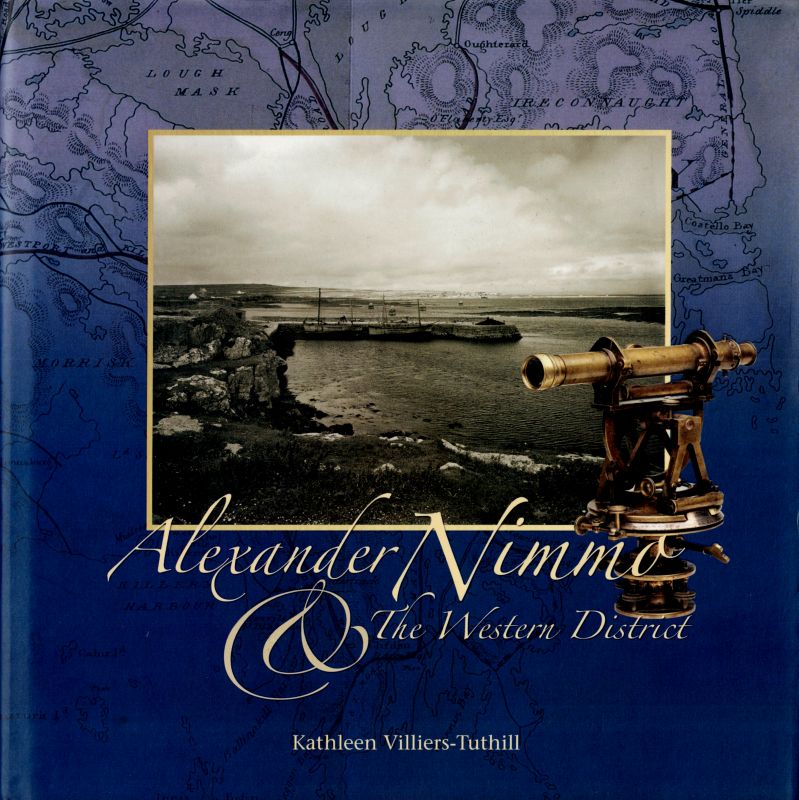
Clifden, Connemara Girl Publications, 2006. Quarto. XVI, 248 pages. Illustrated throughout. With the Map of Ballynahinch Barony as a Frontispiece. Hardcover / Original Publisher’s cloth with the original, illustrated dustjacket. Excellent condition with only minor signs of wear.
Alexander Nimmo, pioneering Scottish engineer, came to Ireland in 1811 and remained in the country until his death in 1832. During this time he was employed by a number of government bodies on various key projects throughout the country: he conducted surveys for the Bog Commission in Kerry and Galway, he surveyed two-thirds of the coastline for the Fishery Board, he directed the construction of two hundred and forty-three miles of road in the Western District, and supervised the erection of over forty piers along the west coast.
The Western District ran from Sligo Bay to Galway Bay, encompassing counties Galway, Mayo, Sligo, Leitrim and Roscommon, and was set up in response to calls for relief during the famine of 1822. The roads and piers were started as public works in the same year and were ultimately responsible for the opening up of remote districts such as Connemara and Erris. The works to a great extend were financed by the government and brought large-scale employment to the poor. But more significantly they left permanent improvements in their wake.
From 1822 and 1831, Alexander Nimmo had full responsibility for public works in the Western District. It was he who chose the site for the piers and the direction the roads were to take. The choices made by Nimmo at this time shaped the landscape we recognize today and resulted in the development of many of today’s villages and coastal communities. His choices also determined which districts were marginalized and which were developed. Nimmo’s decisions would inevitably bring him into conflict with local interests groups, landed proprietors and the Irish Administration in Dublin Castle and were a contributory factor in his eventual removal from the West in 1831.
Alexander Nimmo & The Western District seeks to provide the reader with the background to Nimmo’s work in Ireland; to demonstrate the conditions under which he worked in the West, the infrastructure (or lack of it) that existed prior to his arrival, and the impact that his work had on the coastal regions in particular. The book outlines the material available to Nimmo when he embarked on his coastal survey, and the contemporary assumptions and ideas that may well have influenced his findings and recommendations.
Nimmo’s remarkable reports to the Fishery Board on the coast from Sligo Bay to Galway Bay provide an invaluable picture of conditions on the West coast of Ireland at a time when relatively few travellers documented the region and are reproduced in their entirety in the appendices to this book. The book also carries Nimmo’s drawings of his piers, several maps of his roads, along with early maps of the five counties that made up the Western District. Charts of individual bays and sections of the coast are also reproduced from his chart of the Irish coast, first published in 1832. (Publisher’s Info)
Biography:
Alexander Nimmo FRSE MRIA MICE HFGS (1783 – 20 January 1832) was a Scottish civil engineer and geologist active in early 19th-century Ireland.
Nimmo was born in Cupar, Fife in 1783, the son of a watchmaker, and grew up in Kirkcaldy. He may have been educated at Kirkcaldy Burgh School, then studied at the University of St Andrews and University of Edinburgh. His first role was as Rector of Inverness Royal Academy in 1802, aged only 19. Around 1805, he became a Commissioner for the Scottish Boundaries Commission. In 1811 he was elected a Fellow of the Royal Society of Edinburgh for his contributions to marine geology. His proposers were George Steuart Mackenzie, Alexander Christison, and Thomas Allan.
Move to Ireland
From 1811, he worked in Ireland as an engineer, with his first major task being for the Commission for the Reclamation of Irish Bogs. This was apparently on the recommendation of Thomas Telford.
In 1814, when Dunmore East was still a small County Waterford fishing hamlet, it was chosen by the British Post Office to be the Irish terminal for a new Mail Packet route from Milford Haven in Wales. The Post Office procured Nimmo’s services to design and build a harbour and lighthouse to accommodate the new Mail Packet Service. In building the harbour, Nimmo made use of local red sandstone, and his lighthouse took the form of a “fluted Doric column, with the lantern on top of the capital”. The passenger and mail service operated between Milford and Dunmore for only ten years, before Waterford Port became the Irish terminal; obviating the 10-mile road journey from Dunmore East.
In 1815, he improved the navigation on the river at Cork and improved the adjacent harbour at Cobh. Beginning in 1820, he was employed by the Irish Fisheries Board to make extensive surveys and recommendations for Irelands fishing harbours. (Wikipedia)
- Keywords: Catalogue Irish History Two – Origins of Irish Identity · Engineering · Engineering – Rare · Galway · Geology – Rare · Irish History · Irish History – Rare · Irish History of Engineering · Nimmo, Alexander [Scottish-Irish Geologist and Engineer] · Scottish History Rare · Western District of Ireland
- Language: English
- Inventory Number: 32480AB
EUR 148,--

We ship per DHL Express
Contact
Inanna Rare Books Ltd.
Woodley House
Castletownshend Road
P81 D262 Skibbereen, County Cork
Ireland
Phone: ++353 - (0) 87 - 102 5412
E-Mail: info@inannararebooks.com
Internet: https://www.inannararebooks.com
Online Bookshop specialized in rare
and secondhand books.
Newsletter and E-Catalogue Sign Up
Payment Options


© 2026 Inanna Rare Books Ltd. | Powered by HESCOM-Software

