


[Siger de Brabant] / [Siger de Courtrai]. Collection of eight (8) Volumes of Wor
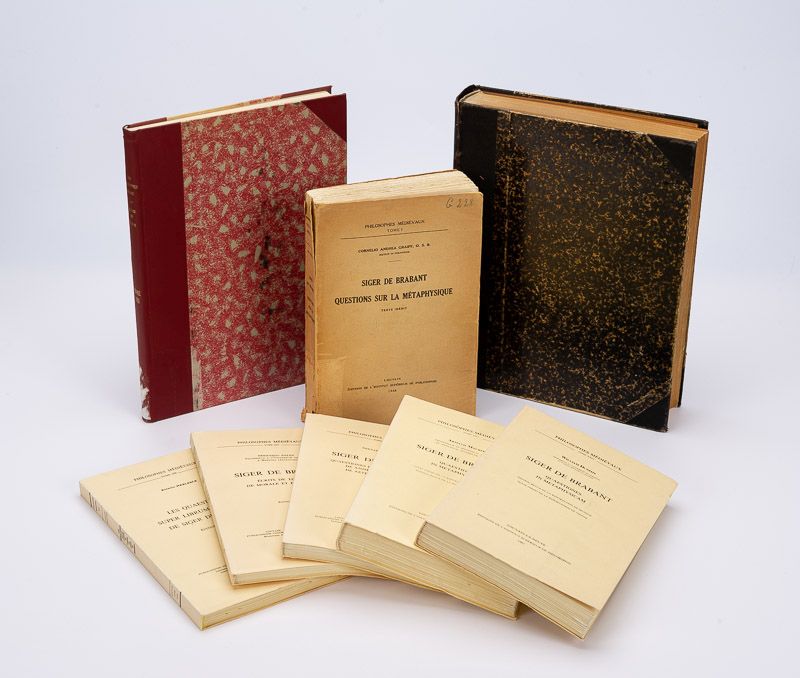
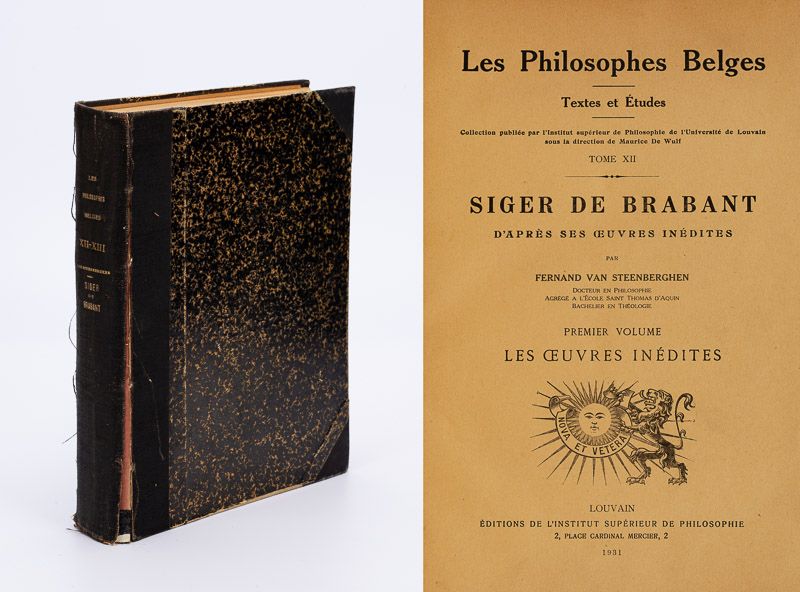
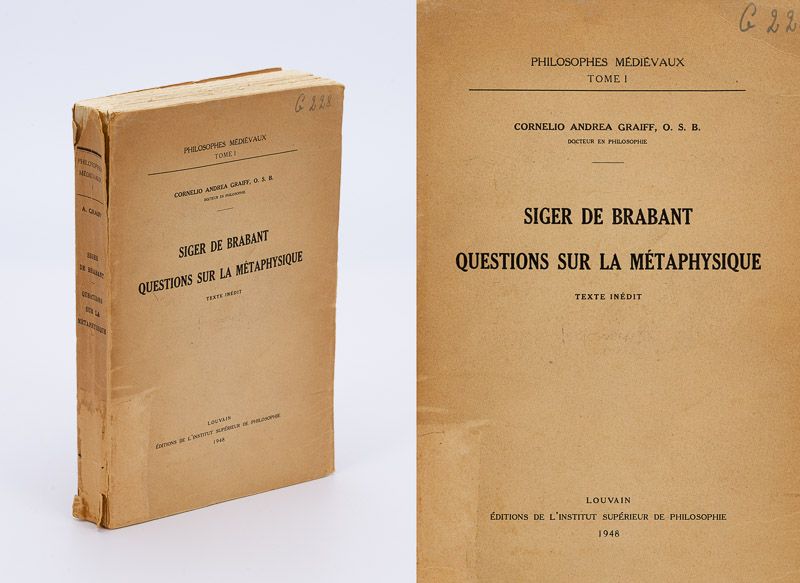
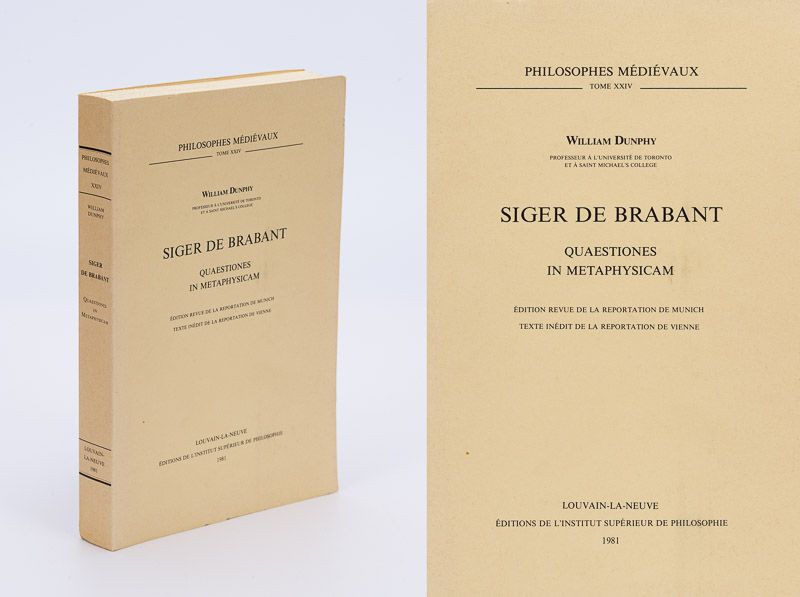
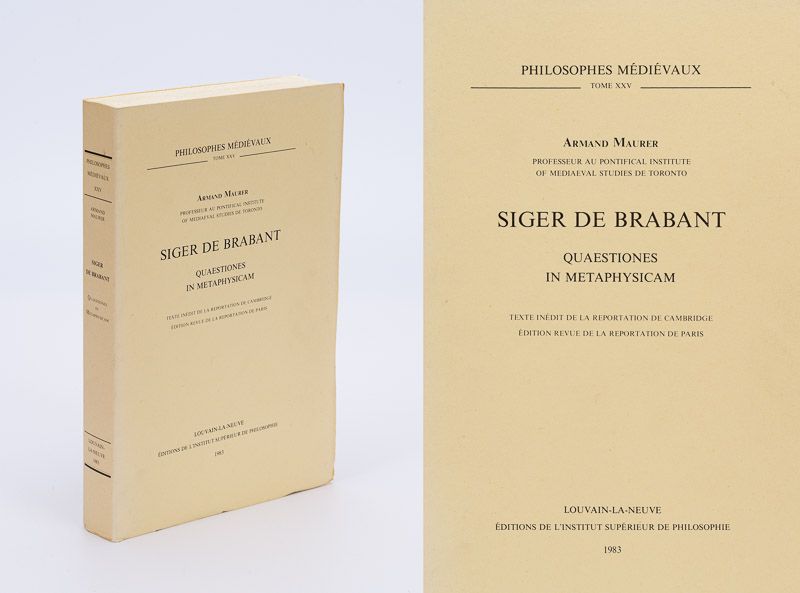
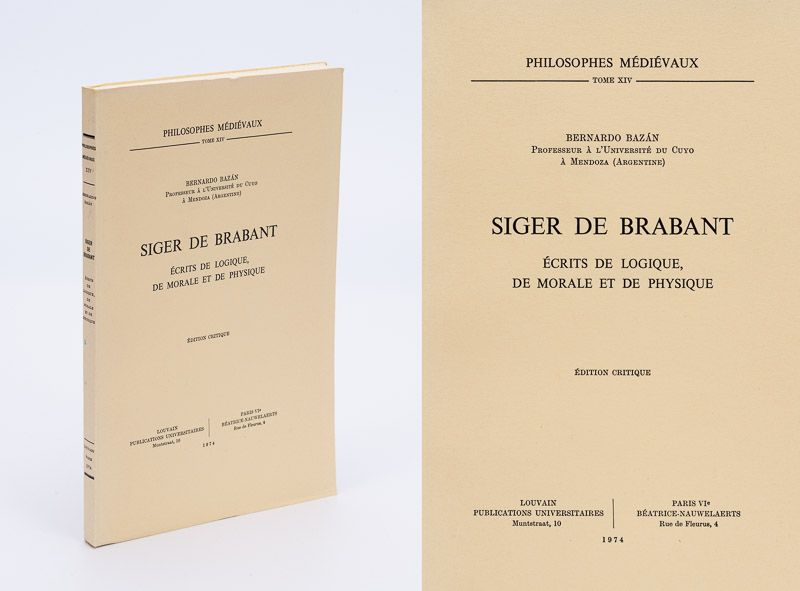
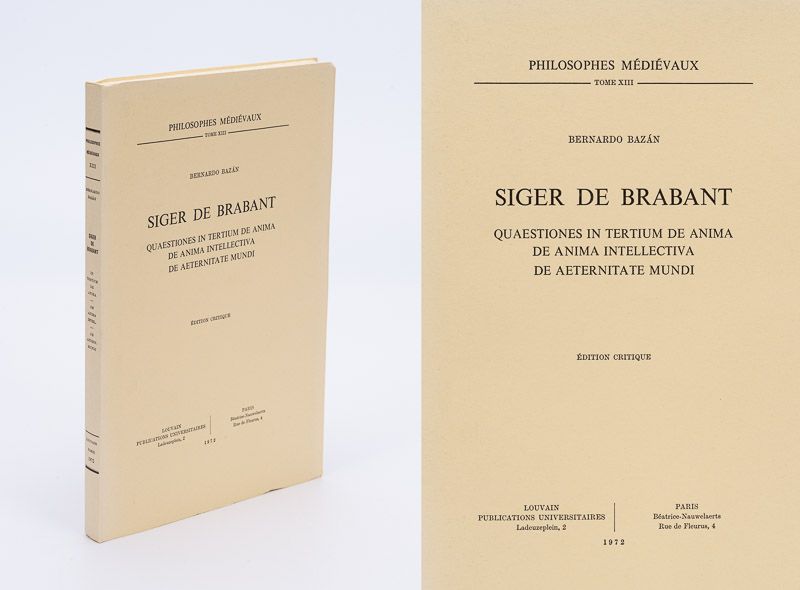
Collection of eight (8) Volumes of Works by Siger de Courtrai and Siger de Brabant. The collection includes: 1. G.Wallerand – “Les Oeuvres de Siger de Courtrai” (Louvain, 1913) / 2. Siger de Brabant d’après ses oeuvres inédites [2 volumes] I: “Les oeuvres inédites” – II: “Siger dans l’histoire de l’Aristotélisme” – Louvain, 1931-1942 [Les Philosophes Belges] / 3. Cornelio Andrea Graiff – “Siger de Brabant Questions sur La Metaphysique” – [Philosophes Medievaux – Tome I] (Louvain, 1948) / 4. Antonio Marlasca – “Les Quaestiones Super Librum de Causis De Siger de Brabant” – Edition Critique [Philosophes Medievaux – Tome XII] (Louvain / Paris, 1972) / 5. Bernardo Bazan – “Siger de Brabant – Quaestiones In Tertium de Anima – De Anima Intellectiva – De Aeternita Mundi” – [Philosophies Medievaux – Tome XIII] – (Louvain / Paris, 1972) / 6. Bernardo Bazan – “Siger de Brabant – Ecrits de Logique, De Morale et de Physique” [Philosophies Medievaux – Tome XIV] (Louvain / Paris, 1974) / 7. William Dunphy – Siger de Brabant – “Quaestiones In Metaphysicam” – [Philosophies Medievaux – Tome XXIV] – (Louvain-la-Neuve, 1981) / 8. Amand Maurer – “Siger de Brabant – Quaestiones In Metaphysicam” – [Philosophies Medievaux – Tome XXV] – (Louvain-la-Neuve, 1983) /
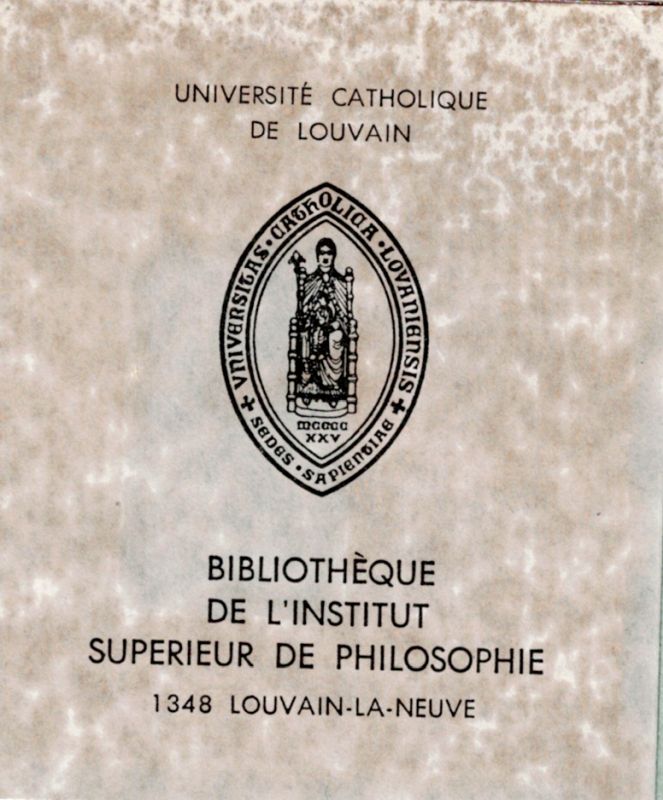
Eight Volumes (bound in seven Volumes). Louvain, Editions de L’Institut Supérieur de Philosophie de l’Université Louvain, 1931 – 1983. Quarto and Octavo. Pagination: 1. Volume: 175 pages / 2.Volume: Volume I and II (bound in one): I: VII, 355 pages / II: VIII, continuation of pagination as pages 357-759 pages plus Errata-Leaf / 3. XXXII, 399 pages / 4. 211 pages / 5. 151 pages / 6. 196 pages / 7. 457 pages / 8. 480 pages //. Hardcover / Original Publisher’s cloth and Original Softcover Volumes. Very good condition with only minor signs of wear. Item No.2of the collection with a split spine (needs rebinding). All other Volumes strong and firm and in excellent condition. Provenanace: From the private collection of german philosopher Philipp W. Rosemann, with his library-stam to the endpapers. Original Provenance of some of these Volumes is the “Universite Catholique de Louvain – Bibliotheque de L’Institut Superieur de Philosophie” (with several Volumes bearing the Exlibris of the University-Library but Professor Rosemann having acquired these directly from the library during a sale of duplicates etc.).
Siger of Courtrai (Sigerus de Cortraco, Siger de Courtrai, Sigerus de Curtraco, Siger von Colterato, Siger von Courtrai, Zeger van Kortrijk). Born about 1283 in Courtrai. ca. 1309 Regent master of arts in Paris. 1310 Fellow of the Sorbonne. 1315 Procurator ofthe Sorbonne. Died May 1341 in Paris (Logicmuseum)
_______________________________________________________________________________________
Siger of Brabant (Sigerus, Sighier, Sigieri or Sygerius de Brabantia; c. 1240 – before 10 November 1284) was a 13th-century philosopher from the southern Low Countries who was an important proponent of Averroism.
Little is known about many of the details of his life. In 1266, he was attached to the Faculty of Arts in the University of Paris at the time when a riot erupted between the French and Picard “nations” of students—a series of loosely organized fraternities. The papal legate threatened Siger with execution as the ringleader of the Picard attack on the French, but no further action was taken.
In the ten years following the riot, he wrote the six works which are ascribed to him and were published under his name by Pierre Mandonnet in 1899. The titles of these treatises are:
De anima intellectiva (1270)
Quaestiones logicales
Quaestiones naturales
De aeternitate mundi
Quaestio utrum haec sit vera: Homo est animal nullo homine existente
Impossibilia
In 1271, he was once more involved in a party struggle. The minority among the “nations” chose him as rector in opposition to the elected candidate, Aubri de Rheims. For three years the strife continued, and was probably based on the opposition between the Averroists, Siger and Pierre Dubois, and the more orthodox schoolmen. The matter was settled by the Papal Legate, Simon de Brion, afterwards Pope Martin IV. Siger retired from Paris to Liège.
Siger was accused of teaching “double truth”—that is, saying one thing could be true through reason, and that the opposite could be true through faith. Because Siger was a scholastic, he probably did not teach double truths but tried to find reconciliations between faith and reason.
In 1277, a general condemnation of Aristotelianism included a special clause directed against Boetius of Dacia and Siger of Brabant. Again Siger and Bernier de Nivelles were summoned to appear on a charge of heresy, especially in connection with the Impossibilia, where the existence of God is discussed. It appears, however, that Siger and Boetius fled to Italy and, according to John Peckham, archbishop of Canterbury, then perished miserably.
The manner of Siger’s death, which occurred at Orvieto, is not known. A Brabantine chronicle says that he was stabbed by a seemingly-insane secretary (a clerico suo quasi dementi). The secretary is said to have used a pen as the murder weapon and Siger’s critics claimed that, since he had done so much damage with his pen, he had deserved that kind of death. Dante, in the Paradiso (x.134–6), says that Siger found “death slow in coming”, and some have concluded that this indicates death by suicide. A 13th-century sonnet by one Durante (xcii.9–14) says that Siger was executed at Orvieto: a ghiado il fe’ morire a gran dolore, Nella corte di Roma ad Orbivieto. The date of this may have been 1283–1284, when Pope Martin IV was in residence at Orvieto. Siger’s fellow radicals were lying low in the face of the Condemnations of 1277 and there was no investigation into his murder.
In politics Siger held that good laws were better than good rulers, and criticised papal infallibility in temporal affairs. The importance of Siger in philosophy lies in his acceptance of Averroism in its entirety, which drew upon him the opposition of Albertus Magnus and Aquinas.
In December 1270, Averroism was condemned by ecclesiastical authority, and during his whole life Siger was exposed to persecution both from the Church and from purely philosophic opponents.
In Dante Alighieri’s The Divine Comedy, Siger of Brabant is found in the Fourth Sphere of Paradise, together with Albertus Magnus and Thomas Aquinas, for being a positive example of Prudence, Justice, Temperance, and Fortitude (Paradiso, x.97-99, 133-8) (Wikipedia)
- Keywords: Averroism · Catalogue Twelve – Philosophy · Collection Philosophy Rare · Philipp W. Rosemann Collection · Philosophy · Philosophy Rare
- Language: Français
- Inventory Number: 32482AB
EUR 880,--

We ship per DHL Express


Contact
Inanna Rare Books Ltd.
Woodley House
Castletownshend Road
P81 D262 Skibbereen, County Cork
Ireland
Phone: ++353 - (0) 87 - 102 5412
E-Mail: info@inannararebooks.com
Internet: https://www.inannararebooks.com
Online Bookshop specialized in rare
and secondhand books.
Newsletter and E-Catalogue Sign Up
Payment Options


© 2026 Inanna Rare Books Ltd. | Powered by HESCOM-Software

