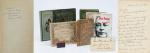
Autograph – Rare (30 items)

Small Archive of personal correspondence between irish-american writer John Montague and irish artist Louis Le Brocquy plus many and related items

14. [John Montague Collection] – Montague, John / Louis le Brocquy / [Dupin, Jacques] / [Samuel Beckett].

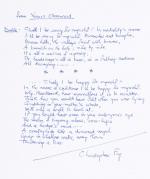
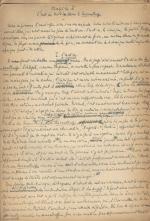
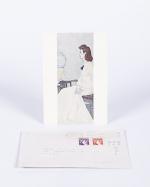
Small Archive of personal correspondence between irish-american writer John Montague and irish artist Louis Le Brocquy plus many related items. The correspondence also includes John Montague touching on Samuel Beckett. The core of the collection includes 1. Extremely insightful and important, very personal manuscript-letter from John Montague to Louis Le Brocquy – Inside an envelope addressed by John Montague to Louis Le Brocquy at his french residence ‘Domaine des Combes’ with Louis Le Brocquy’s answer carefully tucked into the same envelope, treasured by John Montague. The densely filled, very personal 4-page-manuscript letter from John Montague, is dated Christmas 1981, written after “a sabbatical [..] on a long tour which led me as far as Los Angeles” and is a strong reflection of John Montague’s personal struggles, thoughts and influences as a writer; he talks about his ten years of teaching in the US “after O’Riada’s death led to a vacuum” and “enduring the semi-bourgeois limbo of Cork”. Montague speaks about the time “after the harness came off” and he “felt quite strange, and after thirty years my stammer returned in painful, nearly uncontrollable force”. Montague even touches on his fears about his health and continues “I clocked into a clinic for a rest cure….so far liver excellent, so it is not Sean or Brendan all over again (in any case, loving the stuff, as you do, I can’t overdrink; the tastebuds are against it)”. Montague dives into comparisons with Samuel Beckett: “″Did you realize that Sam Beckett was under analysis at the Tavistock Clinic for two years ? – The early Beckett is a smart alec; the break comes when he has to survive in post-war France and accept “his own darkness”. Montague also touches on his struggle with his mother “Isn’t it terrible that we spend up to nearly middle-[a]ge coping with the traumas of youth, with no way round it ? – I have cleared/cleaned/buried & forgiven my mother in my next book “The Dead Kingdom”….” – The letter continues to talk about books, “the Landslide Manuscript”, poetry and his work etc. etc. He mentions a Dupin “play” which “will travel in my Paris luggage”. Montague also touches on the subject of the Irish Troubles and writes “I have always, by the way, believed that 1916 may have been a mistake as Yeats said: “For England may keep faith – For all is said and done” / Montague speaks about “My own area of Tyrone is blessedly free from all but minor incidents” – Amazing document of confidence and trust between two irish landmark personalities. 2. Louis Le Brocquy’s answer to John Montague is dated “New Year’s Day 1981”[which should have been 1982]: A. Very personal manuscript Letter – a direct answer to Montague’s letter from “Christmas 1981” (1 sheet with both pages filled in ink and signed “Louis”) in which Le Brocquy reflects on the tense political situation with Northern Ireland and the overall worldwide tension of a looming war / Le Brocquy writes that he did have a “wild hope that when Charlie took office…that he and Thatcher might between them opted a ‘Rhodesian’ solution in the North” / Le Brocquy also writes about the eagerly awaited publication of “Selected Poems” of John Montague and he also asks John if “you thought of collecting Esteban’s and Dupin’s poems in French with your translations ?” – Le Brocquy offers to help with illustrations etc. – Both letters together in an envelope which suggests that John Montague received his letter to Louis le Brocquy back from the Le Brocquy-estate after Le Brocquy’s death. / Also included: B. A manuscript postcard with Le Brocquy’s “Girl in White” as a postcard-reproduction in which Le Brocquy suggests a project with John Montague and sends greetings to Montague’s wife Evelyn and the kids (in envelope from Carros,France) / 3. In his function as chairman of Amnesty International, Le Brocquy sends a callout by Amnesty International to John Montague and kindly asks him to support the cause. He sends the callout to John by adding a few manuscript, personal lines of affection (in envelope from Carros,France). 4. Manuscript Letter by Jacques Dupin of John Montague in which he also speaks of Louis le Brocquy / 5. Collection of eight Letters, one Postcard and some ephemeral items among which is the original catalogue “Ireland’s Literary Renaissance – 20th Century Portraits [including the Portraits of John Montague (and Thomas Kinsella) by Louis le Brocquy on page 62/63] created by James White for the Irish Promotion Exhibition called “Irish Ways” at Marshall Field’s in Chicago between 15th September – 4th October 1980. Includes a manuscript letter by James White to John Montague, dated 26/11/1980 / Also included in this lot is the very interesting letter by John Montague’s friend at Brown University, Elinor Shaffer, reporting to Montague about the large Writing programme at Brown with “shoals of Poets and Novelists representing different schools and regions”. Elinor Shaffer is very much enthusiastic that even Publisher’s in Residence are now present at Brown and she gives an example in Jay Loughlin [James Laughlin (1914-1997) American poet and the influential founder of New Directions Publishing] who “is the present incumbent and who is giving a seminar on his own list and is praised fro his public-spirited charity in handing out Pound and Williams.” Elinor Shaffer continues: “Gone are the days when students would riot at the hint of capitalist monopolygoverning the choice of texts. It seem Pound told him [James Laughlin] inthe twenties that he would one day make a good publisher (on being shown his poems). These ensconced and laundered literary figures seem a far cry from the old SF’ Berkeley poetic scene of the ‘60’s – Love, Elinor” / 6. Original State of New York Legislative Resolution No.1230 by Senator Daly, “Recognizing the distinguished author and poet John Montague” (John Montagu’s personal copy / 7. Three XXL – original Photographs showing John Montague and colleagues in honorary degree- Cloaks at UCC Cork, including a newspaper-article //

France / Ireland, Carros / Cork, 1980-1983. A4. 4 pages on two sheets (main Montague-letter), 2 pages on 1 sheet (Le Brocquy – answer), 1 postcard, 1 manuscript-letter from Jacques Dupin to John Montague (25.10.1978) about a translation of “L’Éboulement” (Dupin also speaks about Louis le Brocquy in the letter), several pages of letters (mostly typed and signed) from other figures in irish and international literature and art, collection of vintage photos of honorary doctorate degree-Montague at UCC Cork. Original Envelopes. Very good condition with only minor signs of external wear. Besides some ephemeral materials from personalities in Literature and Art, addressed to John Montague, the small collection includes several vintage photographs of John Montague, taken during his acceptance of a honorary Doctorate of Literature at UCC, Cork, as well as a Legislative Resolution by the State of New York (Senator Daly), recognizing and thanking the distinguished author and poet John Montague with this decree on May 26, 1987. Among the lesser interesting materials is a pamphlet titled “Ireland’s Literary Renaissance – 20th century Portraits” in which portraits by Louis Le Brocquy of John Montague and Thomas Kinsella are included. The pamphlet is accompanied by a letter from James White to John Montague in which he explains this being a publication that was released for an exhibition in Chicago and he apologises for the entries being “necessarily short but hopefully reasonably correct”. Provenance: From the private collection of John Montague’s papers in his recently sold West Cork Home.

Show details

Montague / Dorgan - Typescript Draft MS for a book of poetry by Theo Dorgan. With occasional manuscript corrections

15. [John Montague Collection] – [Montague, John] Dorgan, Theo.

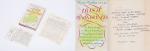
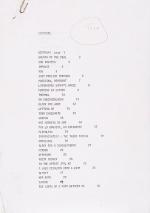
Typescript Draft MS for a book of poetry by Theo Dorgan. With occasional manuscript corrections / suggestions / annotations by Dorgan’s early mentor John Montague, the Typescript MS was held among the private papers of John Montague in his West Cork Home. The typescript includes poems like “Closed Circuit”, “The Promised Garden”. Montague is approving several of the poems by simply applying a tick. John Montague made suggestions in pencil on the structure of “Elegy for a Schoolfriend” and more in depth-suggestions on “Nasty Archer”, “Her Body”,″The Width of a Room Between Us”, “Return”, “Reconciliation”, “Sunday Afternoon”. When asked about helping to date this early draft of his poetry, Theo Dorgan immediately gets back to us and he places it from memory into the early 1980’s. Theo Dorgan was surprised and seemingly chuffed that John Montague held on to this Manuscript and he recalls: “These poems, some in revised versions, make up the backbone of my first published collection, ‘The Ordinary House of Love’.” Dorgan continues: “I’m happy to say that most of them survived Montague’s eagle eye, which was of course a great comfort to me at the time. Still is!” Some of these poems selected had previously been published as broadsheets etc. but the skeleton of the Draft hints already at readying it for publication. Theo Dorgan graciously gives us even more information: “Some of the poems in the eventual book go back to when I was a student, others were definitely written in the second half of the 80s. The bulk of it, however, is in this MS. I base my estimation in part on the fact that what you have is a typescript produced, it appears, on the IBM golfball machine that was the pride and joy of Triskel Arts Centre. That machine was bought in 1980 or 1981, I’m fairly sure of that. I was Literature Officer there, then.” Theo Dorgan was part of John Montague’s circle of mentored poets, even though in an email-exchange with him about this typescript he mentions that “John Montague worked far more with Thomas McCarthy, Maurice Riordan and Gregory O’Donoghue than he did with me, and in many ways Gregory O’Donoghue was at that stage the most accomplished of us all – the only one included in JM’s Faber Book.” What followed then in our conversation with Theo Dorgan is a great example why manuscripts, letters, autographs, typescripts and the connections we often make with documents from the past have such meaning in explaining our emotional ties with people who matter to us on our way of forming personality. They are memories transforming into images, floods of empathy and nostalgia for personal moments lost but treasured because they helped us form our values. Presented with the old typescript, Theo Dorgan’s emotionality is tangible and he confesses more in an internal dialogue with himself and John Montague than with us: “I’m sorry to say that the reason John Montague worked with those others more than he did with me is because, in my shameful, youthful arrogance, I much preferred to trust my own judgement, and also, I suspect, because I was closest to John in temperament and feared coming unduly under his influence. That said, there was no-one whose good opinion of a poem I valued more, and we were close all our lives after. Very likely it was a case of old stag/young stag ! Montague taught us by indirection, he made his extensive library of modern and contemporary poetry available to us without stint, would wait for us to find an affinity (as, e.g. mine with Robert Graves and Galway Kinnell) and would then, in a long, ongoing conversation, help us to understand what it might mean for our own poems that we felt such affinities. A guided companionship in reading and making, if you will.”

Ireland, c.1981-1982. A4. 43 pages typescripts. Paperclipped. Very good condition with only minor signs of external wear. Some fingerstaining and residue of rust from the paperclip. Wonderful and extremely valuable document of not only a collaboration between two of Ireland’s landmark writers but moreover witness to the becoming, the birth of a true poet. Also included (from a different source) is a second printing of the first edition of the subsequent publication “The Ordinary House of Love” – signed by Theo Dorgan. Right at the beginning of the printed version, instead of a dedication to John Montague, Theo Dorgan placed a quote from Montague’s poem “Wine Dark Sea”: ‘For there is no sea / it is all a dream there is no sea / except in the tangle / of our minds; / the wine dark / sea of history on which we all turn / turn and thresh / and disappear.’ (Collected Poems, page 255). Provenance of the annotated typescript: From the private collection of John Montague’s papers in his recently sold West Cork Home.


Show details

Provenance: From the personal library of Adrian Liddell Hart / Collection of 28 Volumes of John Lehmann's "New Writing", some bearing the name of Adrian Liddell Hart

16. [Lehmann, John] / [Liddell Hart, Adrian] / [Harold Acton] / [Manuscript Postcards from Lehmann to Liddell Hart].

Provenance: From the personal library of Adrian Liddell Hart / Collection of three personal autograph/manuscript-postcards from John Lehmann to Adrian Liddell Hart, together with 28 Volumes of John Lehmann’s “New Writing”, some bearing the name of Adrian Liddell Hart, including Volume I (includes George Orwell’s “Shooting an Elephant” in second edition). Besides the 28 Volumes of Lehmann’s “New Writing”, the collection also includes: 1. John Lehmann’s personal copy of Sean O’Faolain’s “Vive Moi!” – An Autobiography (First Edition, London, Rupert Hart-Davies, 1965), with John Lehmann’s name on the front free endpaper and some markings in the text. / 2. John Lehmann – Pleasures of New Writing – An Anthology of Poems, Stories and other Prose Pieces from the pages of NEW WRITING. Edited by John Lehmann. (First Edition, London, John Lehmann, 1952). [Even though this Volume is also from Liddell Hart’s library, it bears a different name of a pre-owner on the half-title].

Mixed Editions. 30 Volumes. London, John Lehmann / Allen Lane – Penguin Books / Rupert Hart-Davis, 1940-1965. Octavo. [The Postcards written from Venice, Florence and Santa Barbarabetween the years 1952 and 1977 / Postcard I: From John Lehmann in Venice to Adrian Liddell Hart: “This city does not boast a supply of the “Sunday Dispatch”, and as the writer was gripped and enthralled by the last installment on June 1st, he hopes you will keep copies of the …for him to read on his return in ten Days time – J.” / Postcard II: From John Lehmann in Florence to Adrian Liddell Hart: “Am staying with [Sir] Harold Acton here in his marvellous Villa – calme luxe [″Villa La Pietra”], all night……pity, you aren’t with me. Off to the sea this afternoon – may post this in Porto Ercole. Your old friend is relaxing. Gracefully – Love J.” [Date hard to decipher, possibly in 1962] / 3. Postcard III: From John Lehmann in Santa Barbara in California to Adrian Liddell Hart: “Terribly sorry to hear about the broken leg, may it mend quickly, as surely it must undo the ministrations of Florence …..Nightingale. I expect to be in England all March, but then off again – to Jimmy Carter Country – Love J.” [20.2.77]. Hardcover and Softcover. Of the series of 28 Volumes of the “New Writing ″ Series, only three with stronger signs of wear and in poorer condition. All others in very good condition with only minor signs of wear. Lehmann’s personal copy of Sean O’Faolain’s Autobiography with the original dustjacket in poor condition but the Volume itself very good.

EUR 1.480,-- 

Show details   Add to cart

Typed Letter signed from american philosopher John Wild to Philosopher Henry David Aiken

17. [Maluf, Brother Francis] Wild, John / Aiken, Henry D.

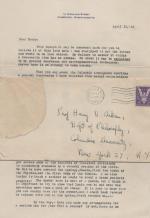
Typed Letter signed from american philosopher John Wild to Philosopher Henry David Aiken, informing Aiken: “I missed you especially two weeks ago when I attempted to defend a realistic view of ethics in terms of the concept of natural law. I am not sure, but I think you might have been in agreement with some of the points I tried to make as over against Lewis’ Kantian subjectivism and Demos’ [Raphael Demos] extreme Platonism….”. Besides some further niceties, John Wild talks in this letter intensely about Christian Arab Philosopher Francis Maluf, from Mashrah, Lebanon, who could be in John Wild’s mind the perfect “section man for your Phil A course”. Wild continues to praise the syrian, Maluf, who had been “teaching Mathematics and Physics in a war job out of Worcester and who has been keeping up his interest in philosophy by attenting courses around here, organizing discussion groups and other intellectual activities which amaze me by their versatility and intensity”. John Wild continues: “He has been offered a permanent job at the University of Beirut in Syria to teach Philosophy there (he is a friend of Malik’s) but if possible wants to stay around here for another year to study and learn before he goes back.” [Maluf had converted to catholicism in 1940 and was later known as Brother Francis Maluf.

Cambridge, April 15th, 1945. Octavo. 2 pages. Softcover. Very good condition with only minor signs of wear. Original two-page-letter with original envelope.

Show details

Goldschmid - Entwicklung und Bibliographie der Pathologisch-Anatomischen Abbildung.

20. Medical Illustration in Dermatology – Goldschmid, Edgar / [Georges Sarton].

Entwicklung und Bibliographie der Pathologisch-Anatomischen Abbildung. [Mit Autograph: TLS – Mit einem zweiseitigen Brief an Dr.Krieg in Wien, der von Goldschmid den Entwurf eines Nekrologs zu Georges Sarton erhofft hatte und diesen in Form dieses Briefs bekommt (von Goldschmid voll signiert) / Typed Letter (two pages, signed) by Edgar Goldschmid; the letter being a draft of an obituary on Georges Sarton (in german)].

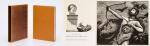
Leipzig, Karl W. Hiersemann, 1925. Quarto (25 cm x 31 cm). 301 Seiten text plus 44 fantastisch-farbige Tafeln in Lichtdruck mit den original-bedruckten Schutzfolien / 301 pages plus 44 fantastic colour-plates with their original tissue-guards. Originales Ganzleinen des Hiersemann-Verlags / Original publisher’s cloth. Sehr guter Zustand mit nur geringen Gebrauchsspuren. Offensichtlich Handexemplar von Dr.Krieg (Wien) mit Anmerkungen in Bleistift auf dem Vorsatz (″Bei G[oldschmid] zufragen”) und gelegentlich im Text mit Korrekturen und Anmerkungen neben den von Goldschmid verfassten Bibliographien, moeglicherweise fuer eine nie erschienene zweite Auflage. / Very good condition with only minor signs of external wear. Extremely important landmark-publication in medicine, focusing on the importance of colour-illustration in dermatological diagnostics. This being the personal copy of Dr.Krieg (Vienna), with some annotations in pencil, reflecting questions and additional suggestions to some of the bibliographical entries, possibly for a second edition of the work.

EUR 580,-- 

Show details   Add to cart

Page: 1 2 3
: