Manuscript Material – Rare (27 items)

Small Archive of personal correspondence between irish-american writer John Montague and irish artist Louis Le Brocquy plus many and related items

23. Le Brocquy, Louis / Montague, John / [Dupin, Jacques] / [Samuel Beckett].

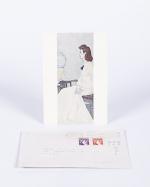
Small Archive of personal correspondence between irish-american writer John Montague and irish artist Louis Le Brocquy plus many related items. The correspondence also includes John Montague touching on Samuel Beckett. The core of the collection includes 1. Extremely insightful and important, very personal manuscript-letter from John Montague to Louis Le Brocquy – Inside an envelope addressed by John Montague to Louis Le Brocquy at his french residence ‘Domaine des Combes’ with Louis Le Brocquy’s answer carefully tucked into the same envelope, treasured by John Montague. The densely filled, very personal 4-page-manuscript letter from John Montague, is dated Christmas 1981, written after “a sabbatical [..] on a long tour which led me as far as Los Angeles” and is a strong reflection of John Montague’s personal struggles, thoughts and influences as a writer; he talks about his ten years of teaching in the US “after O’Riada’s death led to a vacuum” and “enduring the semi-bourgeois limbo of Cork”. Montague speaks about the time “after the harness came off” and he “felt quite strange, and after thirty years my stammer returned in painful, nearly uncontrollable force”. Montague even touches on his fears about his health and continues “I clocked into a clinic for a rest cure….so far liver excellent, so it is not Sean or Brendan all over again (in any case, loving the stuff, as you do, I can’t overdrink; the tastebuds are against it)”. Montague dives into comparisons with Samuel Beckett: “″Did you realize that Sam Beckett was under analysis at the Tavistock Clinic for two years ? – The early Beckett is a smart alec; the break comes when he has to survive in post-war France and accept “his own darkness”. Montague also touches on his struggle with his mother “Isn’t it terrible that we spend up to nearly middle-[a]ge coping with the traumas of youth, with no way round it ? – I have cleared/cleaned/buried & forgiven my mother in my next book “The Dead Kingdom”….” – The letter continues to talk about books, “the Landslide Manuscript”, poetry and his work etc. etc. He mentions a Dupin “play” which “will travel in my Paris luggage”. Montague also touches on the subject of the Irish Troubles and writes “I have always, by the way, believed that 1916 may have been a mistake as Yeats said: “For England may keep faith – For all is said and done” / Montague speaks about “My own area of Tyrone is blessedly free from all but minor incidents” – Amazing document of confidence and trust between two irish landmark personalities. 2. Louis Le Brocquy’s answer to John Montague is dated “New Year’s Day 1981”[which should have been 1982]: A. Very personal manuscript Letter – a direct answer to Montague’s letter from “Christmas 1981” (1 sheet with both pages filled in ink and signed “Louis”) in which Le Brocquy reflects on the tense political situation with Northern Ireland and the overall worldwide tension of a looming war / Le Brocquy writes that he did have a “wild hope that when Charlie took office…that he and Thatcher might between them opted a ‘Rhodesian’ solution in the North” / Le Brocquy also writes about the eagerly awaited publication of “Selected Poems” of John Montague and he also asks John if “you thought of collecting Esteban’s and Dupin’s poems in French with your translations ?” – Le Brocquy offers to help with illustrations etc. – Both letters together in an envelope which suggests that John Montague received his letter to Louis le Brocquy back from the Le Brocquy-estate after Le Brocquy’s death. / Also included: B. A manuscript postcard with Le Brocquy’s “Girl in White” as a postcard-reproduction in which Le Brocquy suggests a project with John Montague and sends greetings to Montague’s wife Evelyn and the kids (in envelope from Carros,France) / C. In his function as chairman of Amnesty International, Le Brocquy sends a callout by Amnesty International to John Montague and kindly asks him to support the cause. He sends the callout to John by adding a few manuscript, personal lines of affection (in envelope from Carros,France).

France / Ireland, Carros / Cork, 1980-1981. A4. 4 pages on two sheets (main Montague-letter), 2 pages on 1 sheet (Le Brocquy – answer), 1 postcard, 1 manuscript-letter from Jacques Dupin to John Montague (25.10.1978) about a translation of “L’Éboulement” (Dupin also speaks about Louis le Brocquy in the letter), several pages of letters (mostly typed and signed) from other figures in irish and international literature and art. Original Envelopes. Very good condition with only minor signs of external wear. Besides some ephemeral materials from personalities in Literature and Art, addressed to John Montague, the small collection includes several vintage photographs of John Montague, taken during his acceptance of a honorary Doctorate of Literature at UCC, Cork, as well as a Legislative Resolution by the State of New York (Senator Daly), recognizing and thanking the distinguished author and poet John Montague with this decree on May 26, 1987. Among the lesser interesting materials is a pamphlet titled “Ireland’s Literary Renaissance – 20th century Portraits” in which portraits by Louis Le Brocquy of John Montague and Thomas Kinsella are included. The pamphlet is accompanied by a letter from James White to John Montague in which he explains this being a publication that was released for an exhibition in Chicago and he apologises for the entries being “necessarily short but hopefully reasonably correct”. Provenance: From the private collection of John Montague’s papers in his recently sold West Cork Home.

Show details

Vere Foster, The Two Duchesses - Presentation copy with important manuscript letter [signed and inscribed]

24. Foster, Vere [Henry Louis / Lewis] / [Georgiana Duchess of Devonshire / Elizabeth, Duchess of Devonshire].

The Two Duchesses – Georgiana, Duchess of Devonshire / Elizabeth, Duchess of Devonshire – Family Correspondence of and Relating to Georgiana, Duchess of Devonshire / Elizabeth, Duchess of Devonshire, Earl of Bristol (Bishop of Derby), The Countess of Bristol, Lord and Lady Byron, The Earl of Aberdeen, Sir Augustus Foster Bart, and Others, 1777-1859. First Edition. With 17 illustrations.

London / Glasgow and Dublin, Blackie & Son Limited, 1898. Octavo (16 cm x 22,5 cm). XII, 497 pages with 16 full-page-illustrations and one small vignette, showing the Two Duchesses in cordial embrace. Hardcover / Original, green publisher’s cloth with gilt lettering and ornament to spine and armorial supralibro to cover with the Motto of the “British chivalric Order of the Garter”: “Honi soit qui mal y pense” [″shame on anyone who thinks evil of it”]. Very good condition with some minor signs of wear only. “Presentation Copy of “The Two Duchesses” with Autograph / Manuscript – Letter by Vere Foster to his niece, Emily Albinia “Alba” Foster. With a stunning, unpublished, two-page manuscript letter, revealing several important details about the immediately favorable reviews and reception of the book “Two Duchesses” [″in the Daily Telegraph”] and Vere Foster’s disdain about some criticism from one J.Donohue [which led to an alteration in the second edition of the book]. Vere Foster is also expecting a review to appear in the “Athenaeum” but reports: “the Athenaeum has nothing yet”. Vere Foster apologizes to his niece for the delay in sending the book and explains that he had left 12 “parcels” with Blackie’s agent and gave instructions to send them, but a few days later found they had been “untouched”. One of the most important finds of Vere Foster – Material in recent years with no sign of similar material on offer in the past years on the international market.

Show details

Louis Cobbett - Two Manuscript Books of Laboratory Notes by student of bacteriology and later publisher of "The Causes of Tuberculosis", Louis Cobbett (1863 - 1947)

25. [Cobbett, Louis] [mentioned are: Behring, Emil von / Koch, Robert / Metchnikoff, Ilya (Élie) / Dönitz, Friedrich Karl Wilhelm / Ehrlich, Paul / Shield, Marmaduke and others]

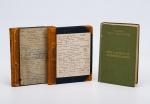
Two Manuscript Books of Laboratory Notes by student of bacteriology and later publisher of “The Causes of Tuberculosis”, Louis Cobbett (1863 – 1947), dealing in these lab notes with the discovery of remedies for Tuberculosis and Diphtheria. Original, two-volume Manuscript-Compendium of research-notes regarding all the important discoveries in Bacteriology (Diphtheria and Tuberculosis) by contemporaries of Louis Cobbett during the years 1885 – 1908 (Behring, Koch, Metchnikoff etc.). The notes were started by Louis Cobbett in 1885, after graduating from Trinity College, Cambridge and while he was working towards his degree in 1899. The stunning documents are not only reading like a first-hand-journal of discoveries, citing and reflecting on all the important developments and medical advancements of the outgoing 19th and beginning 20th century, but these notes were written parallel to Robert Koch, Emil von Behring and others making their breakthrough discoveries for mankind’s desperately needed cures against Tuberculosis and Diphtheria. Cobbett reflects on the publications in the “Zeitschrift fuer Hygiene” and separately published books and articles. Louis Cobbett lists all the important and also the critical publications leading up to (for example) Koch’s discovery of Tuberculin (e.g.: Beck – “Ueber die diagnostische Bedeutung des Kochschen Tuberculins”), he mentions Emil von Behring, Paul Ehrlich’s “Ueber die Constitution des Diphteriegiftes”, he cites A.Jeffery Turner’s “Statistics on the Diphtheria mortality of the 3 principal Australian Colonies for the past 15 years” (published in 1899), he writes about Tuberculin production in fowl, he reflects on A.Calmette and G. Guerin, “supporting [Emil von] Behring in his contention that pulmonary tuberculosis is of intestinal origin”. Other mentions are “TB of human origin (from a cervical gland)”, he speculates on the publication by Fiebiger and Jensen regarding the transmission of tuberculosis from human to animal, he offers drawings of cultures with Rabbit emulsions, Bovine Characters, Avian cultural characters etc. A few lectures are referred to, including one by Sims Woodhead, a colleague of Louis Cobbett and no doubt attended by Cobbett himself; one newspaper report has been pasted in: ‘Important conference’ in Leeds, from Yorkshire Post 1899 / Louis Cobbett intensely elaborates on Kossel and his report on the english Tuberculosis – Commission in 1908 (H. Kossel – Die Tuberkulosefrage und die Arbeiten der englischen Tuberkulosekommission).

[Cambridge], c. 1885 – 1908. Octavo (17 cm x 21 cm). 90 blank leaves with manuscript entries in each volume, usually written on rectos only. Hardcover / Original half leather with dark blue cloth-covered boards bearing paper-labels to covers, detailing some of the sources cited within; marbled endpapers and edges. Very good condition with only minor signs of external wear.

EUR 1.400,-- 

Show details   Add to cart

Montague / Dorgan - Typescript Draft MS for a book of poetry by Theo Dorgan. With occasional manuscript corrections

26. [Montague, John] Dorgan, Theo.

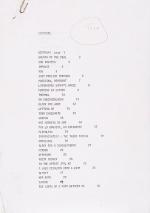
Typescript Draft MS for a book of poetry by Theo Dorgan. With occasional manuscript corrections / suggestions / annotations by Dorgan’s early mentor John Montague, the Typescript MS was held among the private papers of John Montague in his West Cork Home. The typescript includes poems like “Closed Circuit”, “The Promised Garden”. Montague is approving several of the poems by simply applying a tick. John Montague made suggestions in pencil on the structure of “Elegy for a Schoolfriend” and more in depth-suggestions on “Nasty Archer”, “Her Body”,″The Width of a Room Between Us”, “Return”, “Reconciliation”, “Sunday Afternoon”. When asked about helping to date this early draft of his poetry, Theo Dorgan immediately gets back to us and he places it from memory into the early 1980’s. Theo Dorgan was surprised and seemingly chuffed that John Montague held on to this Manuscript and he recalls: “These poems, some in revised versions, make up the backbone of my first published collection, ‘The Ordinary House of Love’.” Dorgan continues: “I’m happy to say that most of them survived Montague’s eagle eye, which was of course a great comfort to me at the time. Still is!” Some of these poems selected had previously been published as broadsheets etc. but the skeleton of the Draft hints already at readying it for publication. Theo Dorgan graciously gives us even more information: “Some of the poems in the eventual book go back to when I was a student, others were definitely written in the second half of the 80s. The bulk of it, however, is in this MS. I base my estimation in part on the fact that what you have is a typescript produced, it appears, on the IBM golfball machine that was the pride and joy of Triskel Arts Centre. That machine was bought in 1980 or 1981, I’m fairly sure of that. I was Literature Officer there, then.” Theo Dorgan was part of John Montague’s circle of mentored poets, even though in an email-exchange with him about this typescript he mentions that “John Montague worked far more with Thomas McCarthy, Maurice Riordan and Gregory O’Donoghue than he did with me, and in many ways Gregory O’Donoghue was at that stage the most accomplished of us all – the only one included in JM’s Faber Book.” What followed then in our conversation with Theo Dorgan is a great example why manuscripts, letters, autographs, typescripts and the connections we often make with documents from the past have such meaning in explaining our emotional ties with people who matter to us on our way of forming personality. They are memories transforming into images, floods of empathy and nostalgia for personal moments lost but treasured because they helped us form our values. Presented with the old typescript, Theo Dorgan’s emotionality is tangible and he confesses more in an internal dialogue with himself and John Montague than with us: “I’m sorry to say that the reason John Montague worked with those others more than he did with me is because, in my shameful, youthful arrogance, I much preferred to trust my own judgement, and also, I suspect, because I was closest to John in temperament and feared coming unduly under his influence. That said, there was no-one whose good opinion of a poem I valued more, and we were close all our lives after. Very likely it was a case of old stag/young stag ! Montague taught us by indirection, he made his extensive library of modern and contemporary poetry available to us without stint, would wait for us to find an affinity (as, e.g. mine with Robert Graves and Galway Kinnell) and would then, in a long, ongoing conversation, help us to understand what it might mean for our own poems that we felt such affinities. A guided companionship in reading and making, if you will.”

Ireland, c.1981-1982. A4. 43 pages typescripts. Paperclipped. Very good condition with only minor signs of external wear. Some fingerstaining and residue of rust from the paperclip. Wonderful and extremely valuable document of not only a collaboration between two of Ireland’s landmark writers but moreover witness to the becoming, the birth of a true poet. Also included (from a different source) is a second printing of the first edition of the subsequent publication “The Ordinary House of Love” – signed by Theo Dorgan. Right at the beginning of the printed version, instead of a dedication to John Montague, Theo Dorgan placed a quote from Montague’s poem “Wine Dark Sea”: ‘For there is no sea / it is all a dream there is no sea / except in the tangle / of our minds; / the wine dark / sea of history on which we all turn / turn and thresh / and disappear.’ (Collected Poems, page 255). Provenance of the annotated typescript: From the private collection of John Montague’s papers in his recently sold West Cork Home.


EUR 2.800,-- 

Show details   Add to cart

Adorno / Horkheimer / Haag - Wichtige Sammlung von bedeutenden Arbeitsexexemplaren / Widmungsexemplaren / Autorenexemplaren der Frankfurter Schule

27. [Adorno, Theodor W. / Horkheimer, Max / Benjamin, Walter] Haag, Karl-Heinz / Schweppenhäuser, Prof. Dr. Hermann.

Wichtige Frankfurter Schule-Sammlung von sehr bedeutenden Arbeitsexemplaren / Widmungsexemplaren / Autorenexemplaren, Autographen und Manuskript-Notiz-Zetteln des deutschen Philosophen Karl-Heinz Haag. Die Arbeitsexemplare (Sieben Buchtitel in neun (9) Bänden) und handschriftlichen Notizen und Autographen (Postkarten), stammen aus der privaten Bibliothek des Adorno und Horkheimer- Schülers, Karl-Heinz Haag. Die in der Sammlung enthaltenen Manuskript-Notizen und Autographen (Postkarten von Horkheimer) sind inhaltsreich und teilweise auch deshalb sehr bedeutend, weil es unter Insidern bekannt ist, dass Haag auch während seiner aktiven Zeit innerhalb der Frankfurter Schule notorisch wenig veröffentlicht und schriftlich kommentiert hat. Beiliegt ausserdem ein Zeitungsausschnitt zur Adorno-Lehrstuhl-Nachfolge. / Important, stunning collection of seven, signed or/and annotated association-copies (working-copies) from the private library of german philosopher Karl-Heinz Haag. Haag was pupil, friend and colleague of Adorno and Horkheimer and was one of the members of the Frankfurt School of Social Theory and Social Research. The collection of annotated books (Seven Booktitles in nine (9) volumes) also includes ephemera (Autograph postcards, newspaper-clipping, as well as several manuscript – pages of significant notes and thoughts by Karl-Heinz Haag regarding topics discussed in some of these publications). The collection is especially important because Haag published and commented notoriously little during and after his tenure in Frankfurt. [See complete set of photographs of this collection on our website].

Frankfurt u.a., Suhrkamp / Institute of Social Research / Kohlhammer etc., 1955 – 1972. Octavo. Paginierung / Collation: 1. Adorno – Aspekte der Hegelschen Philosophie (Inscribed, signed): 59 Seiten mit zahlreichen Annotationen /59 pages, heavily annotated / 2. Haag – Kritik der neueren Ontologie (Author’s copy): 59 Seiten / 59 pages / 3. Adorno – Drei Studien zu Hegel (Inscribed, signed): 172 Seiten mit zahlreichen Annotationen / 172 pages with annotations / 4. Horkheimer – Zur Kritik der instrumentellen Vernunft (Inscribed, signed): 353 Seiten mit vielen Anmerkungen und Anstreichungen / 353 pages, heavily annotated / 5. Horkheimer – Kritische Theorie (Inscribed, signed): XIV, 376, XI, 358 Seiten mit zahlreichen Anmerkungen und Anstreichungen / XIV, 376, XI, 358 pages, heavily annotated / 6. Schweppenhäuser – Tractanda (Inscribed, signed): 141 Seiten / 141 pages. Original Softcover and Hardcover – Volumes. Sehr guter Erhaltungszustand aller Publikationen mit teilweise eingelegten, handschriftlichen Notizen sowie ein alter Zeitungsartikel in dem der Zersetzungsprozess der Frankfurter Schule kommentiert wird. / All publications in very good condition with minor signs of wear. Amazing provenance and possibly one of the last important collections surfacing from the library of a member of the Frankfurt School. The inter-connection between Adorno – Haag – Horkheimer, reflected in Haag’s annotations, lends itself for study and new publications of criticism.

EUR 4.800,-- 

Show details   Add to cart

Page: 1 2 3
: