


[Colbert, The Life of the famous John Baptist Colbert, Late Minister and Secreta
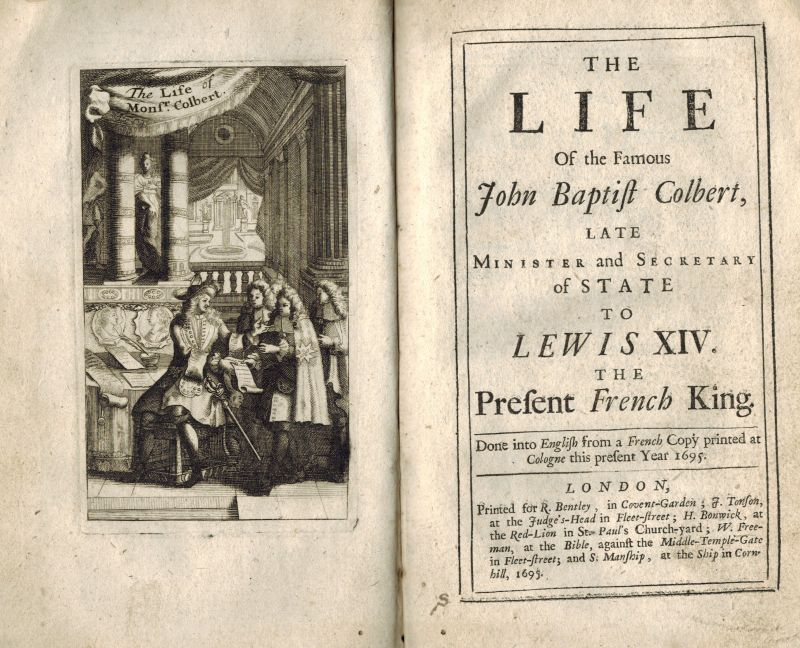
The Life of the famous John Baptist Colbert, Late Minister and Secretary of State to Lewis XIV., the present French King. Done into english from a french copy printed at Cologne this present year 1695.
First english edition. London, Printed for R. Bentley, 1695. Small Octavo. Frontispiece, (14), 246, (8) pages. Hardcover / Rare, original 17th-century or early 18th-century leather. Original binding with stronger signs of rubbing to rear board. Pastedowns loosened. Interior and frontispiece very good. Needs minor attention from bookbinder. Very rare in this original binding !
Jean-Baptiste Colbert (29 August 1619 – 6 September 1683) was a French politician who served as the Minister of Finances of France from 1665 to 1683 under the rule of King Louis XIV. His relentless hard work and thrift made him an esteemed minister. He achieved a reputation for his work of improving the state of French manufacturing and bringing the economy back from the brink of bankruptcy. Historians note that, despite Colbert’s efforts, France actually became increasingly impoverished because of the King’s excessive spending on wars. Colbert worked to create a favourable balance of trade and increase France’s colonial holdings.
Colbert’s market reforms included the foundation of the Manufacture royale de glaces de miroirs in 1665 to supplant the importation of Venetian glass (forbidden in 1672, as soon as the French glass manufacturing industry was on sound footing) and to encourage the technical expertise of Flemish cloth manufacturing in France. He also founded royal tapestry works at Gobelins and supported those at Beauvais. Colbert worked to develop the domestic economy by raising tariffs and by encouraging major public works projects, and to ensure that the French East India Company had access to foreign markets, so that they could always obtain coffee, cotton, dyewoods, fur, pepper and sugar. In addition, Colbert founded the French merchant marine.
Colbert issued more than 150 edicts to regulate the guilds. (One such law had the intention of improving the quality of cloth. The edict declared that if the authorities found a merchant’s cloth unsatisfactory on three separate occasions, they were to tie him to a post with the cloth attached to him.) He created the seigneurial system.
Colbert took much interest in art and literature. He possessed a remarkably fine private library, which he delighted to fill with valuable manuscripts from every part of Europe and the Near East where France had placed a consul. He employed Pierre de Carcavi and Étienne Baluze as librarians. Colbert’s grandson sold the manuscript collection in 1732 to the Bibliothèque Royale.
Colbert founded a number of institutions:
in 1663 the Academy of Inscriptions and Medals
in 1666 the Academy of Sciences (now part of the Institut de France)
in 1667 the Paris Observatory, which he employed Claude Perrault to build and brought Giovanni Domenico Cassini (1625–1712) from Italy to superintend
in 1671 the Academy of Architecture the Academy of Music
the French Academy at Rome, and Academies at Arles, Soissons, Nîmes and many other towns
He reorganised the Academy of Painting and Sculpture which Mazarin had established. Wishing to increase the prestige of the image of France and the French royal family, Colbert played an active role in bringing the great Italian architect-sculptor, Gian Lorenzo Bernini, to Paris (June–October 1665), in order to design the new East Facade of the Louvre and sculpt a marble portrait bust of Louis XIV. This was quite an international diplomatic-artistic coup because Bernini, who had never left Rome or its vicinity, was personal architect to the pope, whom Louis was attempting to humiliate. However the relations between the two strong-willed men, Colbert and Bernini, proved melodramatically stormy and Colbert ultimately rejected Bernini’s Louvre design, though the Italian artist’s bust of the king (housed today in the Versailles palace) won Louis’s appreciation.
Colbert himself became a member of the Académie française; and proposed one very characteristic rule with the intention of expediting the great Dictionary, in which he had a great interest: no one could count as present at any meeting unless he arrived before the hour of commencement and remained till the hour for leaving. In 1673 Colbert presided over the first exhibition of the works of living painters; and he enriched the Louvre with hundreds of pictures and statues.
He gave many pensions to men of letters, among whom we find Molière, Corneille, Racine, Boileau, P D Huet (1630–1721) and Antoine Varillas (1626–1696); and even foreigners, as Huygens, Carlo Dati the Dellacruscan. Evidence exists to show that by this munificence he hoped to draw out praises of his sovereign and himself; but this motive certainly does not account for all the splendid, if in some cases specious, services that he rendered to literature, science and art.
Colbert worked incessantly hard until his final hours. Work was his religion; he once pondered whether it was better to rise early and work or retire very late and work. He concluded that rising early and retiring late would be the ideal combination. Towards the end of his life he suffered from stomach aches, which caused him much distress. He was reduced to eating moist bread dipped in chicken broth for his meals. By 64 he was bedridden and died shortly after his birthday. The surgeons who examined him found that he had been suffering from kidney stones. A huge stone was found in his urinary tract, which would explain his pain. (Wikipedia)
- Keywords: 17th Century · Economic history · Economics · Economics – Rare · French History · French History Rare
- Language: English
- Inventory Number: 110113AB
EUR 750,--

We ship per DHL Express
Contact
Inanna Rare Books Ltd.
Woodley House
Castletownshend Road
P81 D262 Skibbereen, County Cork
Ireland
Phone: ++353 - (0) 87 - 102 5412
E-Mail: info@inannararebooks.com
Internet: https://www.inannararebooks.com
Online Bookshop specialized in rare
and secondhand books.
Newsletter and E-Catalogue Sign Up
Payment Options


© 2026 Inanna Rare Books Ltd. | Powered by HESCOM-Software
Follow Us

