


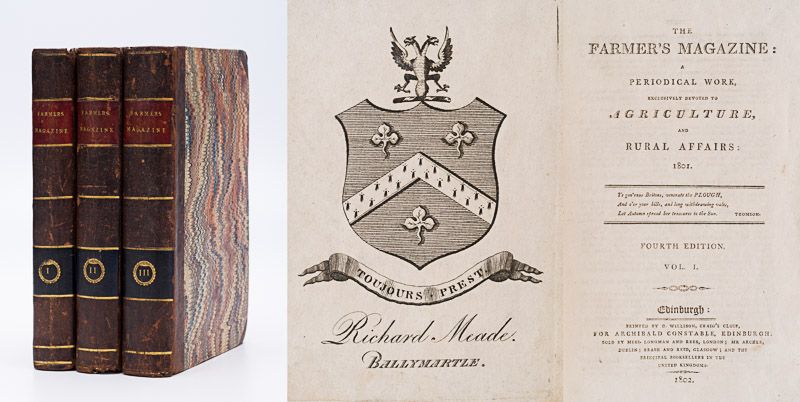
[Constable, The Farmer's Magazine : A Periodical Work, Exclusively Devoted to Ag
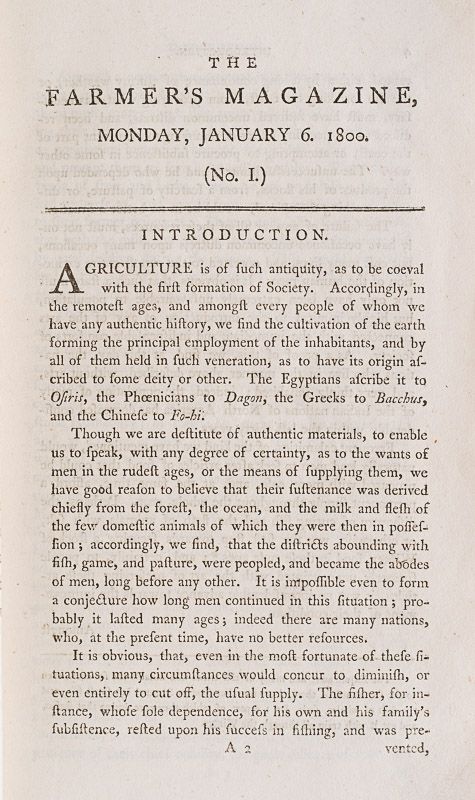
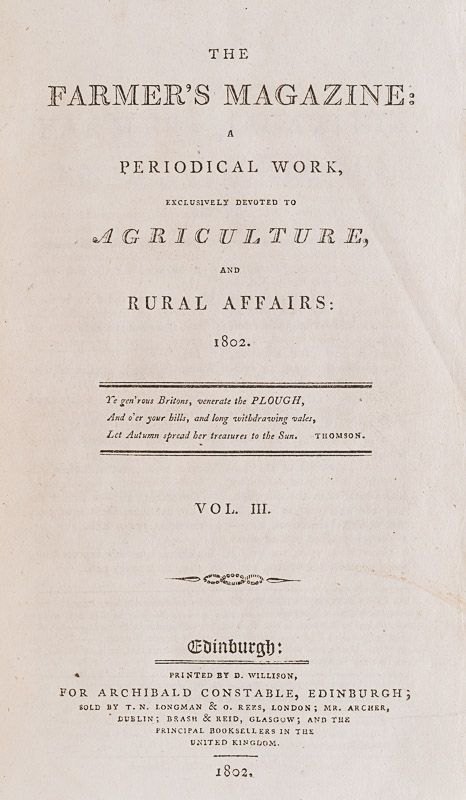
The Farmer’s Magazine : A Periodical Work, Exclusively Devoted to Agriculture, And Rural Affairs.
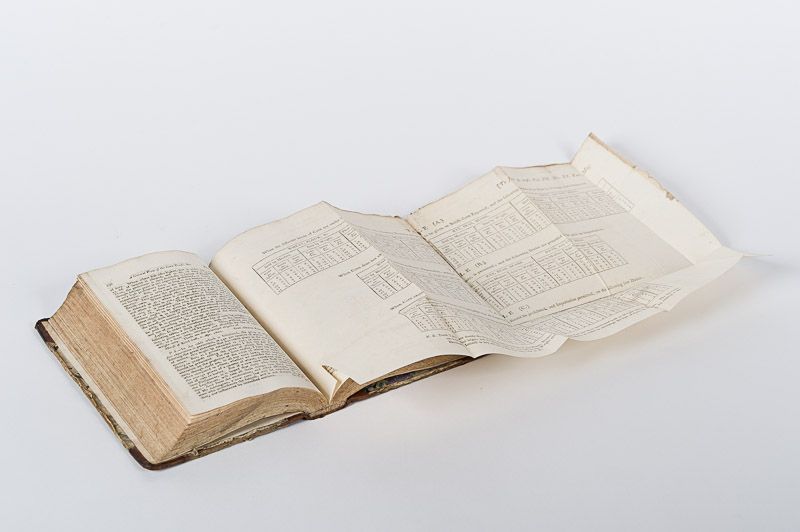
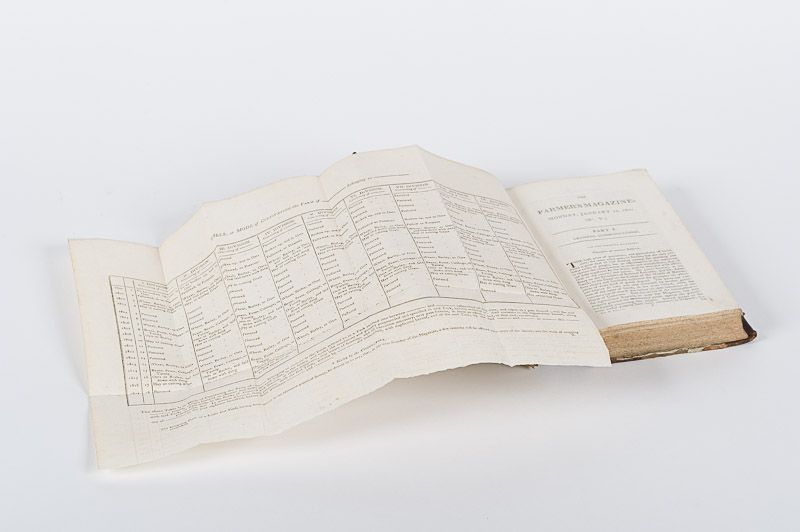
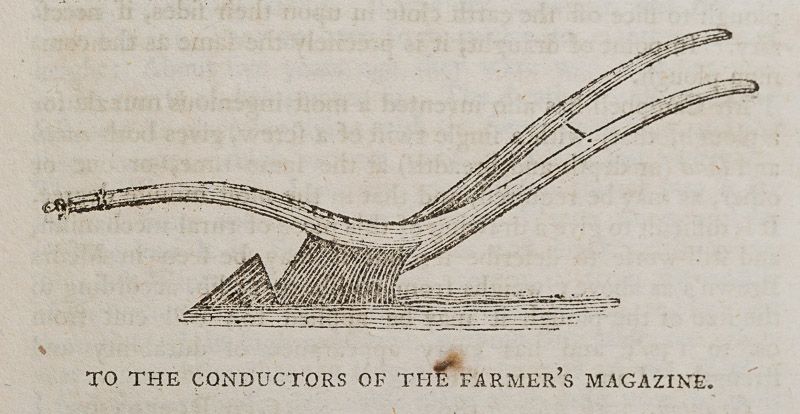
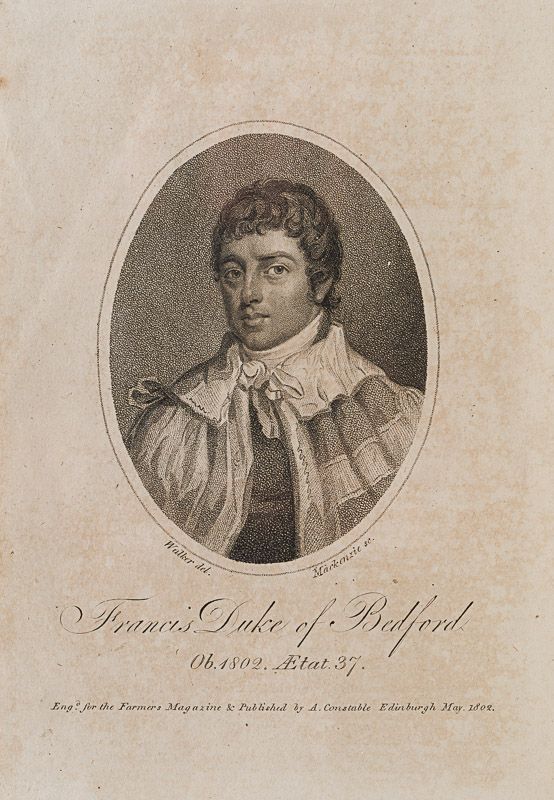
Fourth Edition. Three Volumes [Volume I, II and III]. Edinburgh, Printed by D.Willison for Archibald Constable, 1802. Octavo (14 cm wide x 21.7 cm high). Volume I: II, 489 pages plus 7 unnumbered pages of an Index and including 1 full-page illustration of a “Plough for Cleaning Turnips”/ Volume II: 484, V pages plus 1 page of Advertising of “Books Printed for Archibald Constable” plus 1 Extra-Large Fold-out “Table, or Mode of Cultivating the Farm, 1 full-page plate showcasing the “Advantage to be derived from streighting of Rivers”, 1 full-page plate showcasing different Grubs and Caterpillars, 1 full—page Diagram showing compositions of soil (Clay, Sand or Gravel, Calx, Moorish or Mossy Soil, Loam or Black Rich Earth) / Volume III: Portrait-Frontispiece of Francis Duke of Bedford, 546 pages with 1 full-page “Plan of W. Hunter’s Feeding Byre at Eskmont” (with a Dung Court), 1 Text-Illustration showing “A Machine for Pounding Limestone”, 1 full-page plate showing the phenomenon of “Floating Land” – Farming next to a River, 1 Text-Illustration of “The Argyleshire Plough, invented by Alexander Campbell”, 1 extra-large fold-out plan of a Table showing Price-Developments of British Corn, Barley, Wheat, Peas, Bear, Bigg exported, 1 full-page plate showcasing the architectural structure of a Thrashing Mill Barn, 1 full-page plate showing the structure of sucessful Embankments. Hardcover / Original, decorative half- leather with gilt lettering on spine. Very good condition with only minor signs of wear. Very rare in this original condition. From the library of Richard Meade (Ballymartle), with his Exlibris / Bookplate to pastedown.
This fantastic publication was a novelty at the beginning of the 19th century, published by influential scottish publisher Archibald David Constable.
The Magazine includes some wonderful diagrams and illustrations (see our details in the description) and some of the topics mentioned in detail are for example:
Volume I:
- General View of the Agriculture of the County of Fife
- An Essay on Lime (by a Yorkshire Farmer)
- A Rural Sketch if the County of Lancaster
- Review of Nottinghamshire Survey
- Sheep and Great Farms favourable to Population
- Register of the Weather in 1799
Volume II:
- Proceedings of the County of Caithness
- Agricultural Intelligence (England)
- Agricultural Intelligence (Scotland)
- Strictures on Farm-Management near London
- Of the quantity of Bread Corn required yearly to maintain the Inhabitants of Great Britain
- General View of the Agriculture of the County of Argyle
- Sketch of a Tour through the Northern Counties of Scotland
- Communications on American Husbandry
- On the means of encreasing Manure
- Bordley’s American Husbandry
Volume III:
- Disadvantages if a Fixed Rotation of Crops
- Obstacles arising from Climate
- “Experiments and Onservations on the Culture of Potatoes” by Sir Archibald Grant of Monymusk
- Hints regarding Cattle
- On Potatoes
- A General View of the Corn Trade and Conr Laws in Great Britain
- Account of the Drainage of Loch Coot
- Hints on the Improvement of Waste Land
- On the Husbandry of the Hindoos [sic] (Hindu’s) (From a Letter of an Officer in the British Army in Allahabad in the year 1798)
etc. etc.
Archibald David Constable (24 February 1774 – 21 July 1827) was a Scottish publisher, bookseller and stationer.
Constable was born at Carnbee, Fife, son of the land steward to the Earl of Kellie.
In 1788 Archibald was apprenticed to Peter Hill, an Edinburgh bookseller, based on the High Street south of the Mercat Cross. In 1795 Constable started in business for himself as a dealer in rare books, taking a unit immediately opposite Peter Hill, on the north side of the Mercat Cross. He was then living in a house in Calton village on the edge of Calton Hill.
He bought the rights to publish the Scots Magazine in 1801, and John Leyden, the orientalist, became its editor. In 1800 Constable began the Farmer’s Magazine, and in November 1802 he issued the first number of the Edinburgh Review, under the nominal editorship of Sydney Smith; Lord Jeffrey, was, however, the guiding spirit of the review, having as his associates Lord Brougham, Sir Walter Scott, Henry Hallam, John Playfair and afterwards Lord Macaulay.
In 1802 he published “Minstrelsy of the Scottish Border” by Walter Scott and continued a lifelong friendship with Scott from at least this point. Walter Scott was primarily an advocate, and the Edinburgh courts were only 100m from Constable’s shop.
From at least 1809 his head clerk Robert Cadell had a financial interest in the firm and in 1811 he replaced Hunter of Blackness as a partner, and from 1812 was sole partner with Constable.
Constable made a new departure in publishing by the generosity of his terms to authors. Writers for the Edinburgh Review were paid at an unprecedented rate, and Constable offered Scott 1000 guineas in advance for Marmion. In 1804 A. G. Hunter of Blackness joined Constable as partner, bringing considerable capital into the firm, which thereafter was styled Archibald Constable & Co. In 1805, jointly with Longman & Co., Constable published Scott’s Lay of the Last Minstrel, and in 1807 Marmion. He also published four of James Hogg’s books, The Mountain Bard (1807), The Shepherd’s Guide (1807), The Forest Minstrel (1810) and Poetical Works (1822).
In 1808 a split took place between Constable and Sir Walter Scott, who transferred his business to the publishing firm of John Ballantyne & Co., for which he supplied most of the capital. In 1813, however, a reconciliation took place. Ballantyne was in difficulties, and Constable again became Scott’s publisher, a condition being that the firm of John Ballantyne & Co. should be wound up at an early date, though Scott retained his interest in the printing business of James Ballantyne & Co. Around 1810 he bought a house at the head of Craigs Close, nearby his shop. The premises was previously the house of William Creech and historically had been the home of Andro Hart. The printworks linked to this house seem to have been leased by Constable since around 1800.
In 1808 he served as Moderator of the High Constables of Edinburgh.
In 1812 Constable, who had admitted Robert Cathcart and Robert Cadell as partners on Hunter’s retirement, purchased the copyright of the Encyclopædia Britannica, adding the supplement (6 vols, 1816-1824) to the 4th, 5th and 6th editions. In 1814 he bought the copyright of Waverley. This was issued anonymously; but in a short time 12,000 copies were disposed of, Scott’s other novels following in quick succession. The firm also published the Annual Register.
Constable played a key role in the 1825 purchase of the Astorga Collection by the library of the Faculty of Advocates. The collection, comprising 3,716 pre-1800 volumes which ones belonged to Spain’s 14th Marquis of Astorga, is now held by the National Library of Scotland.
Through over-speculation, complications arose, and in 1826 a financial crash occurred. Constable’s London agents stopped payment, leading to his failure for over £250,000. James Ballantyne & Co. also went bankrupt, owing nearly £90,000. The collapse of both firms had a significant impact on Sir Walter Scott.
Constable started business afresh, and began in 1827 Constable’s Miscellany of Original and Selected Works consisting of a series of original works, and of standard books republished in a cheap form, thus making one of the earliest and most famous attempts to popularize high-quality literature.
Constable died of dropsy (which had plagued him for several years) at home, 3 Park Place in Edinburgh, on 21 July 1827, but his firm survived, and the Constable publishing business continued in the twentieth century, issuing a wide range of fiction and non-fiction books. It continues today as Constable & Robinson. (Wikipedia)
- Keywords: Farming · Farming – Rare · Farming & Agriculture Collection · Food and Drink – Rare · Scottish Agriculture · Scottish History · Scottish History Rare
- Language: English
- Inventory Number: 32435AB
EUR 780,--

We ship per DHL Express




Contact
Inanna Rare Books Ltd.
Woodley House
Castletownshend Road
P81 D262 Skibbereen, County Cork
Ireland
Phone: ++353 - (0) 87 - 102 5412
E-Mail: info@inannararebooks.com
Internet: https://www.inannararebooks.com
Online Bookshop specialized in rare
and secondhand books.
Newsletter and E-Catalogue Sign Up
Payment Options


© 2026 Inanna Rare Books Ltd. | Powered by HESCOM-Software

