


[Benjamin, "L'Oeuvre d'art à l'époque de sa reproduction mécanisée"
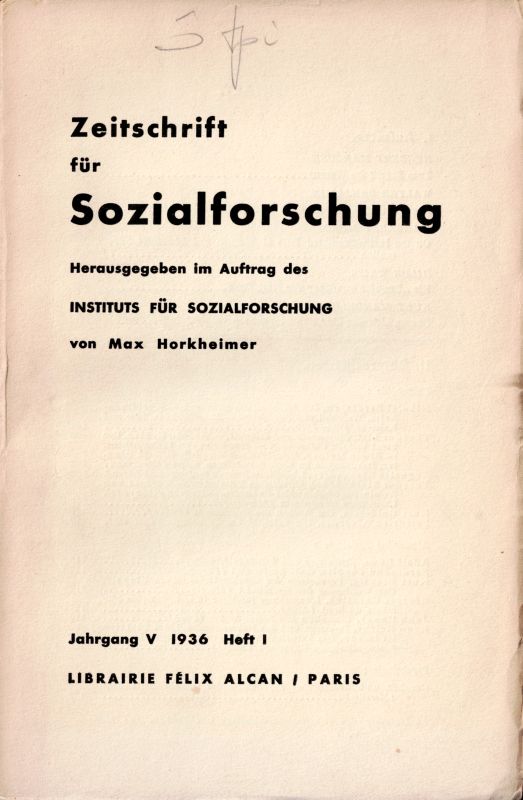
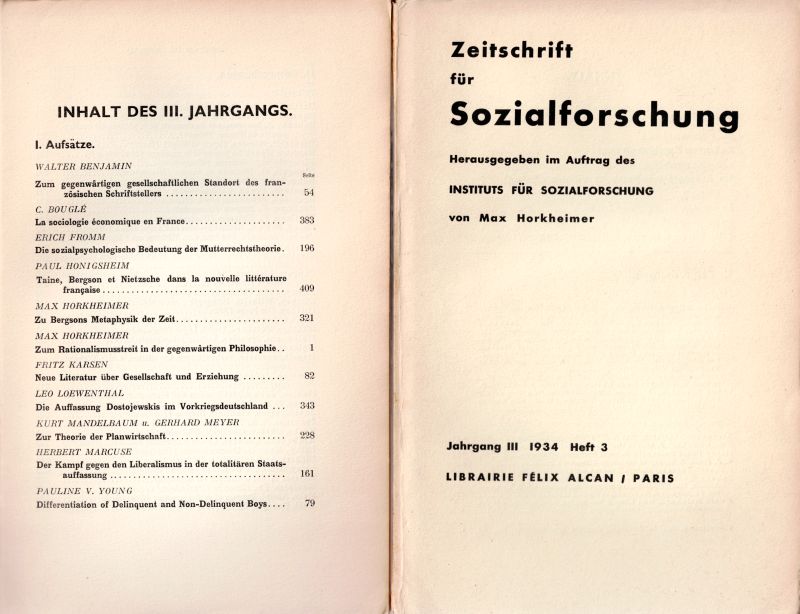
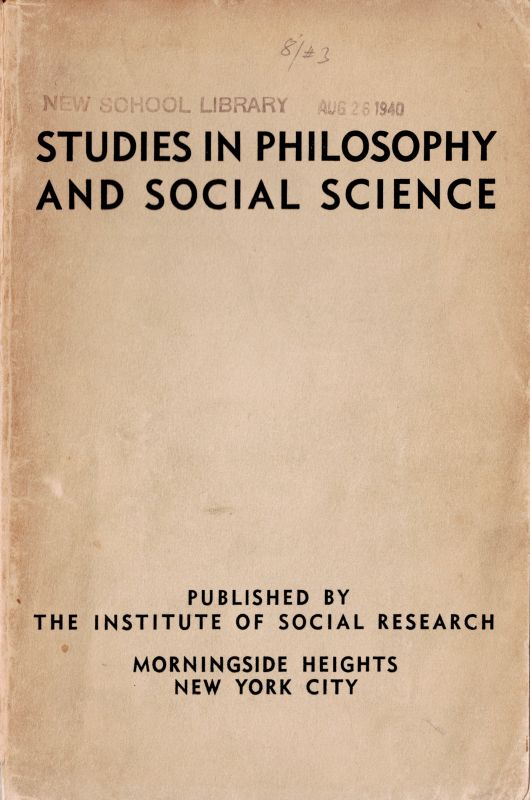
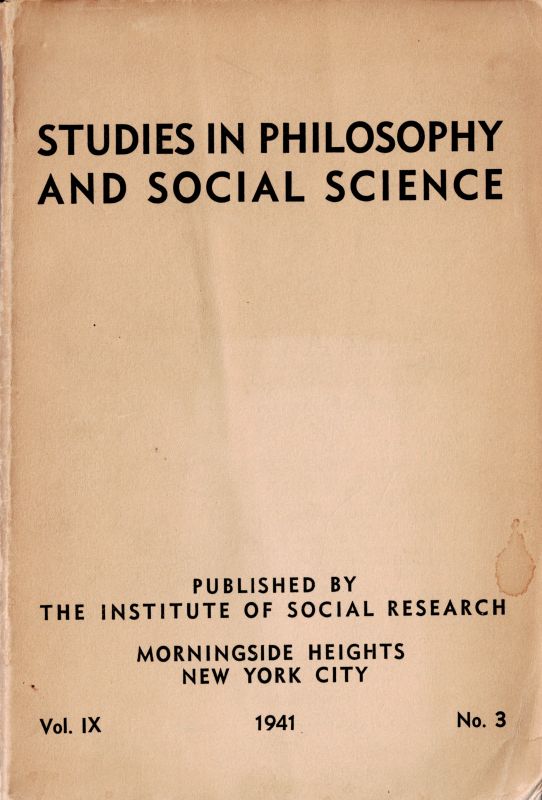
“L’Oeuvre d’art à l’époque de sa reproduction mécanisée” [First Edition of “The Work of Art in the Age of Mechanical Reproduction”, surely the most important work on cultural criticism ever written and here available in its first printing within Volume I of Jahrgang V, 1936 [Annual V, 1936] of the “Zeitschrift fuer Sozialforschung”]. All three Volumes of the very rare “Jahrgang V” are present with one Volume bearing the name of Walter Benjamin’s friend Alfred Sohn-Rethel on the cover]. This most spectacular provenance is not the only surprise but the 1936-set of “Jahrgang V” came to us as part of a nearly complete set of the Zeitschrift fuer Sozialforschung [24 Issues printed in 22 Issues with only three issues missing (Jahrgang I, Heft 1 und Heft 2 und Jahrgang IX, Heft 1)] and the Periodical does not only include all the Volumes with Benjamin’s Essays but one of the issues is actually an original “File Copy” of the “Institute for Research in Social Science” and one issue is stamped “New School Library – Aug 26 1940” and another from the “William Graham Sumner Club at the Sociology Department / Yale University”.
First Edition. Paris, Librairie Félix Alcan, 1936. Octavo. Softcover / Original Publisher’s wrappers. The Volume which includes the First Edition of “The Work of Art in the Age of Mechanical Reproduction” in stunning condition. Three Volumes with stronger signs of wear and all other Volumes in good, very good+ or even better condition. Fantastic provenance also of the Issue 3 of Jahrgang V in 1936 which bears Alfred Sohn-Rethel’s name. Sohn-Rethel’s possession of this issue is not only plausible but reflects all the developments known in critical writings of the Frankfurt School and is the exact time in which he tried, through his friendship with Adorno, to find a philosophical home within the Institute for Social Research. An endeavour which eventually failed through the intervention of Horkheimer but this would not have stopped him to follow the path of the Institute in Exile and its seminal Periodical. We can NOT determine if the other issues belonged to Sohn-Rethel as well. [More images on request].
Including all Volumes with Essays by Walter Benjamin which were published within the Zeitschrift fuer Sozialforschung [ZfS], including all Exile-Publications printed at Librairie Félix Alcan in Paris:
I. Walter Benjamin – “Zum gegenwärtigen gesellschaftlichen Standort des französischen Schriftstellers″
[Zeitschrift für Sozialforschung, Jahrgang III [1934], Seiten 54–78]
II. Walter Benjamin – “Probleme der Sprachsoziologie″
[Zeitschrift für Sozialforschung, Jahrgang IV [1935], Seiten 248-]
III. Walter Benjamin – “L‘oeuvre d‘art à l‘époque de sa reproduction mécanisée″
[Zeitschrift für Sozialforschung, Jahrgang V [1936], Seiten 40 –]
IV. Walter Benjamin – “Eduard Fuchs, der Sammler und der Historiker”
[Zeitschrift für Sozialforschung, Jahrgang VI [1937], Seiten 346 –]
V. Walter Benjamin – “Über einige Motive bei Baudelaire″
[Zeitschrift für Sozialforschung, Jahrgang VIII [1939], Seiten 50 –]
″The Work of Art in the Age of its Technological Reproducibility” was conceived by Benjamin as a contemporary complement to his much larger Arcades Project. He began writing the essay in 1935, from his home in exile in Paris. In October he mentioned the essay in letters to Gretel Karplus and Max Horkheimer, telling the latter that the essay was the beginning of “a materialist theory of art”.
The title in German is ‘Das Kunstwerk im Zeitalter seiner technischen Reproduzierbarkeit’. Between December 1935 and February 1936 Benjamin largely rewrote the essay, and added footnotes – it is this ‘second version’ that is considered to be the ‘urtext’, notably by the film historian Miriam Hansen. In his letter of October 1935 Benjamin had suggested to Horkheimer that the essay might be published in the Frankfurt School journal Zeitschrift für Sozialforschung. Horkheimer agreed to this, on condition that the essay should appear in French translation. Benjamin – then residing in France and deeply concerned with French politics – readily agreed, and collaborated with the philosopher-translator Pierre Klossowski, finishing the translation work in parallel with his completion of the revised essay itself.
In spite of what Howard Eiland calls Benjamin’s “meticulous collaboration” with Klossowski, publication in the Zeitschrift was far from straightforward, with editorial intervention leading to what Benjamin regarded as a toning down of the political intensity of the piece. In spite of these problems, the essay was published in 1936 in Volume 5, Issue 1 of the Zeitschrift für Sozialforschung, in Klossowski’s French translation, with the title: “L’œuvre d’art à l’époque de sa reproduction mécanisée”, followed by abstracts in German and English. Horkheimer’s decision to publish in French was immediately vindicated, as the essay was widely discussed in French intellectual circles. Benjamin continued to revise the essay down to 1939, and it is this third version that was the first to appear in German, in 1955, in the Gesammelte Schriften, and in English as ‘The Work of Art in the Age of Mechanical Reproduction’ in the 1969 volume Illuminations, translated by Harry Zohn. The second (1935/36) version is now often preferred as the ‘Ur-text’, and is the text translated in the 2008 Harvard University Press edition titled The Work of Art in the Age of Its Technological Reproducibility, and Other Writings on Media.
″The Work of Art in the Age of Mechanical Reproduction” (German: Das Kunstwerk im Zeitalter seiner technischen Reproduzierbarkeit; 1935), by Walter Benjamin, is an essay of cultural criticism which proposes and explains that mechanical reproduction devalues the aura (uniqueness) of a work of art, and that in the age of mechanical reproduction and the absence of traditional and ritualistic values, the production of art would be inherently based upon the praxis of politics.
The essay was written during the Nazi régime (1933–1945) in Germany. Its first draft was composed in 1935 during the year that the Nuremberg Race Laws were passed in the Third Reich and Leni Riefenstahl’s film documentary of the Nuremberg Rally (Triumph of the Will) debuted to critical praise, sweeping the film awards across Europe. The essay presents a theory of art that is “useful for the formulation of revolutionary demands in the politics of art” in a mass culture. It remains a prophetic and trenchantly anti-fascist manifesto, instructing readers in the interpretation of mass cultural forms inclined towards the fertilization and acceleration of totalitarianism.
Themes and motifs of Benjamin’s essay include: the aura of a work of art; the artistic authenticity of the artefact; the cultural authority of the work of art; and the aestheticization of politics for the production of art, became resources for research in the fields of art history and architectural theory, cultural studies, and media theory. (Wikipedia)
- Keywords: Catalogue Twelve – Philosophy · Walter Benjamin · Walter Benjamin – Collection · Walter Benjamin Circle of Friends · Walter Benjamin Sammlung · Walter Benjamin Umkreis
- Language: English / French / German
- Inventory Number: 32523AB
EUR 16.800,--

We ship per DHL Express








Contact
Inanna Rare Books Ltd.
Woodley House
Castletownshend Road
P81 D262 Skibbereen, County Cork
Ireland
Phone: ++353 - (0) 87 - 102 5412
E-Mail: info@inannararebooks.com
Internet: https://www.inannararebooks.com
Online Bookshop specialized in rare
and secondhand books.
Newsletter and E-Catalogue Sign Up
Payment Options


© 2026 Inanna Rare Books Ltd. | Powered by HESCOM-Software
Follow Us

