


Xenophon / Hutchinson, Xenophontis de Cyri Institutione - Libri Octo.
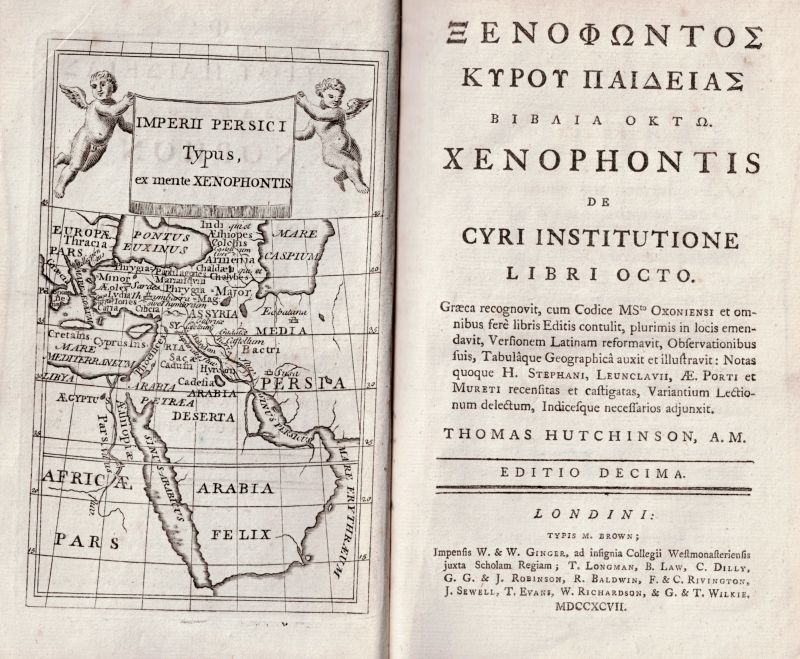
Xenophontis de Cyri Institutione – Libri Octo.
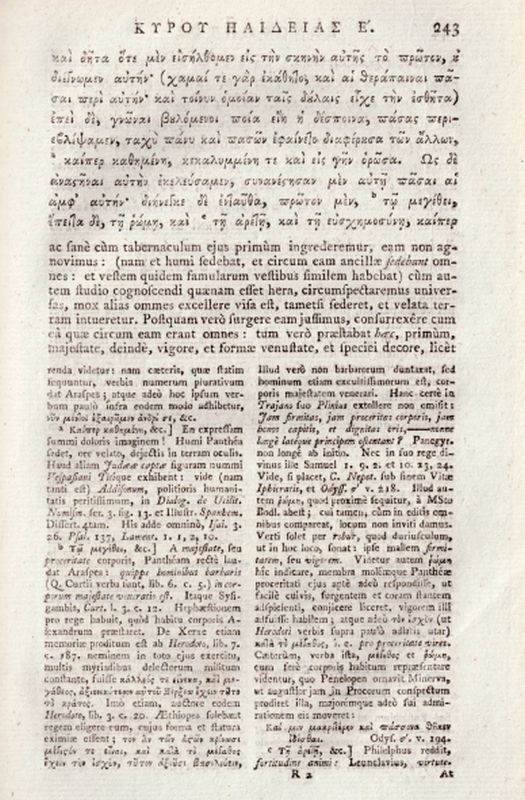
Edition Decima [Bilingual in Greek and Latin]. London, Impensis W.&W.Ginger, ad insignia Collegii Westmonasteriensis juxta Scholam Regiam, 1797. Octavo. Frontispiece-Map, [2], 548 pages. Hardcover / Original full leather with gilt lettering on spine and boards. In protective Mylar. Very good condition with only minor signs of wear. From the library of Daniel Conner (Connerville / Manch House), with his Exlibris / Bookplate to pastedown.
Xenophon of Athens (c. 430 – 355/354 BC) was a Greek military leader, philosopher, and historian. At the age of 30, he was elected as one of the leaders of the retreating Greek mercenaries, the Ten Thousand, who had been part of Cyrus the Younger’s attempt to seize control of the Achaemenid Empire. As the military historian Theodore Ayrault Dodge wrote, “the centuries since have devised nothing to surpass the genius of this warrior”.
For at least two millennia, it has been debated whether Xenophon was first and foremost a general, historian, or philosopher. For the majority of time in the past two millennia, Xenophon was recognised as a philosopher. Quintilian in The Orator’s Education discusses the most prominent historians, orators and philosophers as examples of eloquence and recognises Xenophon’s historical work, but ultimately places Xenophon next to Plato as a philosopher. Today, Xenophon is recognised as one of the greatest writers of antiquity. Xenophon’s works span multiple genres and are written in plain Attic Greek, which is why they have often been used in translation exercises for contemporary students of the Ancient Greek language. In the Lives and Opinions of Eminent Philosophers, Diogenes Laërtius observed that Xenophon was known as the “Attic Muse” because of the sweetness of his diction.
Despite being born an Athenian citizen, Xenophon came to be associated with Sparta, the traditional opponent of Athens. Much of what is known today about the Spartan society comes from Xenophon’s royal biography of the Spartan king Agesilaus and the Constitution of the Lacedaemonians. The sub-satrap Mania is primarily known through Xenophon’s writings. Xenophon’s Anabasis recounts his adventures with the Ten Thousand while in the service of Cyrus the Younger, Cyrus’s failed campaign to claim the Persian throne from Artaxerxes II of Persia, and the return of Greek mercenaries after Cyrus’s death in the Battle of Cunaxa.
Xenophon wrote Cyropaedia, outlining both military and political methods used by Cyrus the Great to conquer the Neo-Babylonian Empire in 539 BC. Anabasis and Cyropaedia inspired Alexander the Great and other Greeks to conquer Babylon and the Achaemenid Empire in 331 BC. The Hellenica continues directly from the final sentence of Thucydides’ History of the Peloponnesian War covering the last seven years of the Peloponnesian War (431–404 BC) and the subsequent forty-two years (404–362 BC) ending with the Second Battle of Mantinea. Xenophon’s writings on military strategies remain influential and are believed to be among the first to utilise and describe flanking manoeuvres and feints in military tactics. (Wikipedia)
- Keywords: Altphilologie · Catalogue Greek History & Philosophy · Classical Literature · Classical Literature – Rare · Classical Philology · Classical Studies · Classical Studies – Rare · Classics · Greek History · Greek Philosophy · Philologie · Philology · Xenophon of Athens
- Language: Greek - Latin
- Inventory Number: 32384AB
EUR 275,--

We ship per DHL Express


Contact
Inanna Rare Books Ltd.
Woodley House
Castletownshend Road
P81 D262 Skibbereen, County Cork
Ireland
Phone: ++353 - (0) 87 - 102 5412
E-Mail: info@inannararebooks.com
Internet: https://www.inannararebooks.com
Online Bookshop specialized in rare
and secondhand books.
Newsletter and E-Catalogue Sign Up
Payment Options


© 2026 Inanna Rare Books Ltd. | Powered by HESCOM-Software

