


Diodorus Siculus. Bibliothecae Historicae - Libri Qui Supersunt E Recensione Pet
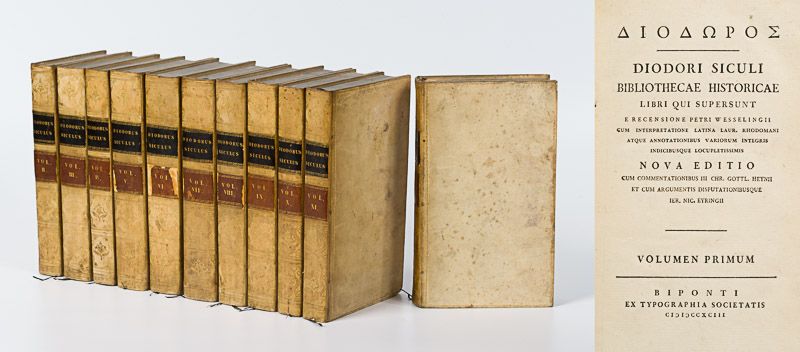
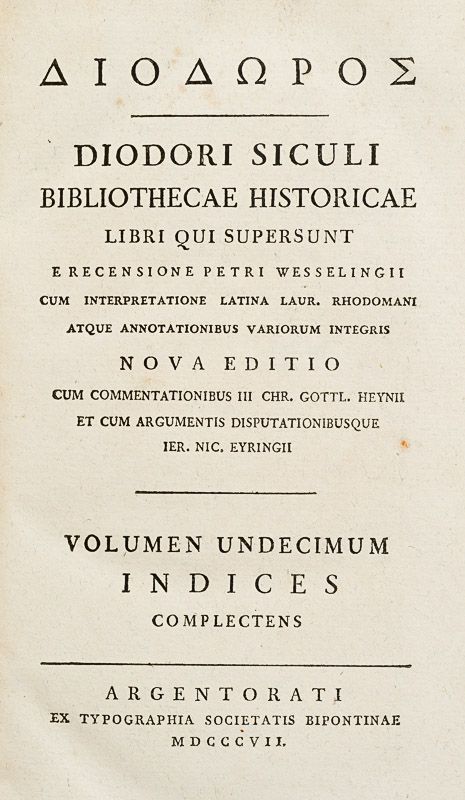
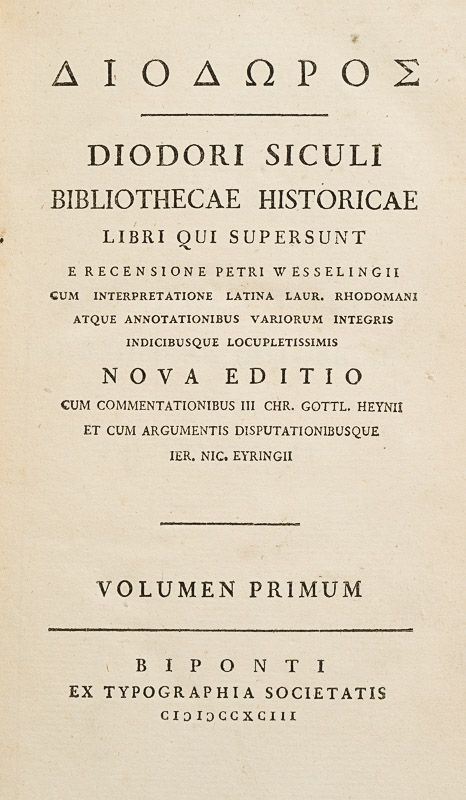
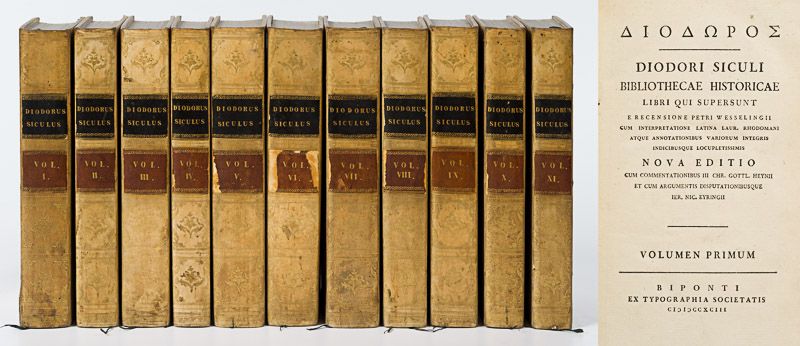
Bibliothecae Historicae – Libri Qui Supersunt E Recensione Petri Wesselingii Cum Interpretatione Latina Laur. Rhodomani Atque Annotationibus Variorum Integris Indicibusque Locupletissimis. Nova editio, cum commentationibus III Chr. Gottl. Heynii [Christian Gottlob Heyne] et cum argumentis disputationibusque Ier. Nic. Eyringii.
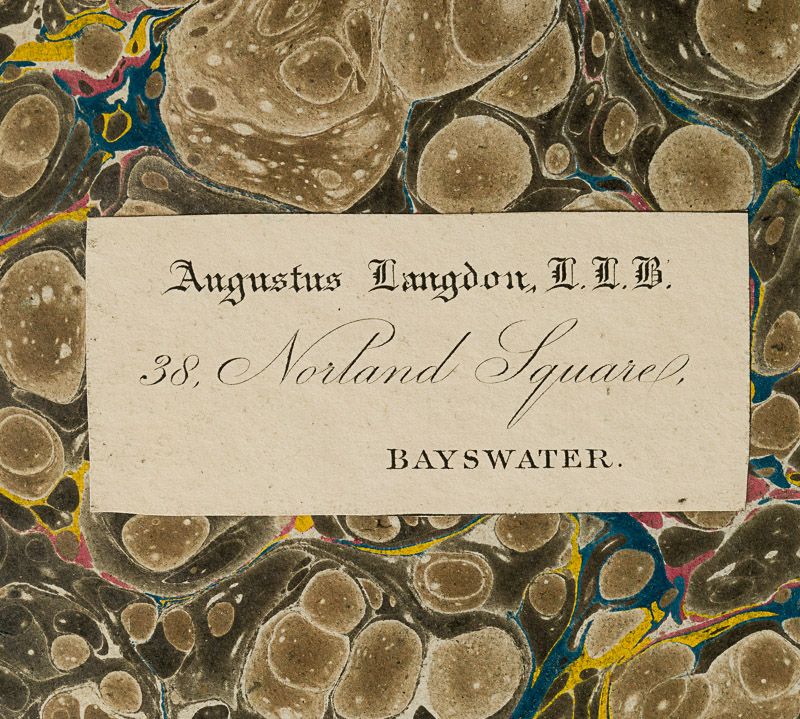
[Editio Bipontina] / Bilingual Edition in Greek and Latin. 11 Volumes [complete set]. Biponti [Zweibrücken], Ex typographia Societatis, 1793. Octavo. Pagination: Volume I: CLXXXII, 476 pages / Volume II: 565 pages / Volume III; 645 pages / Volume IV: LXXII, 400 pages / Volume V: 638 pages / Volume VI: 680 pages / Volume VII: 680 pages / Volume VIII: 568 pages / Volume IX: 553 pages / Volume X: 493 pages plus 1 unnumbered page of Corrigenda / Volume XI: 456 pages. Hardcover / Original full vellum with gilt lettering and ornament on spine. Very good condition with only minor signs of wear. Very few Volumes with the pages a bit dusty and only some Volumes with a minor, faded dampstain to the outer margins. [From the library of Augustus Langdon, Bayswater, with his Exlibris to pastedown].
Diodorus Siculus or Diodorus of Sicily (Diódoros; fl. 1st century BC) was an ancient Greek historian from Sicily. He is known for writing the monumental universal history Bibliotheca historica, in forty books, fifteen of which survive intact, between 60 and 30 BC. The history is arranged in three parts. The first covers mythic history up to the destruction of Troy, arranged geographically, describing regions around the world from Egypt, India and Arabia to Europe. The second covers the time from the Trojan War to the death of Alexander the Great. The third covers the period to about 60 BC. Bibliotheca, meaning ‘library’, acknowledges that he was drawing on the work of many other authors.
Diodorus’ universal history, which he named Bibliotheca historica (″Historical Library”), was immense and consisted of 40 books, of which 1–5 and 11–20 survive: fragments of the lost books are preserved in Photius and the Excerpts of Constantine Porphyrogenitus.
It was divided into three sections. The first section (books I–VI) deals with the mythic history of the non-Hellenic and Hellenic tribes up to the destruction of Troy and is geographical in theme, describing the history and culture of Ancient Egypt (book I), of Mesopotamia, India, Scythia, and Arabia (II), of North Africa (III), and of Greece and Europe (IV–VI).
The next section (books VII–XVII) recounts the history of the world from the Trojan War down to the death of Alexander the Great. The last section (books XVII to the end) concerns the historical events from the successors of Alexander down to either 60 BC or the beginning of Julius Caesar’s Gallic Wars. The end has been lost, so it is unclear whether Diodorus reached the beginning of the Gallic War as he promises at the beginning of his work or, as evidence suggests, old and tired from his labours, he stopped short at 60 BC.
Diodorus selected the name “Bibliotheca” in acknowledgment that he was assembling a composite work from many sources. Identified authors on whose works he drew include Hecataeus of Abdera, Ctesias of Cnidus, Ephorus, Theopompus, Hieronymus of Cardia, Duris of Samos, Diyllus, Philistus, Timaeus, Polybius, and Posidonius. (Wikipedia)
- Keywords: Altphilologie · Catalogue Greek History & Philosophy · Classical Literature · Classical Literature – Rare · Classical Philology · Classical Studies · Classical Studies – Rare · Classics · Greek History · Greek Philosophy · Philologie · Philology · Trojan War · Troy
- Language: Greek - Latin
- Inventory Number: 32387AB
EUR 680,--

We ship per DHL Express


Contact
Inanna Rare Books Ltd.
Woodley House
Castletownshend Road
P81 D262 Skibbereen, County Cork
Ireland
Phone: ++353 - (0) 87 - 102 5412
E-Mail: info@inannararebooks.com
Internet: https://www.inannararebooks.com
Online Bookshop specialized in rare
and secondhand books.
Newsletter and E-Catalogue Sign Up
Payment Options


© 2026 Inanna Rare Books Ltd. | Powered by HESCOM-Software

