


[Hope, Anastasius : Or, Memoirs of a Greek ; Written at the close of the Eightee
Anastasius : Or, Memoirs of a Greek ; Written at the close of the Eighteenth Century.
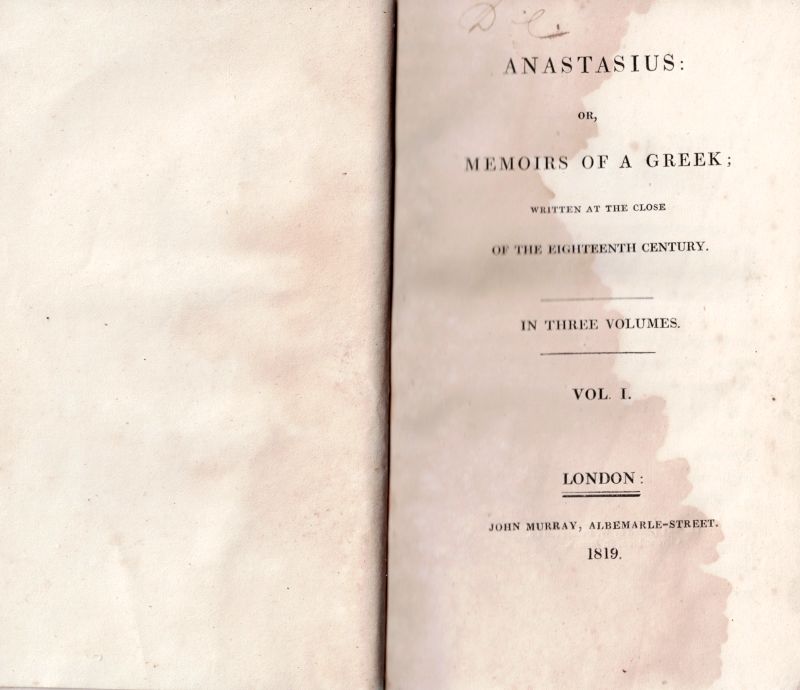
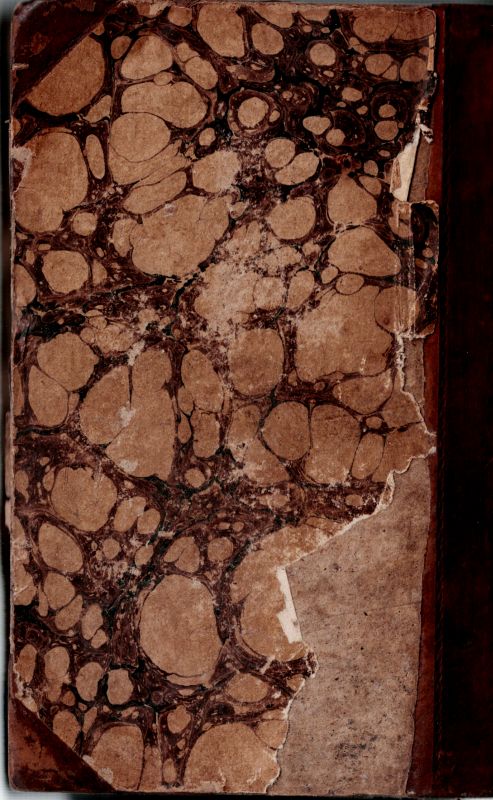
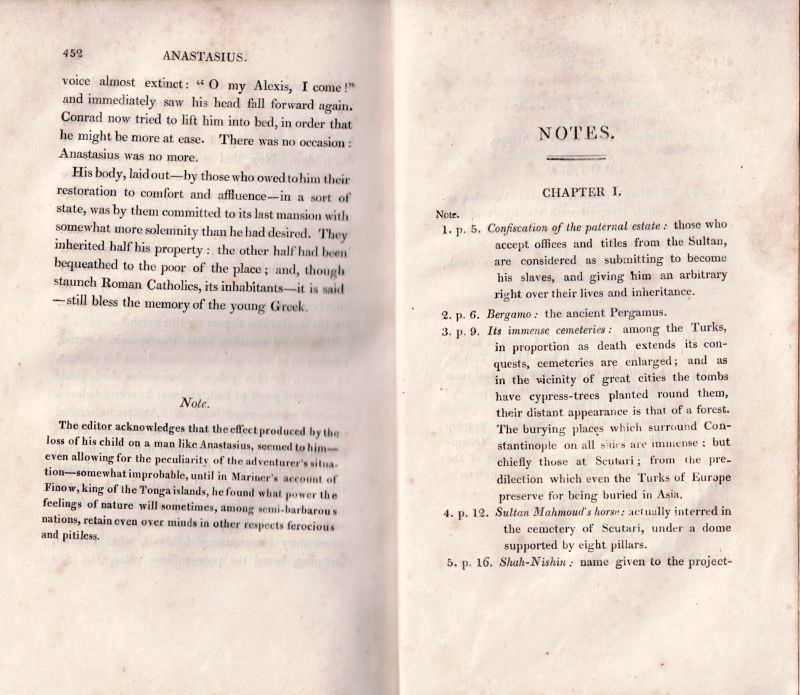
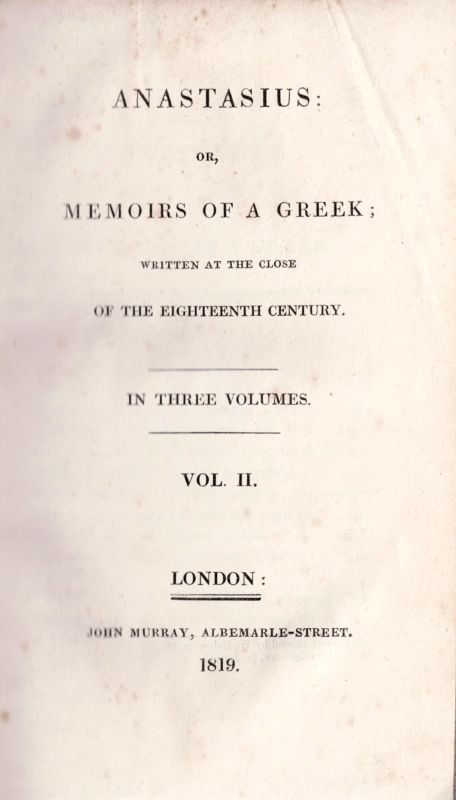
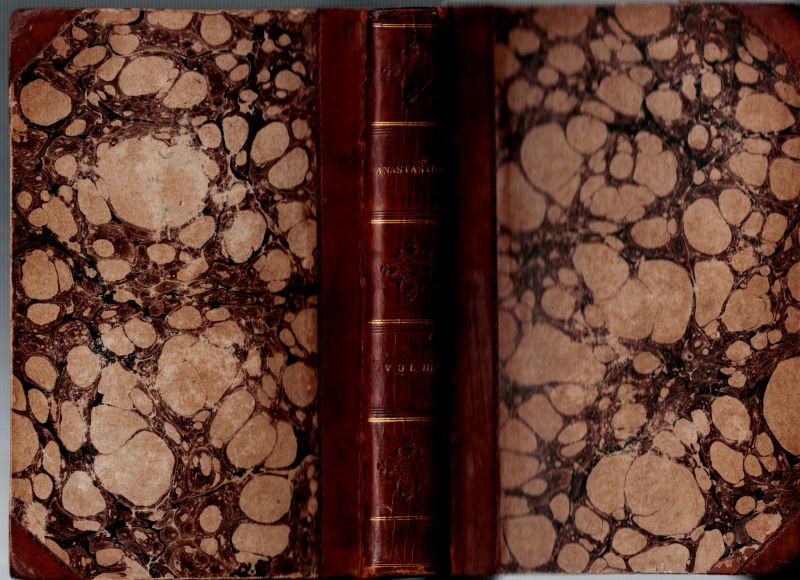
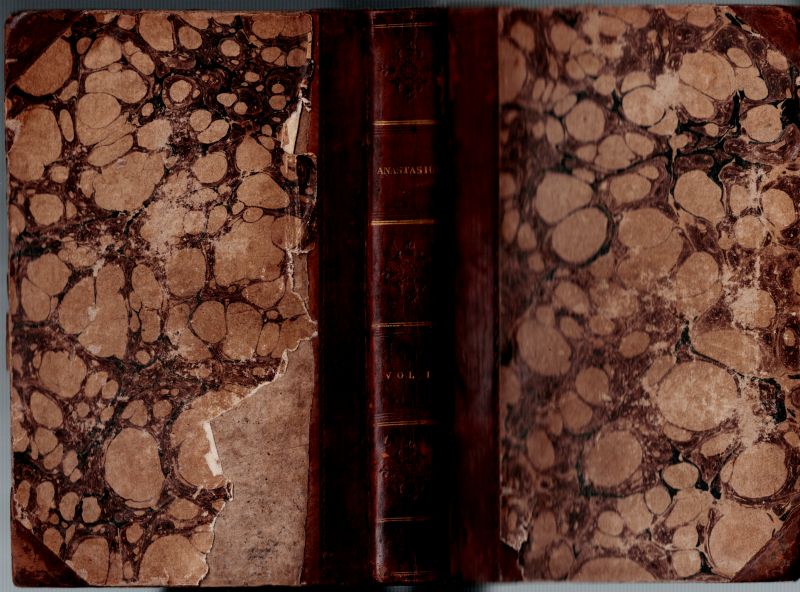
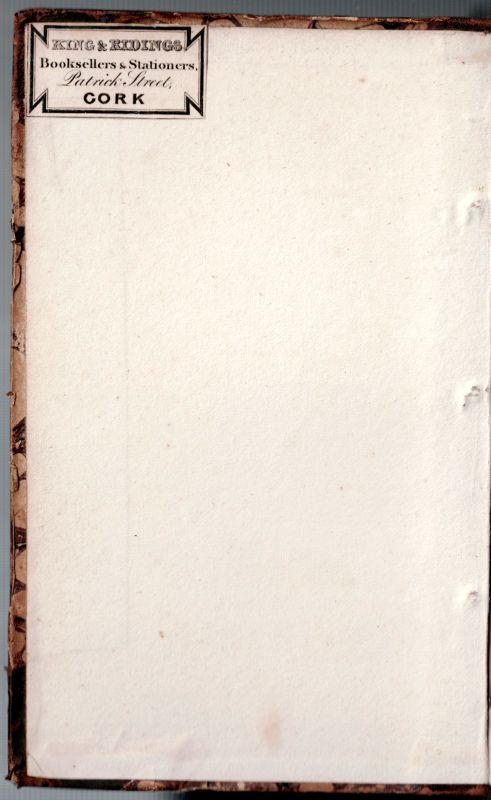
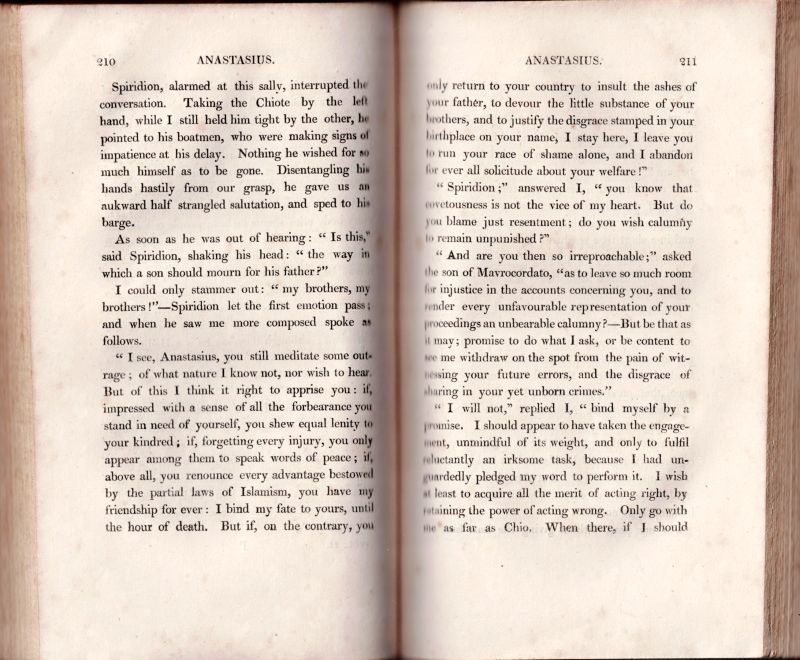
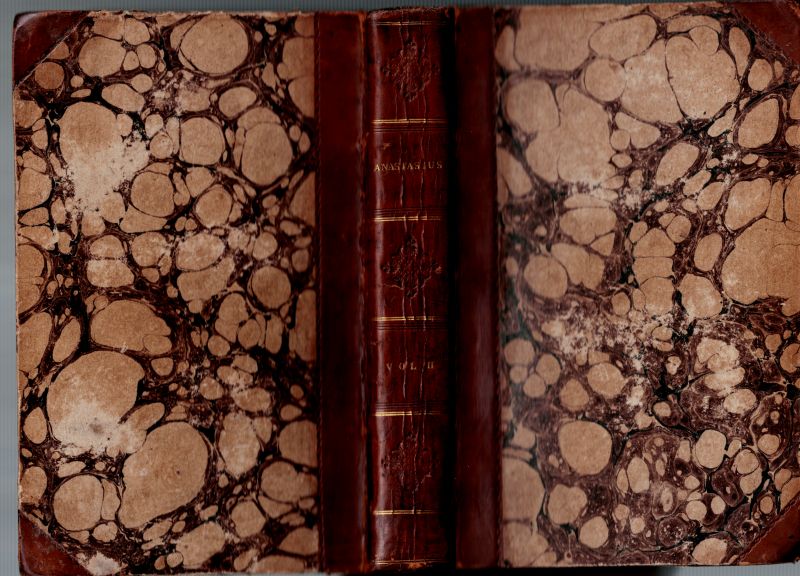
First Edition. In Three Volumes. London, John Murray, 1819. Octavo (12.2 cm wide x 19 cm high). Pagination: Volume I: III, 376 pages/ Volume II: 429 pages / Volume III: 457 pages. Hardcover / Original half-leather with gilt lettering on spine and marbled-paper-covered boards. Dampstain fading from pastedown, endpapers to page 80 of Volume I. All Volumes in beautifully firm and strong bindings and with some rubbing to the marbled paper covered boards with some lesions to the paper. Interior in general very good with occasional foxing. A very, very rare set in its orginal bindings and the only version of the frst edition of this important publication we ever were able to handle in our 32 years as antiquarian bookdealers.
Thomas Hope (30 August 1769 – 2 February 1831) was a Dutch-British interior and Regency designer, traveler, author, philosopher, art collector, and partner in the banking firm Hope & Co. He is best known as an early promoter of Greek Revival architecture, opening his house as a museum and his novel Anastasius, a work which many experts considered a rival to the writings of Lord Byron.
Born in Amsterdam, he fled to London after the French Revolution spread to the Netherlands, leaving a large part of his art collection behind.
The eldest son of Jan Hope, Thomas descended from a branch of an old Scottish family (Quakers) who for several generations were merchant bankers known as the Hopes of Amsterdam, or Hope & Co. He was baptized on 3 September in the English Reformed Church, Amsterdam. He had two brothers, Adrian Elias (1772-1834), an innovative gardener, and Henry Philip (1774-1839), a famous collector of the arts and precious gems. Hope was possibly painted as a boy by Guy Head who visited Amsterdam in 1780. Thomas inherited a love of the arts from his parents. His father spent his final years turning his summer home, Groenendaal Park in Heemstede into a grand park of sculpture which would be open to the public.
In 1784, when Thomas was fifteen, his father died unexpectedly in the Hague right after purchasing Bosbeek, the mansion that would later house his large art collection. He shared his art collection as part of the Hope & Co. partnership with his cousin Henry Hope.
At the age of eighteen, Thomas began to devote most of his time to the study of the arts, especially classical architecture. During his eight-year grand tour through Europe, Asia and Africa, Thomas became especially interested in architecture and sculpture, collecting a large collection of artifacts that attracted his attention (e.g. the Hope Dionysus).
Not long after his mother died in early January 1790, Thomas received the rights and liabilities of a person of full age and was admitted to the board of the Hope company. He owned almost a sixth of the shares, and instantly became a millionaire. Between 1792 and 1794 he and Henry Philip traveled in Italy, buying antiquities (Venus, restored by Antonio Canova).
Henry Hope was the executor of their mother’s will in June 1794; Thomas received the largest and most expensive mansion on Herengracht. On 24 December 1794 he crashed in the Watergraafsmeer with another chaise. (On 27, the French general Pichegru crossed the Meuse on the ice and moved north.) Within a few weeks, he fled to London to avoid the Batavian Revolution and the French occupation of the Netherlands and never returned.
Hope was eager to advance public awareness of historical painting and design and to influence design in the grand houses of Regency London. In pursuit of his scholarly projects, he began sketching furniture, room interiors and costumes, and publishing books with his accompanying scholarly texts.
In 1807 Thomas Hope published sketches of his furniture, in a folio volume, titled Household Furniture and Interior Decoration, which had considerable influence and brought about a change in the upholstery and interior decoration of houses. Hope’s furniture designs were in the pseudo-classical manner generally called “English Empire”. It was sometimes extravagant, and often heavy, but was much more restrained than the wilder and later flights of Thomas Sheraton in this style.
In 1809 he published the Costumes of the Ancients, and in 1812 Designs of Modern Costumes, works which display a large amount of antiquarian research. A Historical Essay on Architecture, which featured illustrations based on early Hope drawings, was published posthumously by his family in 1835. Thus Hope became famous in London’s aristocratic circles as ‘the costume and furniture man’. The sobriquet was regarded as a compliment by his enthusiastic supporters, but for his critics, including Lord Byron, it was a term of ridicule.
1807: Household Furniture and Interior Decoration. Faksimile-Neuausgabe 1937.
1809: Costumes of the Ancients.
1812: Designs of Modern Costumes.
1819: Anastasius: or, Memoirs of a Greek; Written at the close of the Eighteenth Century.
1831: Origin and Prospect of Man.
1835: Historical Essay on Architecture.
Anastasius:
At age fifty, Hope began work on a novel at the suggestion of a few friends. The first edition of Anastasius was complete in 1819 and was published by London publisher John Murray. It received foreign translations into French, German and Flemish.
The novel lifted a curtain of ignorance about the East without being a mere retelling of Hope’s own travels. The eponymous narrator-hero Anastasius was fearless, curious, cunning, ruthless, brave and, above all, sexy. As a newly converted Muslim mercenary soldier, Selim, his travels threw him among friends, lovers and enemies.
The novel described the lives of the inhabitants of the Ottoman Empire and the wars fought among the Turks, Russians and Wahabees. It also included many previously unfamiliar details of Islamic culture: music, language, cuisine, religion, laws and literature.
Because of his modesty, Hope originally chose not to declare his authorship of Anastasius in the first edition. Ironically, given Hope’s mild reputation, the authorship of the dashing Anastasius was at first mistakenly attributed to Lord Byron, who, according to legend, confided to Marguerite, Countess of Blessington, that he wept bitterly on reading it. “To have been the author of Anastasius, I would have given the two poems which brought me the most glory.” These events prompted Hope to reveal his identity as author in later editions, adding a map of Anastasius’s travels and fine-tuning the text, although his authorship was initially greeted with incredulity by some journals.
Soon after Hope’s death in 1831, his widow Louisa remarried her cousin William Carr Beresford, 1st Viscount Beresford. His family thereafter embraced conservative values, causing them to authorise the demolition of the writer’s legendary London home, disperse his fabled art collection, and distance themselves from his Oriental masterpiece. No substantial collection of Hope’s personal papers survived the family indifference and Anastasius, his magnum opus, became a victim of the sanctimonious morality of the Victorian age.
Nevertheless, it influenced the later works of William Thackeray, Mark Twain and Herman Melville. More recently, the noted Orientalist Robert Irwin wrote, “this book, one of the most important books of the nineteenth century, should be much more widely read.″
In addition to his other accomplishments, Hope was the author of an important philosophical work published posthumously, The Origin and Prospect of Man (1831), in which his speculations diverged widely from the social and religious views of the Victorian age.
This volume, which has been cited by the philosopher Roger Scruton, was a highly eclectic work and took a global view of the challenges facing humanity.
In his obituary published in The Mirror of Literature, Amusement, and Instruction Volume 17, No. 476, Saturday, 12 February 1831, it was written, “We remember the opinion of a writer in the Edinburgh Review, soon after the publication of Anastasius. With a degree of pleasantry and acumen peculiar to northern criticism, he asks, ‘Where has Mr. Hope hidden all his eloquence and poetry up to this hour? How is it that he has, all of a sudden, burst out into descriptions which would not disgrace the pen of Tacitus, and displayed a depth of feeling and vigor of imagination which Lord Byron could not excel? We do not shrink from one syllable of this eulogy.’″
Still commonly known among literary circles as “Anastasius Hope”, the combined artistic legacy of Thomas Hope is still of universal interest and importance. (Wikipedia)
- Keywords: 19th Century – Rare · 19th Century Literature · Byron · Byron Circle · Catalogue Greek History & Philosophy · Catalogue Nineteen – English Literature before 1850 · Catalogue No.10 – International Literature · English Literature – Rare · English Literature of the 19th century · Thomas Hope (Designer and Novelist)
- Language: English
- Inventory Number: 32484AB
EUR 6.800,--

We ship per DHL Express


Contact
Inanna Rare Books Ltd.
Woodley House
Castletownshend Road
P81 D262 Skibbereen, County Cork
Ireland
Phone: ++353 - (0) 87 - 102 5412
E-Mail: info@inannararebooks.com
Internet: https://www.inannararebooks.com
Online Bookshop specialized in rare
and secondhand books.
Newsletter and E-Catalogue Sign Up
Payment Options


© 2026 Inanna Rare Books Ltd. | Powered by HESCOM-Software

