Inscribed (155 items)

Small Archive of personal correspondence between irish-american writer John Montague and irish artist Louis Le Brocquy plus many and related items

72. Le Brocquy, Louis / Montague, John / [Dupin, Jacques] / [Samuel Beckett].

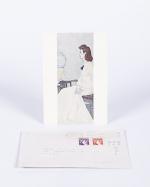
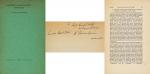
Small Archive of personal correspondence between irish-american writer John Montague and irish artist Louis Le Brocquy plus many related items. The correspondence also includes John Montague touching on Samuel Beckett. The core of the collection includes 1. Extremely insightful and important, very personal manuscript-letter from John Montague to Louis Le Brocquy – Inside an envelope addressed by John Montague to Louis Le Brocquy at his french residence ‘Domaine des Combes’ with Louis Le Brocquy’s answer carefully tucked into the same envelope, treasured by John Montague. The densely filled, very personal 4-page-manuscript letter from John Montague, is dated Christmas 1981, written after “a sabbatical [..] on a long tour which led me as far as Los Angeles” and is a strong reflection of John Montague’s personal struggles, thoughts and influences as a writer; he talks about his ten years of teaching in the US “after O’Riada’s death led to a vacuum” and “enduring the semi-bourgeois limbo of Cork”. Montague speaks about the time “after the harness came off” and he “felt quite strange, and after thirty years my stammer returned in painful, nearly uncontrollable force”. Montague even touches on his fears about his health and continues “I clocked into a clinic for a rest cure….so far liver excellent, so it is not Sean or Brendan all over again (in any case, loving the stuff, as you do, I can’t overdrink; the tastebuds are against it)”. Montague dives into comparisons with Samuel Beckett: “″Did you realize that Sam Beckett was under analysis at the Tavistock Clinic for two years ? – The early Beckett is a smart alec; the break comes when he has to survive in post-war France and accept “his own darkness”. Montague also touches on his struggle with his mother “Isn’t it terrible that we spend up to nearly middle-[a]ge coping with the traumas of youth, with no way round it ? – I have cleared/cleaned/buried & forgiven my mother in my next book “The Dead Kingdom”….” – The letter continues to talk about books, “the Landslide Manuscript”, poetry and his work etc. etc. He mentions a Dupin “play” which “will travel in my Paris luggage”. Montague also touches on the subject of the Irish Troubles and writes “I have always, by the way, believed that 1916 may have been a mistake as Yeats said: “For England may keep faith – For all is said and done” / Montague speaks about “My own area of Tyrone is blessedly free from all but minor incidents” – Amazing document of confidence and trust between two irish landmark personalities. 2. Louis Le Brocquy’s answer to John Montague is dated “New Year’s Day 1981”[which should have been 1982]: A. Very personal manuscript Letter – a direct answer to Montague’s letter from “Christmas 1981” (1 sheet with both pages filled in ink and signed “Louis”) in which Le Brocquy reflects on the tense political situation with Northern Ireland and the overall worldwide tension of a looming war / Le Brocquy writes that he did have a “wild hope that when Charlie took office…that he and Thatcher might between them opted a ‘Rhodesian’ solution in the North” / Le Brocquy also writes about the eagerly awaited publication of “Selected Poems” of John Montague and he also asks John if “you thought of collecting Esteban’s and Dupin’s poems in French with your translations ?” – Le Brocquy offers to help with illustrations etc. – Both letters together in an envelope which suggests that John Montague received his letter to Louis le Brocquy back from the Le Brocquy-estate after Le Brocquy’s death. / Also included: B. A manuscript postcard with Le Brocquy’s “Girl in White” as a postcard-reproduction in which Le Brocquy suggests a project with John Montague and sends greetings to Montague’s wife Evelyn and the kids (in envelope from Carros,France) / C. In his function as chairman of Amnesty International, Le Brocquy sends a callout by Amnesty International to John Montague and kindly asks him to support the cause. He sends the callout to John by adding a few manuscript, personal lines of affection (in envelope from Carros,France).

France / Ireland, Carros / Cork, 1980-1981. A4. 4 pages on two sheets (main Montague-letter), 2 pages on 1 sheet (Le Brocquy – answer), 1 postcard, 1 manuscript-letter from Jacques Dupin to John Montague (25.10.1978) about a translation of “L’Éboulement” (Dupin also speaks about Louis le Brocquy in the letter), several pages of letters (mostly typed and signed) from other figures in irish and international literature and art. Original Envelopes. Very good condition with only minor signs of external wear. Besides some ephemeral materials from personalities in Literature and Art, addressed to John Montague, the small collection includes several vintage photographs of John Montague, taken during his acceptance of a honorary Doctorate of Literature at UCC, Cork, as well as a Legislative Resolution by the State of New York (Senator Daly), recognizing and thanking the distinguished author and poet John Montague with this decree on May 26, 1987. Among the lesser interesting materials is a pamphlet titled “Ireland’s Literary Renaissance – 20th century Portraits” in which portraits by Louis Le Brocquy of John Montague and Thomas Kinsella are included. The pamphlet is accompanied by a letter from James White to John Montague in which he explains this being a publication that was released for an exhibition in Chicago and he apologises for the entries being “necessarily short but hopefully reasonably correct”. Provenance: From the private collection of John Montague’s papers in his recently sold West Cork Home.


Show details

David Puttnam - Collection of original Film / Movie - Memorabilia, inscribed/signed books and the extensive Record Collection

73. Puttnam, David.

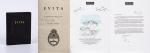
Collection of Film / Movie & Music – Memorabilia with rare, inscribed/signed books, photographs and promotional ephemera as well as related materials from the private library of Lord David Puttnam and few other sources. The collection includes a large amount of international publications and important monographs on the History of Film and Movies and also several signed and/or inscribed/dedicated Vinyl-Records by early friends of David Puttnam (Ringo Starr, Barbra Streisand etc.) together with some publications on Literature, History, Photography. Also included are several amazing association-copies from David Puttnam’s time as producer at Columbia Studios; like a signed and spectecularly inscribed book by important Director Spike Lee, Director and friend Alan Parker etc. etc. We list here a few items but the complete list of items, described in detail and photographed, will be visible over time on our website under “Libraries & Collections”. Among the titles are for example: 1. A xeroxed copy of the second draft of “Chariots of Fire”, which David Puttnam signed in 2019 and to which he added a wonderful manuscript note and story of the Script: “This is a very interesting early Draft of ‘Chariots of Fire’ – A year later we started shooting the film in Cambridge – Almost exactly two years later the film won the BAFTA Best Picture Award and a few weeks later The ‘Oscar’ ! – Colin Welland also won for Best Screenplay that same evening. Reading this you can see why. Regards – David Puttnam”/ 2. Collection of signed vintage Vinyl owned by Lord David Puttnam, signed and inscribed Records by famous artists and musicians like Barbra Streisand, Ringo Starr, Jean-Michel Jarre as well as soundtracks of his own films (included are Local Hero [not signed by Mark Knopfler but signed by David Puttnam], Midnight Express) etc. / 3. Amazing, absolutely wonderful association copy of Alan Parker’s “Cartoon Version” of his movie “Evita” with which he thanked his cast and crew. This being a personally inscribed copy from Alan Parker to his friends David & Patsy Puttnam. Accompanied by a two-page letter, signed by Parker and citing a quote of David Puttnam reflecting on his own experiences in the movie-business with a bit of ironic advice for his friend Alan Parker on how to exit the movie-business. / 4. Collection of books by writers befriended to David Puttnam, often signed and/or inscribed (Nick Hornby – Fever Pitch etc.) / 5. Collection of monographs and biographies on and by Actors, Directors, Film and Movie-MakingTechnique, Sociology of Film etc. etc. / 6. Large collection of photographical stills as well as portraits of Directors on set during the act of directing, etc. etc.

London / UK / USA, c.1968-1996. Octavo. Original Hardcover with the rare illustrated dustjacket in protective collector’s Mylar. Very good condition with only minor signs of external wear.

EUR 25.000,-- 

Show details   Add to cart

Pages from a Diary Written in Nineteen Hundred and Thirty. [Signed / Inscribed by George Yeats

76. Yeats, William Butler / [George [Georgie] Yeats / Mrs. Eva Hempel / Eduard Hempel].

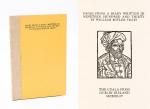
Pages from a Diary Written in Nineteen Hundred and Thirty. [Signed / Inscribed by George Yeats to Mrs. [Eva] Hempel, wife of german ambassador to Ireland during World War II].

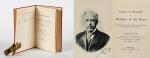
No.8 / 200 copies, of the original limited edition. Dublin, The Cuala Press, 1944 [September 1944]. Octavo. 58 pages. Original Hardcover. Inscribed by George Yeats on the front free endpaper: “Mrs. Hempel from George Yeats, April 1944”. This has to be of course “April 1945”. The impossibility of signing/inscribing a book in April 1944 if it was only published in September 1944 is easily explained with the classic everyday-mistake of still writing the previous year in the first few months of the following year. A stunning association. The signature and inscription is a solid match to George Yeats’ autographs in her later hand and William Butler Yeats and George Yeats were frequent visitors to the Hempel’s in Dublin. In addition, the low number of the edition (8/200) suggests this being one of the reference copies given to George Yeats, who contributed heavily to the volume and even added an explanatory note (in print) verso the titlepage. This copy is near fine, bound in the publisher’s quarter buckram over yellow, paper-covered boards. The books pages remained unopened. Eva Hempel’s husband Eduard Hempel is one of the most controversial figures in modern Irish history, excoriated by some as ‘Hitler’s man’, defended by others such as the country’s first President, Eamon De Valera. Certainly, Hempel presented William Butler Yeats in 1938 with a copy of ‘Germany Speaks’ whose inscription described an ‘unforgettable afternoon’ spent together by Yeats and Hempel. Eduard Hempel and his wife were accepted socialites in the Dublin world of World War II, famously receiving a condolence call by de Valera upon the death of Hitler. Eduard Hempel and his wife Eva were granted asylum in Ireland after world war II and stayed way beyond the end of World War II.

EUR 380,-- 

Show details   Add to cart

[Behring, Collection of nine important Emil von Behring - offprints from the Exile-library of Prof. Dr. Hans Sachs

79. [Behring, Emil von / Sachs, Hans].

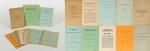
Collection of nine important Emil von Behring – offprints from the Exile-library of Prof. Dr. Hans Sachs, german serologist who had to flee Nazi-germany and died in his Dublin exile in 1945. The collection also includes the original offprint of an obituary for Emil von Behring, published by Hans Sachs in the “Frankfurter Zeitung” in 1917. The rare Offprint by Paul H. Römer (with epilogue by Emil von Behring), is inscribed to Dr.Hans Sachs. The offprints included in this collection are (in order of their publication): 1. Emil von Behring und F(ranz) Nissen – Ueber bacterienfeindliche Eigenschaften verschiedener Blutserumarten – Ein Beitrag zur Immunitätsfrage (1890) / 2. Emil von Behring und (Erich) Wernicke – Ueber Immunisierung und Heilung von Versuchsthieren bei der Diphterie (1892) / 3. Emil von Behring – Über Heilprinzipien, insbesondere über das ätiologische und das isopathische Heilprinzip (1898) / 4. Emil von Behring – Tuberkulosebekämpfung – Vortrag gehalten auf der Versammlung von Naturforschern und Ärzten am 25. September 1903 in Kassel – [Mit Besitzer-Stempel von Dr.Hans Sachs auf Titelbroschur und Titelblatt / With ownership-stamp of Dr. Hans Sachs on cover and titlepage] / 5. Paul H. Römer (Nebst einem Nachwort von Emil von Behring) – Ueber die Einwirkung des galvanischen Stroms auf Tetanus-Gift, Tetanus-Antitoxin und Toxin-Antitoxin-Gemische – [Mit handschriftlicher Widmung von Paul Römer “Herrn Dr.Sachs sehr ergebenst – v. V.” [vom Verfasser] / Inscribed by Paul Römer to Dr.Hans Sachs] – [Paul Heinrich Römer, from Kirchhain (near Marburg, Germany), was an important colleague of Behring and Sachs. Subsequently, Römer’s experimental studies on Polio led to Jonas Edward Salk’s and Albert Bruce Sabin’s development of a Polio-vaccine. According to Rudolf Siegert [specialist for the History of the ‘Marburg-Virus’], Paul Heinrich Römer, who died at the early age of 40 in World War One, should have been credited with discovery of the Polio remedy / 6. Emil von Behring – Indikationen für die serumtherapeutische Tetanusbekämpfung (1914) / 7. Emil von Behring und Richard Hagemann – Ueber das Diphterieschutzmittel “TA” (Mit 1 Tafel) und Emil von Behring – Aufgaben und Leistungen meines neuen Diphterieschutzmittels und Richard Hagemann – Ueber von Behring’s neues Diphterieschutzmittel (1914) / 8. Emil von Behring – Experimentelle Analyse und Theorie der anaphylaktischen und apotoxischen Vergiftung (1914) / 9. Emil von Behring (Marburg) – Indikationen und Kontra-Indikationen fuer das neue Diphterieschutzmittel “TA” (1914) / 10. Hans Sachs (Frankfurt) – Nachruf / Obituary – Emil von Behring (Sonderabdruck aus der Frankfurter Zeitung – Erstes Morgenblatt vom 4.April 1917)//

Wiesbaden / Leipzig / Berlin / Marburg , Thieme / Elwert / u.a., 1890 – 1914. Octavo. Original Softcover. Very good condition with only minor signs of external wear / The earliest offprint by Behring and Nissen, with a faded dampstain to lower margins / Otherwise with some minor fraying to some of the offprints only. Rare, important collection and very interesting association between Emil von Behring, the first Nobel Laureate of Medicine and Dr.Hans Sachs, jewish serologist and pioneer in efficient diagnosis of syphilis and one of the sad examples of the purge of scientists by Hitler’s regime in 1930s germany. / The collection also comes with several important works of Reference including: 1. A copy of Derek S. Linton’s stunning work: “Emil von Behring – Infectious Disease, Immunology, Serum Therapy” – [Philadelphia, 2005] / 2. also part of the collection is Arthur M. Silverstein’s work on “A History of Immunology” – [San Diego, 1992] see images of this collection !

EUR 1.000,-- 

Show details   Add to cart

Page: 1 2 ... 5 6 7 8 9 10 11 ... 15 16
: