

Philosophy (242 items)

Sartre / Beckett / de Beauvoir etc. - Les Temps Modernes [Modern Times]. Revue Mensuelle. 88 (eightyeight) Issues

231. Sartre, Jean-Paul / de Beauvoir, Simone / Merleau-Ponty, Maurice / Beckett, Samuel / Benjamin, Walter etc.

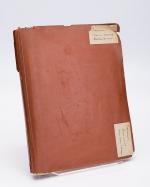
Les Temps Modernes [Modern Times]. Revue Mensuelle. 88 (eightyeight) Issues / Volumes of this important Periodical / [Lot de 88 numéros: 2e année – No. 13 (Octobre 1946) – 11e année – No. 125 (Juin 1956)]. The collection includes reviews / critique of famous essays like Simone de Beauvoir’s “La Lesbienne” and Jean-Paul Sartre’s “La mort dans l’ame” and “Le Diable et le Bon Dieu” / Werner Krauss – “Un Allemand a Paris / Enno Kind – La Resistance allemande etc. The collection includes: Year 1947: 2e année, No.13 / 2e année, No.14 / 2e année, No.22 / 2e année, No.23/24 / 2e année, No.25 / 3e année, No.26 / 3e année, No. 27 / Year 1948: 3e année, No.28 / 3e année, No.29 / 3e année, No. 30 / 3e année, No.31 / 3e année, No.32 / 3e année, No.33 / 3e année, No.34 / 3e année, No.35 / 3e année, No.36 / 4e année, No.37 / 4e année, No.38 / Year 1949: 4e année, No.39 / 4e année, No.40 / 4e année, No.41 / 4e année, No.42 / 4e année, No.43 / 4e année, No.44 / 5e année, No.45 / 5e année, No.46-47 / 5e année, No.48 / 5e année, No.49 / 5e année, No.50 / Year 1950: 5e année, No.51 / 5e année, No.43 / 5e année, No.54 / 5e année, No.55 / 5e année, No.56 / 6e année, No.57 / 6e année, No.58 / 6e année, No.59 / 6e année, No.60 / Year 1951: 6e année, No.63 / 6e année, No.64 / 6e année, No.65 / 6e année, No.66 / 6e année, No.67 / 6e année, No.68 / 7e année, No.69 / 7e année, No.70 / 7e année, No.71 / 7e année, No.72 / 7e année, No.73 / 7e année, No.74 / Year 1952: 7e année, No.75 / 7e année, No.76 / 7e année, No.77 / 7e année, No.79 / 7e année, No.80 / 8e année, No.81 / 8e année, No.82 / 8e année, No.83 / 8e année, No.84-85 / 8e année, No.86 / Year 1953: 8e année, No.87 / 8e année, No.88 / 8e année, No.89 / 8e année, No.90 / 8e année, No.91 / 9e année, No.92 / 9e année, No.93-94 / 9e année, No.95 / Year 1954: 9e année, No.99 / 9e année, No.100 / 9e année, No.101 / 9e année, No.102 / 9e année, No.103 / 10e année, No.104 / 10e année, No.105 / 10e année, No.106 / 10e année, No.107 / 10e année, No.108 / Year 1955: 10e année, No.109 / 10e année, No.110 / 10e année, No.111 / 10e année, No.112-113 (Numero Special: “La Gauche” – avec Simone de Beauvoir, Victor Leduc, Maurice Duverger, Claude Lanzmann, Jean T. Desant etc. etc.) / 10e année, No.114-115 / Year 1956: 11e année, No.121 / 11e année, No.122 / 11e année, No.123 / 11e année, No.124 / 11e année, No.125 //

Paris, Les Temp Modernes [Gallimard (1945-1948) / Julliard (1949-1965), 1946 -1956. Octavo. Original Softcover / Broche Originale. Some of the issues with condition-problems but in general in good to very good condition with some of the issues having frayed and detached wrappers. Only one frontwrapper with titles missing. A very rare run of 88 issues of this rare periodical. 88 Issues with interruptions in between.

EUR 1.000,-- 

Show details   Add to cart

Collection of Five (5) Manuscript Letters from Greek-American Philosopher, Raphael Demos

235. [Aiken, Henry David] Demos, Raphael.

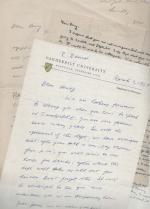
Collection of Five (5) Manuscript Letters from Greek-American Philosopher, Raphael Demos to Philosopher Henry David Aiken. Besides very few personal matters (Aiken rented a Lice-infested house from Demos), the letters are lengthy and full of content regarding philosophical questions. Demos thanks Aiken for his “thoughtful comments about my article on ‘Society and the Individual’ and Demos reflects on Aiken: “Now as to your point that goodwill is addressed to me which is capable of joys and sorrows and not just an angel – I will distinguish between respect and goodwill. Angels, because rational, have intrinsic worth, and so claim respect certainly. Value and respectability don’t imply capacity for feeling. But goodwill does imply that the recipient is a striving, failing, succeeding, up-ended individual, who has sorrows & grip – not just an angelic being. While the Greek identify man with his rationality, it is noticeable that common sense proceeds otherwise; when the Radcliffe girls say their Professor is so human, they don’t mean he is intellectual, they mean the opposite – that he has non-rational impulses and feelings…..” / The collection of letters originates from the personal collection of Henry Aiken and also comes with a scathing letter from American Philosopher Arthur Edward Murphy in which Murphy writes to Aiken about Raphael Demos and does not hold back in his evaluation of Demos and his Philosophy: “I just saw your remarks re Demos in the Journal. Very well done ! I think Demos is not very bright, however, and it is perhaps better not to give him too much publicity. I don’t think he will convert any one except for those already suffering from dithers & blithers. And it is a waste to refute him. Intelligent people don’t have to be convinced. And bigots like R.D. can’t be convinced. Strictly speaking, before Demos creates an obligation in others… he ought to say in plain unemotional prose what he means by such concepts as ‘God’ & ‘evidence’. It is perfectly possible that if we knew how he uses these terms, we would agree that what he says is trivially true. This discussion is presumably in the domain of logic. But discussion on that domain when one of the parties refuses to make explicit the rules of his game can never terminate in illumination. Nevertheless, I think you handled him neatly & have done yourself no harm as general opinion is concerned. He is a perfect horrible example of retrogression. Ugh ! A perfectly low grade person morally & intellectually nonregarding as a seer & defender of orthodoxy…… Have you seen Lazerowitz’s [Morris Lazerowitz] paper in Mind on Universals. It is highly provocative. I would like to discuss it with you….”.

Westport Point (Massachusetts), c.1944 – 1967. Octavo. 13 pages of letters by Raphael Demos to Aiken / [Plus:] 1 page of a manuscript letter by Arthur Edward Murphy to Aiken about Demos. Very good condition with only minor signs of wear. Original Letters or anything published by Raphael Demos or Arthur Edward Murphy, are very rare !

Show details

Vaihinger, Sammlung bedeutender Ausgaben des Philosophen Hans Vaihinger

237. Vaihinger, Hans / Bode, Wilhelm / Vlach, Milo.

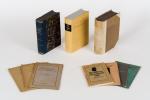
Sammlung bedeutender Ausgaben des Philosophen Hans Vaihinger mit signierten Widmungsexemplaren an den Wiener Philosophen und Vaihinger-Spezialisten Milo Vlach, Kunsthistoriker Wilhelm Bode, signierte Sonderdrucke, ein signierter Brief / (mit zwei Dubletten). Die Sammlung enthält die erste und dritte Auflage seines Hauptwerks sowie einen Neudruck der 9./10. Auflage von 1927: 1. Die Philosophie des Als Ob. System der theoretischen, praktischen und religiösen Fiktionen der Menschheit auf Grund eines idealistischen Positivismus. Mit einem Anhang über Kant und Nietzsche. Erste Ausgabe. XXXV,804 Seiten. Berlin, 1911. Blaues Halbleinen. / 2. Die Philosophie des Als Ob. Dritte, durchgesehene Auflage. XXXIX, 804 Seiten. Leipzig, Felix Meiner, 1918. Dekoratives Halbpergament / 3. Die Philosophie des Als Ob. Neudruck der 9./10. Auflage, 1927 (1986 Scientia). Gelbes Leinen. / 4. Der Atheismusstreit gegn die Philosophie des Als Ob und das Kantische System. Berlin, 1916. Widmung: “Überreicht vom Verfasser” / 5. Der Atheismusstreit gegn die Philosophie des Als Ob und das Kantische System. Berlin, 1916. Signiert: “Primum vivere deinde philosophari – Halle, d. 1.Juli 1921 – Vaihinger” / 6. Pessimismus und Optimismus vom Kantschen Standpunkt aus. Berlin, 1924. Widmung: “Überreicht vom Verfasser” / 7. Wie Kant beinahe geheiratet hätte – Kulturhistorische Novelle von August Stricker. Mit einem Vorwort neu herausgegeben von Hans Vaihinger. Leipzig, 1924. Widmung: “Herrn Dr.Milo Vlach in Wien mit den herzlichsten Grüssen – Halle a/S. im Jan.25 – Vaihinger” / 8. Nietzsche als Philosoph. Feldausgabe. Berlin, 1916 – Widmung: “Herrn Doktorand Miloslav Vlach in Wien mit freundlichem Gruss von H. Vaihinger” / 9. Ist die Philosophie des Als Ob Skeptizismus ? – Widmung: “Freundlichen Gruss, heute, am 100.Geburtstag von Friedrich Albert Lange, dem Vorkämpfer religiöser Selbstbehauptung – Halle, 28.IX.28 – Vaihinger” / 10. Ist die Philosophie des Als Ob Skeptizismus ? – Widmung: “Überreicht vom Verfasser” / 11. Wie die Philosophie des Als Ob entstand. Leipzig, Felix Meiner, 1921. Widmung: “Herrn Dr.Wilhelm Bode in Weimar, dem echten Vertreter der Lebenskunst Goethes, des Vorkämpfers für die ästhetische Illusionstheorie und für den religiösen Symbolismus. Zum 30. März 1922 – Vaihinger” / 12. Nietzsche als Philosoph. Langensalza, 1930. Widmung: “Herrn und Frau Obersekretär Barkhaus mit herzlichen Weihnachtswünschen, überreicht von H. Vaihinger – Halle a/S. im Dezember 1930.” / 13. Zweiseitiger Brief (Schreibmaschine) auf Vaihingers persönlichem Briefpapier, datiert Hale, 16.Dezember 1925. An einen “Herrn Stifts-Repetent Kraus” [Repetent an Vaihingers alter Schule – dem Evangelischen Stift in Tübingen.] Kraus hatte wohl eine philosophische Arbeitsgruppe von sieben Schülern und Vaihinger’s “Philosophie des Als Ob” muss Gegenstand der Arbeitsgruppe gewesen sein und Kraus hat aus diesem Grund mit Vaihinger kontakt aufgenommen. In der ausführlichen Art Vaihingers erwähnt dieser in seiner Antwort an Kraus den Einfluss von Otto Ritschl auf die Entstehung der “Philosophie des Als Ob”, er erwähnt auch Wobbermin in Göttingen und schreibt weiterhin: “als ehemaliger Stiftler betrachte ich es als eine Ehre, wenn im Stifte auch die “Philosophie des Als Ob” dadurch Anerkennung findet, dass man sich dort mit den von mir aufgeworfenen Theorien beschäftigt”.

Leipzig / Berlin / Halle etc., 1911 – 1930. Octavo. c. 2000 Seiten. Hardcover / Softcover. Die Sammlung generell in sehr gutem Zustand mit diesen Ausnahmen: Kleiner Wasserschaden an “Ist die Philosophie des Als Ob Skeptizismus ?” und “Pessimismus und Optimismus”. Eine Ausgabe des “Atheismusstreits” Papier etwas brüchig. / Anstreichungen und Anmerkungen in der Erstausgabe der “Philosophie des Als Ob”. Vorsatzblatt der Halbpergamentausgabe fehlt. Eine seltene Sammlung !!

EUR 1.800,-- 

Show details   Add to cart

Adorno / Horkheimer / Haag - Wichtige Sammlung von bedeutenden Arbeitsexexemplaren / Widmungsexemplaren / Autorenexemplaren der Frankfurter Schule

240. [Adorno, Theodor W. / Horkheimer, Max / Benjamin, Walter] Haag, Karl-Heinz / Schweppenhäuser, Prof. Dr. Hermann.

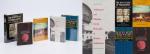
Wichtige Frankfurter Schule-Sammlung von sehr bedeutenden Arbeitsexemplaren / Widmungsexemplaren / Autorenexemplaren, Autographen und Manuskript-Notiz-Zetteln des deutschen Philosophen Karl-Heinz Haag. Die Arbeitsexemplare (Sieben Buchtitel in neun (9) Bänden) und handschriftlichen Notizen und Autographen (Postkarten), stammen aus der privaten Bibliothek des Adorno und Horkheimer- Schülers, Karl-Heinz Haag. Die in der Sammlung enthaltenen Manuskript-Notizen und Autographen (Postkarten von Horkheimer) sind inhaltsreich und teilweise auch deshalb sehr bedeutend, weil es unter Insidern bekannt ist, dass Haag auch während seiner aktiven Zeit innerhalb der Frankfurter Schule notorisch wenig veröffentlicht und schriftlich kommentiert hat. Beiliegt ausserdem ein Zeitungsausschnitt zur Adorno-Lehrstuhl-Nachfolge. / Important, stunning collection of seven, signed or/and annotated association-copies (working-copies) from the private library of german philosopher Karl-Heinz Haag. Haag was pupil, friend and colleague of Adorno and Horkheimer and was one of the members of the Frankfurt School of Social Theory and Social Research. The collection of annotated books (Seven Booktitles in nine (9) volumes) also includes ephemera (Autograph postcards, newspaper-clipping, as well as several manuscript – pages of significant notes and thoughts by Karl-Heinz Haag regarding topics discussed in some of these publications). The collection is especially important because Haag published and commented notoriously little during and after his tenure in Frankfurt. [See complete set of photographs of this collection on our website].

Frankfurt u.a., Suhrkamp / Institute of Social Research / Kohlhammer etc., 1955 – 1972. Octavo. Paginierung / Collation: 1. Adorno – Aspekte der Hegelschen Philosophie (Inscribed, signed): 59 Seiten mit zahlreichen Annotationen /59 pages, heavily annotated / 2. Haag – Kritik der neueren Ontologie (Author’s copy): 59 Seiten / 59 pages / 3. Adorno – Drei Studien zu Hegel (Inscribed, signed): 172 Seiten mit zahlreichen Annotationen / 172 pages with annotations / 4. Horkheimer – Zur Kritik der instrumentellen Vernunft (Inscribed, signed): 353 Seiten mit vielen Anmerkungen und Anstreichungen / 353 pages, heavily annotated / 5. Horkheimer – Kritische Theorie (Inscribed, signed): XIV, 376, XI, 358 Seiten mit zahlreichen Anmerkungen und Anstreichungen / XIV, 376, XI, 358 pages, heavily annotated / 6. Schweppenhäuser – Tractanda (Inscribed, signed): 141 Seiten / 141 pages. Original Softcover and Hardcover – Volumes. Sehr guter Erhaltungszustand aller Publikationen mit teilweise eingelegten, handschriftlichen Notizen sowie ein alter Zeitungsartikel in dem der Zersetzungsprozess der Frankfurter Schule kommentiert wird. / All publications in very good condition with minor signs of wear. Amazing provenance and possibly one of the last important collections surfacing from the library of a member of the Frankfurt School. The inter-connection between Adorno – Haag – Horkheimer, reflected in Haag’s annotations, lends itself for study and new publications of criticism.

EUR 3.800,-- 

Show details   Add to cart

Page: 1 2 ... 21 22 23 24 25
: