Provenance (28 items)

Cordus, Euricius - Botanologicon / Brasavola, Antonio Musa - Examen omnium simplicium medicamentorum

3. Cordus, Euricius / Brasavola, Antonio Musa / [Hieronymus Schreiber / Jerôme Schreiber]

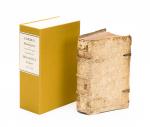
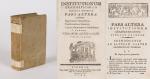
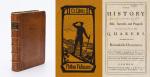
Botanologicon (Euricii Cordi Simesusii Medici Botanologicon) – Angebunden / Bound with: Antonio Musa Brasavola – Examen omnium simplicium medicamentorum, quorum in officinis usus est. Addita sunt Insuper Aristotelis problemata, quae ad stirpium genus, & oleracea pertinent.

Cologne (Köln) / Leyden (Lyon), Johann Gymnicus (Gymnich) / Johannes and Franciscus Frellon, 1534 / 1537. Octavo. Collation complete: I. Euricius Cordus – Botanologicon: Title with the woodcut device of Cologne-printer Johann Gymnicus, including his Motto, the first line of a Verse from the Aeneid by Virgil ‘Discite Iustitiam Moniti’, 183, [21] pp., 2 blank leaves. The titlepage of the Botanologicon bears the manuscript ownership-entry of Nuremberg’s Astronomer, Philosopher and Mathematician Hieronymus Schreiber [also called Jerôme Schreiber], student-friend of Euricius Cordus’ son Valerius Cordus in Wittenberg and later trustee of Valerius Cordus’ scholarly estate after Valerius Cordus’ premature death in Rome. Dated in the same hand on the titlepage also the entry ‘Anno 1539’, when Valerius Cordus matriculated at Wittenberg and Schreiber already had studied there since May 1532. With several contemporary manuscript annotations throughout both titles (the Botanologicon and Examen) / II. A. M. Brasavola – Examen omnium simplicium medicamentorum: Title, [1], [‘Reverendissimo to Ioannes Argenterius’, 4 pp.], [‘Ad Illustris & Sereniss. (‘Epistola Nuncupatoria’) to the Duces of Ferrara’ 17 pp.], [Epigramma, 1 p.], [Examen & Aristotelis Problemata 542 pages, [Dedication to Franciscus Frellaeus, 2 pp.], [Index copiosissimus in Examen Omnium, 13 pp.], [1]. With several manuscript annotations. Original, contemporary blind-stamped pigskin over wooden boards with some stronger signs of running to the corners, with partially bevelled edges and both of the original metal clasps intact. Very good condition with only minor signs of external wear. Title in ink to upper spine and also to top of fore-edge. Very few pressed plants loosely inserted. Interior in excellent condition with some minor staining to very few pages only.

EUR 48.000,-- 

Show details   Add to cart

Montague / Dorgan - Typescript Draft MS for a book of poetry by Theo Dorgan. With occasional manuscript corrections

11. [John Montague Collection] – [Montague, John] Dorgan, Theo.

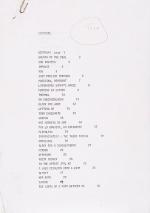
Typescript Draft MS for a book of poetry by Theo Dorgan. With occasional manuscript corrections / suggestions / annotations by Dorgan’s early mentor John Montague, the Typescript MS was held among the private papers of John Montague in his West Cork Home. The typescript includes poems like “Closed Circuit”, “The Promised Garden”. Montague is approving several of the poems by simply applying a tick. John Montague made suggestions in pencil on the structure of “Elegy for a Schoolfriend” and more in depth-suggestions on “Nasty Archer”, “Her Body”,″The Width of a Room Between Us”, “Return”, “Reconciliation”, “Sunday Afternoon”. When asked about helping to date this early draft of his poetry, Theo Dorgan immediately gets back to us and he places it from memory into the early 1980’s. Theo Dorgan was surprised and seemingly chuffed that John Montague held on to this Manuscript and he recalls: “These poems, some in revised versions, make up the backbone of my first published collection, ‘The Ordinary House of Love’.” Dorgan continues: “I’m happy to say that most of them survived Montague’s eagle eye, which was of course a great comfort to me at the time. Still is!” Some of these poems selected had previously been published as broadsheets etc. but the skeleton of the Draft hints already at readying it for publication. Theo Dorgan graciously gives us even more information: “Some of the poems in the eventual book go back to when I was a student, others were definitely written in the second half of the 80s. The bulk of it, however, is in this MS. I base my estimation in part on the fact that what you have is a typescript produced, it appears, on the IBM golfball machine that was the pride and joy of Triskel Arts Centre. That machine was bought in 1980 or 1981, I’m fairly sure of that. I was Literature Officer there, then.” Theo Dorgan was part of John Montague’s circle of mentored poets, even though in an email-exchange with him about this typescript he mentions that “John Montague worked far more with Thomas McCarthy, Maurice Riordan and Gregory O’Donoghue than he did with me, and in many ways Gregory O’Donoghue was at that stage the most accomplished of us all – the only one included in JM’s Faber Book.” What followed then in our conversation with Theo Dorgan is a great example why manuscripts, letters, autographs, typescripts and the connections we often make with documents from the past have such meaning in explaining our emotional ties with people who matter to us on our way of forming personality. They are memories transforming into images, floods of empathy and nostalgia for personal moments lost but treasured because they helped us form our values. Presented with the old typescript, Theo Dorgan’s emotionality is tangible and he confesses more in an internal dialogue with himself and John Montague than with us: “I’m sorry to say that the reason John Montague worked with those others more than he did with me is because, in my shameful, youthful arrogance, I much preferred to trust my own judgement, and also, I suspect, because I was closest to John in temperament and feared coming unduly under his influence. That said, there was no-one whose good opinion of a poem I valued more, and we were close all our lives after. Very likely it was a case of old stag/young stag ! Montague taught us by indirection, he made his extensive library of modern and contemporary poetry available to us without stint, would wait for us to find an affinity (as, e.g. mine with Robert Graves and Galway Kinnell) and would then, in a long, ongoing conversation, help us to understand what it might mean for our own poems that we felt such affinities. A guided companionship in reading and making, if you will.″

Ireland, c.1981-1982. A4. 43 pages typescripts. Paperclipped. Very good condition with only minor signs of external wear. Some fingerstaining and residue of rust from the paperclip. Wonderful and extremely valuable document of not only a collaboration between two of Ireland’s landmark writers but moreover witness to the becoming, the birth of a true poet. Also included (from a different source) is a second printing of the first edition of the subsequent publication “The Ordinary House of Love” – signed by Theo Dorgan. Right at the beginning of the printed version, instead of a dedication to John Montague, Theo Dorgan placed a quote from Montague’s poem “Wine Dark Sea”: ‘For there is no sea / it is all a dream there is no sea / except in the tangle / of our minds; / the wine dark / sea of history on which we all turn / turn and thresh / and disappear.’ (Collected Poems, page 255). Provenance of the annotated typescript: From the private collection of John Montague’s papers in his recently sold West Cork Home.


Show details

Provenance: From the personal library of Adrian Liddell Hart / Collection of 28 Volumes of John Lehmann's "New Writing", some bearing the name of Adrian Liddell Hart

13. [Lehmann, John] / [Liddell Hart, Adrian] / [Harold Acton] / [Manuscript Postcards from Lehmann to Liddell Hart].

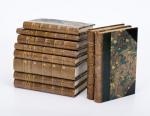
Provenance: From the personal library of Adrian Liddell Hart / Collection of three personal autograph/manuscript-postcards from John Lehmann to Adrian Liddell Hart, together with 28 Volumes of John Lehmann’s “New Writing”, some bearing the name of Adrian Liddell Hart, including Volume I (includes George Orwell’s “Shooting an Elephant” in second edition). Besides the 28 Volumes of Lehmann’s “New Writing”, the collection also includes: 1. John Lehmann’s personal copy of Sean O’Faolain’s “Vive Moi!” – An Autobiography (First Edition, London, Rupert Hart-Davies, 1965), with John Lehmann’s name on the front free endpaper and some markings in the text. / 2. John Lehmann – Pleasures of New Writing – An Anthology of Poems, Stories and other Prose Pieces from the pages of NEW WRITING. Edited by John Lehmann. (First Edition, London, John Lehmann, 1952). [Even though this Volume is also from Liddell Hart’s library, it bears a different name of a pre-owner on the half-title].

Mixed Editions. 30 Volumes. London, John Lehmann / Allen Lane – Penguin Books / Rupert Hart-Davis, 1940-1965. Octavo. [The Postcards written from Venice, Florence and Santa Barbarabetween the years 1952 and 1977 / Postcard I: From John Lehmann in Venice to Adrian Liddell Hart: “This city does not boast a supply of the “Sunday Dispatch”, and as the writer was gripped and enthralled by the last installment on June 1st, he hopes you will keep copies of the …for him to read on his return in ten Days time – J.” / Postcard II: From John Lehmann in Florence to Adrian Liddell Hart: “Am staying with [Sir] Harold Acton here in his marvellous Villa – calme luxe [″Villa La Pietra”], all night……pity, you aren’t with me. Off to the sea this afternoon – may post this in Porto Ercole. Your old friend is relaxing. Gracefully – Love J.” [Date hard to decipher, possibly in 1962] / 3. Postcard III: From John Lehmann in Santa Barbara in California to Adrian Liddell Hart: “Terribly sorry to hear about the broken leg, may it mend quickly, as surely it must undo the ministrations of Florence …..Nightingale. I expect to be in England all March, but then off again – to Jimmy Carter Country – Love J.” [20.2.77]. Hardcover and Softcover. Of the series of 28 Volumes of the “New Writing ″ Series, only three with stronger signs of wear and in poorer condition. All others in very good condition with only minor signs of wear. Lehmann’s personal copy of Sean O’Faolain’s Autobiography with the original dustjacket in poor condition but the Volume itself very good.

EUR 1.480,-- 

Show details   Add to cart

Provenance: From the personal library of Adrian Liddell Hart / Collection of books on Military History, Strategy

15. [Liddell Hart, Adrian] / [Liddell Hart, Basil H.].

Provenance: From the personal library of Adrian Liddell Hart / Collection of thirteen (13) books on Military History, Strategy and two of his father’s, Sir Basil Liddell Hart, publications. Most of the books with the bookplate of Sir Basil Liddell Hart but with the name of Adrian written to the endpaper. The collection includes: 1. John Strachey – On The Prevention of War (1962) / 2. Lawrence Freedman – The Evolution of Nuclear Strategy (1982) / 3. Edward Mead Earle – Makers of Modern Strategy – Military Thought from Machiavelli to Hitler – Edited by Edward Mead Earle with the collaboration of Gordon A.Craig and Felix Gilbert (1966) / 4. B.H.Liddell Hart – History of the First World War (Reprint London, 1979) / 5. B.H.Liddell Hart – Why don’t we learn from History ? (First American Edition, New York, 1971) / 6. Hugh Thomas – The Spanish Civil War – (Third Edition, Penguin Books, 1977) / 7. Robin Lane Fox – Alexander The Great (Futura, 1975) / 8. Arturo Barea – The Track – It became a battlefield, there where they built the road across Morocco (Four Square Books, 1958) / 9. Steven Runciman – The Fall of Constantinople 1453 (Cambridge University Press, 1969) / 10. Geoffrey Rawson – Nelson Letters (Dent & Sons, 1971) / 11. Christopher Duffy – Borodino – Napoleon Against Russia, 1812 (Sphere Books, 1972) / 12. R.L.V.ffrench Blake – The Crimean War – Concise Campaigns (Sphere Books, 1973) / 13.Pieter Geyl – Napoleon: For and Against (Penguin Books, 1965) //

Mixed Editions. 30 Volumes. London, John Lehmann / Allen Lane – Penguin Books / Rupert Hart-Davis, 1940-1965. Octavo. [The Postcards written from Venice, Florence and Santa Barbarabetween the years 1952 and 1977 / Postcard I: From John Lehmann in Venice to Adrian Liddell Hart: “This city does not boast a supply of the “Sunday Dispatch”, and as the writer was gripped and enthralled by the last installment on June 1st, he hopes you will keep copies of the …for him to read on his return in ten Days time – J.” / Postcard II: From John Lehmann in Florence to Adrian Liddell Hart: “Am staying with [Sir] Harold Acton here in his marvellous Villa – calme luxe [″Villa La Pietra”], all night……pity, you aren’t with me. Off to the sea this afternoon – may post this in Porto Ercole. Your old friend is relaxing. Gracefully – Love J.” [Date hard to decipher, possibly in 1962] / 3. Postcard III: From John Lehmann in Santa Barbara in California to Adrian Liddell Hart: “Terribly sorry to hear about the broken leg, may it mend quickly, as surely it must undo the ministrations of Florence …..Nightingale. I expect to be in England all March, but then off again – to Jimmy Carter Country – Love J.” [20.2.77]. Hardcover and Softcover. Of the series of 28 Volumes of the “New Writing ″ Series, only three with stronger signs of wear and in poorer condition. All others in very good condition with only minor signs of wear. Lehmann’s personal copy of Sean O’Faolain’s Autobiography with the original dustjacket in poor condition but the Volume itself very good.

EUR 480,-- 

Show details   Add to cart

Thomas Mann, Collection of important publications by Thomas Mann in the swedish language

17. Mann, Thomas / [Provenance: Falk Simon (Collector)].

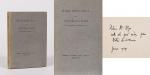
Collection of nine (9) important publications by Thomas Mann in the swedish language. All editions in this collection are Translations from german into the swedish language, done by eminent swedish poets, writers and translators like Anders Oesterling (Österling), Anna Lamberg Wahlin and Walborg Hedberg. The collection has been beautifully rebound for swedish Bibliophile and Collector of antique Silver, “Falk Simon”, and most of the original wrappers and artwork to wrappers, has been preserved. The Exlibris of “Falk Simon” is to be found in each Volume (except “Buddenbrooks”, which has only one Exlibris) / Included are: 1. “Lille Herr Friedemann” – Stockholm, Billows, 1929. Översättning av J.G.S. / 2. “Huset Buddenbrook” – Historien om en Familjs Förfall I-II. Första Delen & Andra Delen. (Bonniers, 1937) – Översättning av Walborg Hedberg. / 3. “Underbarnet” – Översättning fran Tyskan av Karin Allardt (Stockholm, Bonniers, 1920) [Includes: Underbarnet / Tunga Timmar / Hos Profeten / En skimrande episod / Huru Jappe och Do Escobar pryglade upp varandra / Besvikelse / Tobias Mindernickel] / 4. Tonio Kröger – Översättning av Walborg Hedberg (Stockholm, Wahlstroem & Widstrand, 1922) / 5. Hans Kunglig Höghet – Översättning av Walborg Hedberg (Stockholm, Bonniers, 1910) – Name of preowner “Alfhild Söderlund – 1911” on titlepage / 6. Ockulta Upplevelser – Översättning av Anna Lamberg Wahlin / 7. Mario och Trollkarlen – Tre Noveller av Thomas Mann – Till Svenska af Anna Lamberg Wahlin (Stockholm, Bonniers, 1930) / 8. Lotte i Weimar – Roman – Översättning av Nils Holmberg (Stockholm, Bonniers, 1946) / 9. De Ombytta Huvudena – En Indisk Legend – Översättning av Anders Österling /

Stockholm,, Bonniers and others, 1910 – 1946. Octavo. More than 1800 pages. Hardcover / Decorative half leather with marbled-paper-covered-boards. With Exlibris of Falk Simon. Overall in excellent condition with some minor signs of wear only. Rare set !

EUR 1.000,-- 

Show details   Add to cart

Meister, Ausstellung - Gedichte von Ernst Meister [Originalausgabe

19. Meister, Ernst.

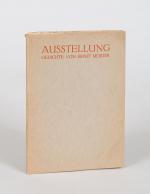
Ausstellung – Gedichte von Ernst Meister [Originalausgabe / wahrscheinlich das originale Korrekturexemplar des Autors oder Verlags].

Erste Ausgabe. Marburg, Verlag Marburger Flugblätter, 1932. Oktav. 64 Seiten. Original Softcover (cremefarbene Englisch-Broschur mit roter Betitelung). Der Buchblock minimal von der Broschur gelöst. Sonst in sehr gutem Zustand, mit Merkmalen eines Korrekturexemplars: Der obere Schnitt etwas uneben, einige Seiten mit handschriftlicher, zusätzlicher Numerierung (und auch Anmerkung) die eine andere Paginierungsfolge oder Reihenfolge der Gedichte suggeriert. Einige Textstellen mit handschriftlicher Änderung einzelner Buchstaben. Kurze Widmung auf dem Vorsatzblatt: “f. Ulla” (nicht verifizierbar ob von Meister). Das Gedicht “Der Gebückte” mit einer handschriftlichen Anmerkung die eine eventuelle, dreimalige Wiederholung des ersten Teiles (‘Er geht’) mit zwei Fragezeichen erwägt. Sehr seltene, erste Veröffentlichung von Ernst Meister. Der Fund dieser Ausgabe ist eine kleine Sensation da Ernst Meister die Auflage persönlich vernichtete nachdem der Verlag Ihm die Bücher zurückgesendet hatte. Seine Ehefrau Else Meister rettete, laut einigen Quellen, nur einige wenige Exemplare aus der Mülltonne. / Als Zugabe zu der Ausgabe liegt dem Band eine Sammlung von sehr seltenen “Mitteilung[en] für Freunde” bei. Ernst Meister hat diese “Im Handsatz als Manuskript gedruckt”. Beiliegen No.2 – 6 der Mitteilungen”. Diese sind signiert mit dem Namenszug “Ernst Meister” versehen und der Jahreszahl der Herausgabe auf der Titelbroschur.

EUR 2.500,-- 

Show details   Add to cart

Page: 1 2
: