Complete Catalog (8586 items)

Walter Benjamin, "L'Œuvre d'art à l'époque de sa reproduction mécanisée"

31. [Benjamin, Walter].

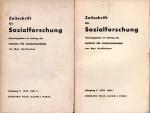
“L’Oeuvre d’art à l’époque de sa reproduction mécanisée” [First Edition of “The Work of Art in the Age of Mechanical Reproduction”, surely the most important work on cultural criticism ever written and here available in its first printing within Volume I of Jahrgang V, 1936 [Annual V, 1936] of the “Zeitschrift fuer Sozialforschung”]. All three Volumes of the very rare “Jahrgang V” are present with one Volume bearing the name of Walter Benjamin’s friend Alfred Sohn-Rethel on the cover]. This most spectacular provenance is not the only surprise but the 1936-set of “Jahrgang V” came to us as part of a nearly complete set of the Zeitschrift fuer Sozialforschung [24 Issues printed in 22 Issues with only three issues missing (Jahrgang I, Heft 1 und Heft 2 und Jahrgang IX, Heft 1)] and the Periodical does not only include all the Volumes with Benjamin’s Essays but one of the issues is actually an original “File Copy” of the “Institute for Research in Social Science” and one issue is stamped “New School Library – Aug 26 1940” and another from the “William Graham Sumner Club at the Sociology Department / Yale University”.

First Edition. Paris, Librairie Félix Alcan, 1936. Octavo. Softcover / Original Publisher’s wrappers. The Volume which includes the First Edition of “The Work of Art in the Age of Mechanical Reproduction” in stunning condition. Three Volumes with stronger signs of wear and all other Volumes in good, very good+ or even better condition. Fantastic provenance also of the Issue 3 of Jahrgang V in 1936 which bears Alfred Sohn-Rethel’s name. Sohn-Rethel’s possession of this issue is not only plausible but reflects all the developments known in critical writings of the Frankfurt School and is the exact time in which he tried, through his friendship with Adorno, to find a philosophical home within the Institute for Social Research. An endeavour which eventually failed through the intervention of Horkheimer but this would not have stopped him to follow the path of the Institute in Exile and its seminal Periodical. We can NOT determine if the other issues belonged to Sohn-Rethel as well. [More images on request].

EUR 16.800,-- 

Show details   Add to cart

[West Highland Line] / [Scottish Railway Line Glasgow to Mallaig]

32. [West Highland Line] / [Scottish Railway Line Glasgow to Mallaig] / [Rathad Iarainn nan Eilean – “Iron Road to the Isles”]

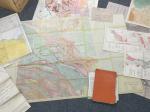
Massive Photographic Documentation of The Western Highland Line [Glasgow to Mallaig] in 900 [ninehundred] vintage Photographs, taken over a period of 30 Years by a Railway and Nature-Explorer and placed in four massive XXL Folders with extensive, beautiful and detaild annotations and explanations. The photographs range from smaller formats (10 cm wide x 15.2 cm high) to a huge amount of Extra-Large Vintage Photographs (39.2 cm wide x 29.4 cm high) and many even measure 40 cm x33 cm, filling entire leaves. Many of the photographs are impeccably applied inside these High-End-Archival-Folders with often numerous captions in the handwriting of the Photographer / Highland Explorer. An inexplicably stunning and absolutely unique documentation of the scottish landscape along the West Highland Line between the years 1974 – 2002. The images document Scottish rivers, Lochs and Roads, Mountains and Hills alongside the Railway-Lines but landscapes are also often shown without the Railway present. Besides the nature we also find photographs of architectural features like overpasses or industrial buildings and railway-track-imagery masterfully photographe, bordering on the abilities of a New Objectivity – photographer like Albert Renger-Patzsch. An important, maybe even singular photographic Impact-study of Railway to the Scottish Highlands. The anonymous photographer has injected himself occasionally in the images, beautifully showing his pitched tent and motorcycle in order let the viewer understand the dedication his travels have cost him. The masterful photographer also showcases his love for detail and artistry by ever so often partially and sparsely coloring Railway-Waggons or Locomotives within his black-and-white-photography, highlighting the technology in the vulnerable landscape, giving the whole collection an artistic and critical component of focusing the viewer on the object of his desire, yet contrasting how lost even a magnificent Locomotive and its carriages seems when vanishing in front of the majestic scottish landscape. The documentation is meticulous, often allowing for multiple vintage photographs on one page showing the same location during different times, exhausting all questions of functionality of the Railway opposed to the landscape with or without Railway in the shots. For the conservation-movement of the Scottish Highlands this collection is an unbelievable chance to preserve the memory of this landmark Railway-Line, connecting the extreme remote with the urban. For those who research the scottish landscape this is a unique opportunity to acquire the life’s work of one man’s obsession with “Railway and Landscape” in the Scottish Highland.

Scotland, 1974-2002. Oblong-Folio (44 cm wide x 36 cm high). Hardcover / Original Full-Leather Folders with stong, black cardboards and original tissue-guards. Excellent condition with only minor signs of wear. With hundreds of manuscript annotations on the photography, the photography-technique, film used and with extensive elaborations on each photograph in these albums. More images on request !

EUR 12.800,-- 

Show details   Add to cart

[Tey, Josephine Tey - John Gielgud Collection of stunning Association copies

33. [Tey, Josephine / Daviot, Gordon] / [Gielgud, John].

Josephine Tey – John Gielgud Collection of stunning Association copies of Plays which crucially defined both of their careers as writers and actors. The collection includes important, signed and inscribed association – copies of the two significant productions “Richard of Bordeaux” and “Queen of Scots”, both from John Gielgud’s personal library and with manuscript inscriptions to John Gielgud [and Laurence [Larry] Olivier] by Josephine Tey, aka Gordon Daviot, aka Elizabeth MacKintosh. The collection includes: 1. Gordon Daviot [Josephine Tey] – “Richard of Bordeaux – A Play in Two Acts” – With John Gielgud’s Bookplate (Ex Libris). The ultimate Association-copy, warmly and lengthy inscribed by Josephine Tey to John Gielgud. First Edition. London, Victor Gollancz, 1933 / 2. “Richard of Bordeaux” – Original Programme of “The Streatham Hill Theatre”, 1934. Signed by John Gielgud / 3. Gordon Daviot [Josephine Tey] – “Richard of Bordeaux” – Original File-copy with dustjacket and Publisher’s wrapper “The Play of the Year” at the New Theatre” – First Edition, 1933 / 4. Gordon Daviot [Josephine Tey] Gordon Daviot – “Richard of Bordeaux – A Play in Two Acts” – [Fifth Edition, 1933] – Special Cast, Producer and Production-Signed copy and inscribed to one “Eileen Grainger”, with the most interesting dedications in manuscript signatures – Signed and inscribed by lead actor and producer John Gielgud [Richard II], Signed and inscribed by leading Lady, actress Gwen Ffrangcon-Davies, Signed and inscribed by Gordon Daviot [Josephine Tey], Also beautifully signed and inscribed with a musical score by Shakespeare-composer and Musical Director for John Gielgud, Herbert Menges OBE ! / 5. “Queen of Scots – A Play in Three Acts” – The Ultimate Association-copy, inscribed by Josephine Tey to her producer: “John Gielgud – from ‘his Gordon Daviot’ / July 1934” / 6. Gordon Daviot – “Queen of Scots – A Play in Three Acts” – Association-copy, signed and warmly and lengthy inscribed by Josephine Tey to Laurence Olivier / 7. Gordon Daviot [Josephine Tey] – “Richard of Bordeaux” – A Softcover-Version of the Play in Fourth Impression, 1933 / 8. Josephine Tey – “The Daughter of Time” – First Edition, Second Impression (Second Printing). London, Peter Davies, July 1951 [The First Edition was in June 1951]. Original Hardcover with the slightly frayed original dustjacket in Mylar / 9. John Gielgud – “Early Stages” – New and Revised Edition. London, The Falcon Press, 1948. With pages of detail about the work of John Gielgud with Gordon Daviot [Josephine Tey] / 10. Jennifer Morag Henderson – “Josephine Tey – A Life” – With a Foreword by Val McDermid. Sandstone Press, 2015 //

London, Victor Gollancz, 1933 – 1948. Octavo. Hardcover / Original Publisher’s cloth. Very good condition with only minor signs of wear.

EUR 12.800,-- 

Show details   Add to cart

[Cumberbatch, Large Family Archive of the Benwell Rees - Family, including William Benwell Rees

35. [Cumberbatch, Benedict] Cumberbatch, Henry Arnold / Rees, Helen / Basil Benwell Rees / William Benwell Rees / Etheldreda Blanche Barker / [Sir Winston Churchill / Sir Anthony Arthur Duncan Montague Browne [Private Secretary to Sir Winston Churchill]].

Large Family Archive of the Benwell Rees – Family, including William Benwell Rees (brother to actor Benedict Cumberbatch’s grandmother Helen Rees, by marriage to British Diplomat Henry Arnold Cumberbatch, who was Consul in Romania, Turkey and Lebanon ). The archive includes at least one manuscript letter by Henry Arnold Cumberbatch and around one thousand documents chronicling the lives of the ex-patriate Benwell Rees family from 1890-1970 in Alexandria and Monaco, including William Benwell Rees, whose marriage to Etheldreda Blanche Barker cemented the family’s role in the highest circles of Alexandria life. The archive also charts their son Basil Rees’ decade in Monaco under Princess Grace and Prince Rainer III where he served as President of the British Association in the 1950’s-‘60s and solicited a letter written by Sir Anthony Arthur Duncan Montague Browne, on Winston Churchill’s behalf on Chartwell headed paper in which the former Prime Minister declined to attend an event in Monaco [signed by Montague Browne]. The archive is held in five heavy volumes, bursting with a plethora of amazing and wonderful historical letters, ephemera, emotional messages and telegrams, old images, theatre-programmes, and especially also includes programmes of plays in which ancestors of Benedict played (J.M.Barrie, Shakespeare etc.). The original letters and documents paint an interesting picture of Benedict Cumberbatch’s grandmother’s side of the family history in the Levant, their service in the Middle East and their social lives. The five volumes are bound in bespoke red morocco over textured paper-covered-boards and they contain at least one reference to Helen Rees next to a newspaper-clipping and dozens of wonderful handwritten letters and cards. Each volume about four inches across spine with title in gilt to upper cover and around 100 leaves in each with documents mounted recto and verso throughout, with photographs, invitations, business materials and clippings that chart the family’s life in their service for the British Colonial Office. The five Volumes include for example: Volume 1: The Benwell Rees’: begins with Egyptian Gazette, 1890 and a programme for a performance c1900 at the Port Theatre, Marina, Alexandria of Rumpelstilkskin; visiting cards and contemporary reports of the marriage of W B Rees and Etheldreda Blanche Barker in Alexandria, February 1901; Windsor Hotels prospectus and flyer (a WBR enterprise); 1913 Casino de Monte Carlo ticket for Ethel Rees; Kings School Canterbury ephemera and St Johns’ College, Cambridge for Basil Rees from 1920’s, graduated June 1924. Volume 2: The Benwell Rees’ Vol II, 1920’s-1990’s: includes J M Barrie, Quality Street programme for English Girls’ School, Alexandria, 1941; invitations from Princess Grace of Monaco etc Volume 3: Basil Rees Vol III, cover nearly detached, 1953- Basil Rees living at 2 Rue Origene, Alexandria, and covering period of move to Palais Majestic, Monaco after which he served as President of the British Association and his sudden death in 1967. Invitations to dinner and place settings with the Prince and Princess of Monaco. Birthday greetings; international stamp collecting societies. Photographic ‘Permis de Sejour’ for William Benwell Rees in Monaco, October 1918. Volume 4: Basil Rees Vol. IV Begins with telegram from Rees to the Queen; mostly very extensive formal correspondence concerned with Rees’ Presidency of he British Association in Monaco; invitations, notes, printed volume of Statutes of association from 1950, royal correspondence with Monaco and Britain. Volume 5 and 6 (two large Volumes): Basil Rees 4-5-1902 AND Basil Rees 4-5 1902 [William Basil Benwell Rees ; Birth: 4 May 1902. Alexandria, Al Iskandariyah, Egypt ; Death: 10 Feb 1967 (aged 64). Monaco]. Volume I covers the early days of the Alexandria – Period and beautiful ephemera of a Rees-wedding (Miss Elaine Trevitt Briggs to Charles Owen Benwell Rees, social life in Alexandria, Theatre and Dinners etc. as well as the many Freemason – Engagements of the “Alexandria Lodge No.4184” in the year 1942 and also a rare Volume of Bye-Laws for the District Grand Lodge of Egypt and the Sudan Volume II covers William Basil Benwell Rees; Royal Navy ID card, British Forces, September 1943 – other material relating to Rees’ work as Duty Defence Officer at the Royal Navy Defence Base in Alexandria, HMS Nice. Volume begins in 1902 and includes Alexandria Dog Show, W B B Rees at Jesus College, Cambridge; Egypt NAAFI permits; lock of Basil Rees’ hair, aged 2 etc.

Alexandria / Monaco / etc., c. 1902 – 1967. Octavo. Six Volumes with hundreds of pieces of Ephemera, an original Theatre Couplet, photographs, newspaper-clippings, Theatre Programmes etc. Half Morocco. Bindings stronger rubbed and slightly damaged.

EUR 12.800,-- 

Show details   Add to cart

Vere Foster, The Two Duchesses - Presentation copy with important manuscript letter [signed and inscribed]

38. Foster, Vere [Henry Louis / Lewis] / [Georgiana Duchess of Devonshire / Elizabeth, Duchess of Devonshire].

The Two Duchesses – Georgiana, Duchess of Devonshire / Elizabeth, Duchess of Devonshire – Family Correspondence of and Relating to Georgiana, Duchess of Devonshire / Elizabeth, Duchess of Devonshire, Earl of Bristol (Bishop of Derby), The Countess of Bristol, Lord and Lady Byron, The Earl of Aberdeen, Sir Augustus Foster Bart, and Others, 1777-1859. First Edition. With 17 illustrations.

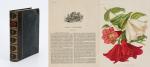
London / Glasgow and Dublin, Blackie & Son Limited, 1898. Octavo (16 cm x 22,5 cm). XII, 497 pages with 16 full-page-illustrations and one small vignette, showing the Two Duchesses in cordial embrace. Hardcover / Original, green publisher’s cloth with gilt lettering and ornament to spine and armorial supralibro to cover with the Motto of the “British chivalric Order of the Garter”: “Honi soit qui mal y pense” [″shame on anyone who thinks evil of it”]. Very good condition with some minor signs of wear only. “Presentation Copy of “The Two Duchesses” with Autograph / Manuscript – Letter by Vere Foster to his niece, Emily Albinia “Alba” Foster. With a stunning, unpublished, two-page manuscript letter, revealing several important details about the immediately favorable reviews and reception of the book “Two Duchesses” [″in the Daily Telegraph”] and Vere Foster’s disdain about some criticism from one J.Donohue [which led to an alteration in the second edition of the book]. Vere Foster is also expecting a review to appear in the “Athenaeum” but reports: “the Athenaeum has nothing yet”. Vere Foster apologizes to his niece for the delay in sending the book and explains that he had left 12 “parcels” with Blackie’s agent and gave instructions to send them, but a few days later found they had been “untouched”. One of the most important finds of Vere Foster – Material in recent years with no sign of similar material on offer in the past years on the international market.

Show details

Franz Rosenzweig - Der Stern der Erlösung [Hand-Exemplar des Walter Benjamin-Freundes Florens Christian Rang].

39. [Walter Benjamin Collection] – [Rang, Florens Christian / Benjamin, Walter] Rosenzweig, Franz.

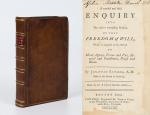
Der Stern der Erlösung [Personal copy of Walter Benjamin’s friend “Florens Christian Rang” / Persönliches Exemplar aus der Bibliothek des Walter Benjamin-Freundes “Florens Christian Rang”. Voll signiert von Rang auf dem Titelblatt. Besitzvermerk von Florens Christian Rang in Tinte. Mit sehr interessanten Text-Markierungen in Buntstift und Bleistift, sowie zwei Annotationen zu Text-Verweisen im hinteren Einbanddeckel [hier kann nicht einwandfrei gesagt werden ob alle Anstreichungen von Rang sind da es zwei Formen von Anstreichungen gibt / Rang selbst hat nachweislich auch mit Buntstift markiert]. Die Handschrift mit dem Textverweis im Innendeckel deckt sich nicht mit online verfuegbaren Schriftproben Rang’s (siehe Abbildungen auf der Webseite des Florens Christian Rang Archivs)]. Bedeutender Fund für die Florens Christian Rang-Forschung da Walter Benjamin beide, Franz Rosenzweig und Florens Christian Rang, in seinem Essay, “Privilegiertes Denken – Zu Theodor Haeckers Vergil”, in einem Atemzug als bedeutende Kämpfer “gegen die Idolatrie des Geistes” nennt. Leider wird Benjamin’s Erwähnung von Rosenzweig und Rang oft nur verkürzt zitiert obwohl Benjamin in seinem Essay [1932] zu Haecker’s Vergil-Polemik noch einen Schritt weitergeht und die Bedeutung von entschärfenden, informierten und kompetenten Stimmen wie Rosenzweig und Rang hervorhebt. Benjamin schreibt in der wichtigen Passage: “Es ist nicht unsere Schuld, wenn der Verfasser [Haecker] das realpolitische Äquivalent seiner »Idee des Men­schen« in so peinliche Nähe rückt: jenes, im drastischen Sinne privilegierte, Verständnis der nichtabendländischen Völker, welches gekennzeichnet ist durch das Ineinanderwirken von Ausbeutung und Mission. So pflegt nun einmal die Kontrebande auszuschauen, die in das Musselin des reinen Geistes gewickelt, die Reisenden nach Wolkenkuckucksheim mit sich führen. Am allerwenigsten sollte die Theologie ein solches Wolkenkuckucksheim sein. Es sind denn auch in der Tat theologische Denker gewesen, die gerade in unserer Generation erschienen, um den Kampf gegen die Idolatrie des Geistes aufzunehmen: der Jude Franz Rosenzweig von der Sprache, der Protestant Florens Christian Rang von der Politik her. Nun hält allerdings auch Haecker sich für einen Sprachdenker so gut wie er ein Politiker ist, wennschon er vielleicht vorzieht, nicht dafür zu gelten. Aber das eben schließt ihn aus der Reihe der echten theologischen Denker aus, daß er die Philosophie der Sprache wie der Politik vom Geiste aus handhaben zu können meint, ohne weder mit der Philologie noch mit der Ökonomie näher sich einzulassen. Freilich – und so erst rückt der Sachverhalt ins rechte Licht – bei Rosenzweig und vollends bei Rang handelt es sich um häretisch gestimmte Männer, denen es nichts Unmögliches ist, die Tradition auf ihrem eigenen Rücken zu befördern, statt sie seßhaft zu verwalten.” Die zahlreichen und sehr aufschlussreichen Anstreichungen in Rosenzweig’s Werk, bestätigen Benjamin’s Auffassung, da Sie uns erlauben Rang’s Transformierung vom Nationalisten zum politisch moderat eingestellten Konservativen, teilweise nachvollziehen zu können. Die Publikation Rosenzweigs fällt ausserdem in die kritische Phase von Rang’s Wandlung. Die “Deutsche Bauhütte”, Rang’s publizistisches Testament seiner Entfernung vom Nationalismus, erschien nur drei Jahre später. Die vorliegende Ausgabe ist eindrucksvoller Nachweis für die immer neue Bereitschaft Rangs zur völligen Aufgabe seiner Ideale und zur Offenheit gegenüber einem philosophischen und politischen Erweckungserlebnisses, begonnen mit der Abkehr vom Christentum und vollzogen mit der Lektüre des Magnum Opus eines jüdischen Philosophen dessen Werk er mit seinem Besitzeintrag für sich ganz privat legitimiert. Zum Zeitpunkt der Lektüre von Rosenzweig’s “Stern der Erlösung”, hatte Rang bereits durch Mitarbeit im Forte-Kreis seine wilhelminischen “Phantasmagorien einer preussischen Religion” [Christine Holste – “Der Forte-Kreis 910 – 1915”] abgelegt und war durch solch disperaten Kontakte wie zu Martin Buber und Gustav Landauer ein Kandidat für eben jene Evolution die Benjamin in ihm spüren musste. Benjamin, der Rang nicht nur persönlich kannte sondern ihn auch “erkannte”, schrieb an Scholem, dass er „seltsamerweise […] diesem Mann, ebenso wie seine Unterstützung und Bestätigung, das zu danken vermochte und danken mußte, was ich von deutscher Bildung Wesentlichstes in mich aufgenommen habe. Denn nicht nur, daß in diesem Bereiche die Hauptgegenstände unserer beharrlichen Betrachtung fast sämtlich dieselben waren – das Leben, das in diesen großen Gegenständen lebt, habe ich menschlich ganz allein in ihm lebendig gesehen, ausbrechend mit desto mehr vulkanischer Gewaltsamkeit, als es unter der Kruste des übrigen Deutschland erstarrt lag. Wenn ich mit ihm sprach, war nicht sowohl Harmonie in unsern Gedanken, als daß ich, wetterfest und athletisch, an dem unmöglichen, zerrissenen Massiv der seinigen mich versuchte und oft genug eine Zinne mit weitem Ausblick auf eigne unerschlossne Gedankenbereiche gewann. Sein Geist war von Wahnsinn durchzogen wie ein Massiv von Schluchten. Aber durch die Moralität dieses Mannes gewann Wahnsinn keine Macht über ihn.” / Of utmost interest for the evaluation of Rang’s development from nationalist to empathetic centrist. Benjamin famously mentions both, Florens Christian Rang and Franz Rosenzweig as equally important influences for his Generation in “fighting the Idolatry of the Spirit/Mind”. This makes Rang’s personal copy of Rosenzweig’s masterpiece an enormously interesting find; possibly even a key to Rang’s ideological and religious transformation].

Erste Ausgabe. Frankfurt am Main, J.Kauffmann Verlag, 1921. Oktav (16 cm x 22,5 cm). 532, [2] Seiten. Hardcover / Originaler Verlagseinband mit illustriertem und beschriftetem Einbanddeckel. Die seltene Publikation, aus der Bibliothek von Florens Christian Rang, wurde mit einem neuen Einbandrücken versehen und das originale Rückenschildchen wurde neu aufgezogen. Die Bindung ist firm, die originalen Vorsatzblätter wurden erhalten. Das sonst notorisch schlecht erhaltene Papier der Publikation, hier generell in aussergewöhnlich guter Erhaltung; allerdings mit einigen kleineren Schäden: Kleine Einrisse ohne Textverlust auf den Seiten 7-8 / Sehr feine Einrisse ohne Textverlust auf den Seiten 207 – 210 / Unschöne Ausrisse mit nur geringem Textverlust am Rand der Seiten 409 – 414.


Show details

Page: 1 2 3 4 5 6 7 ... 858 859
: