


[Newenham, The Case of Ireland's Being Bound by Acts of Parliament in England,
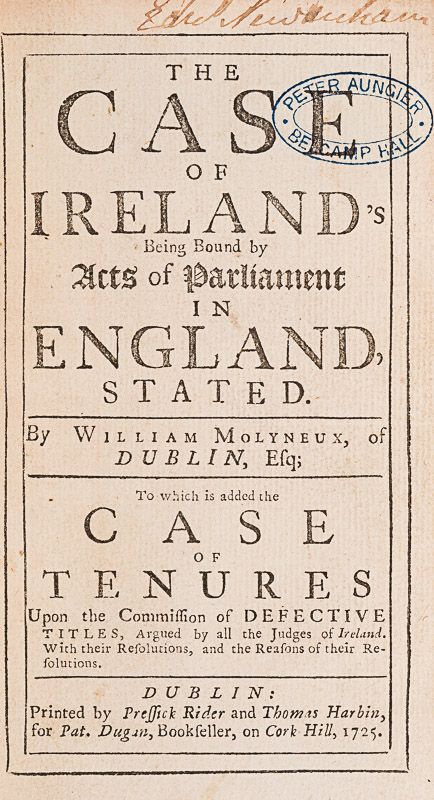
The Case of Ireland’s Being Bound by Acts of Parliament in England, stated. To Which is Added “The Case of Tenures Upon the Commission of Defective Titles, Argued by all the Judges of Ireland, With Their Resolutions, And the Reasons of Their Resolutions” [this work has its own titlepage].
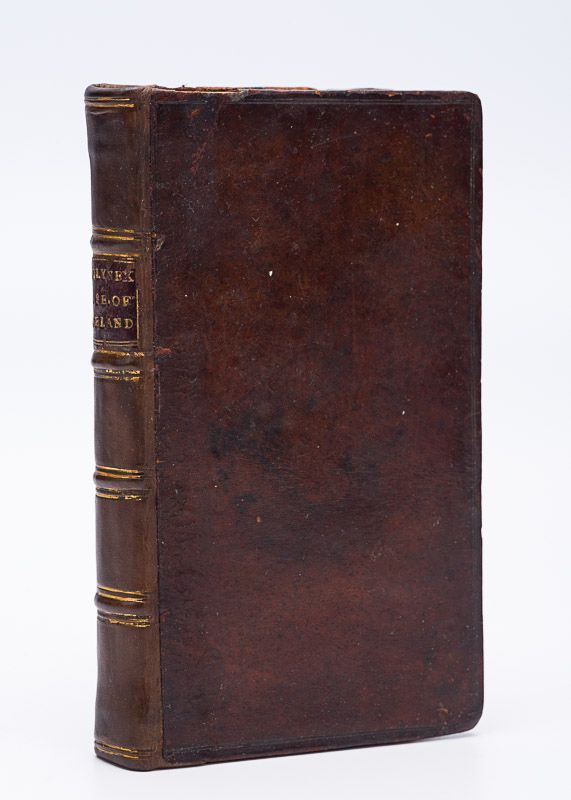
Dublin, Pressick Rider and Thomas Harbin for Pat. Dugan, Bookseller on Cork-Hill,. 1725. Small-Octavo (9.8 cm x 15.8 cm). VI, [4], 186, [1] pages [including the final leaf “The Order of the Councel-Board, upon this Resolution of the Judges”]. Original Hardcover / 18th century full calf / Recently professionally rebacked and restored with original endpapers intact. Excellent condition. Provenance: From the library of Sir Edward Newenham, friend of George Washington and Benjamin Franklin. With Newenham’s name in ink on titlepage.
Provenance: Sir Edward Newenham (1734–1814) was an Irish politician.
A younger son of William Newenham, of Coolmore House, County Cork, and Dorothea, daughter and heiress of Edward Worth, he was born on 5 November 1734. He was appointed collector of the excise of Dublin in 1764, but was removed in 1772, apparently for political reasons.
In the Irish Parliament Newenham represented Enniscorthy from 1769 to 1776, and County Dublin from 1776 to 1797. He was a man of moderate political views, but a reformer of Parliament, within the limits of the constitution, and on strictly Protestant lines. He induced Parliament to add a clause to the Catholic Relief Bill of 1778 for the removal of nonconformist disabilities; but it was opposed by government, and struck out by the English privy council.
Also he was personal and ardent writing friend to George Washington and Benjamin Franklin. He met Franklin, John Jay and the Marquis de Lafayette whilst on a European Tour with his immediate family during the year of 1782. Newenham even constructed a monument to Washington and American independence in the grounds of his home at Belcamp Hall in 1778. (Wikipedia)
A noted “Duelist” 3 times over, one of these duels, was over a dispute in parliament. This duel took place on 20 March 1778 between Newenham and John Beresford, in which, neither was wounded. On the revival of the Catholic emancipation question in 1782 he spoke against further concessions. He disapproved of Henry Flood’s renunciation agitation, on the ground that he did not make his amendments at the proper time, and in parliament supported Flood’s Reform Bill. He took part in the volunteer convention on College Green in 1779, in charge of his “Liberty Volunteers”. This coincided with a painting by Francis Wheatley (right), depicting this epic event. Sir Edward is noted in this painting, along with the “Dublin Volunteers” (Duke of Leinster) and the “Liberty Artillery” headed by one of Sir Edward’s allies, the Pre-United Irishman – James Napper Tandy. (Wikipedia)
______________________________________________________________________________
William Molyneux FRS (17 April 1656 – 11 October 1698) was an Anglo-Irish writer on science, politics and natural philosophy.
He is noted as a close friend of fellow philosopher John Locke, and for proposing Molyneux’s Problem, a thought experiment widely discussed.
Early in 1698, Molyneux published The Case of Ireland’s being Bound by Acts of Parliament in England, Stated. This controversial work—through application of historical and legal precedent—dealt with contentious constitutional issues that had emerged in the latter years of the seventeenth century as a result of attempts on the part of the English Parliament to pass laws that would suppress the Irish woolen trade. It also dealt with the disputed appellate jurisdiction of the Irish House of Lords. Molyneux’s arguments reflected those made in an unpublished piece written about 1660 by his father-in-law Sir William Domville, entitled “A Disquisition Touching That Great Question Whether an Act of Parliament Made in England Shall Bind the Kingdom and People of Ireland Without Their Allowance and Acceptance of Such Act in the Kingdom of Ireland”.
Following a debate in the English House of Commons, it was resolved that Molyneux’s publication was ‘of dangerous consequence to the crown and people of England by denying the authority of the king and parliament of England to bind the kingdom and people of Ireland’. Despite condemnation in England, Molyneux was not punished but his work was condemned as seditious and was ceremonially burned at Tyburn by the public hangman. His arguments remained topical in Ireland as constitutional issues arose throughout the eighteenth century, and formed part of Swift’s argument in Drapier’s Letters. The tract also gained attention in the American colonies as they moved towards independence. Although ‘The Case of Ireland’ was later associated with independence movements—both in Ireland and America—as one historian points out, ‘Molyneux’s constitutional arguments can easily be misinterpreted’ and he was ‘in no sense a separatist’. (Wikipedia)
- Keywords: 17th Century – Rare · 18th Century – Irish Country House Library · 18th Century – Rare · British Legal History · Catalogue Irish History Six – General Irish History · Catalogue Irish History Two – Origins of Irish Identity · Catalogue One – History of Law · Irish Constitution · Irish Constitutional History · Irish History – Rare · Irish History in the 17th century · Irish History in the 18th century · Irish Law · Irish Legal History · Irish Woolen Trade · Law – Rare
- Language: English
- Inventory Number: 29361AB
EUR 480,--

We ship per DHL Express


Contact
Inanna Rare Books Ltd.
Woodley House
Castletownshend Road
P81 D262 Skibbereen, County Cork
Ireland
Phone: ++353 - (0) 87 - 102 5412
E-Mail: info@inannararebooks.com
Internet: https://www.inannararebooks.com
Online Bookshop specialized in rare
and secondhand books.
Newsletter and E-Catalogue Sign Up
Payment Options


© 2026 Inanna Rare Books Ltd. | Powered by HESCOM-Software

