

Catalogue Winter 2020 / 2021 (52 items)

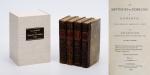
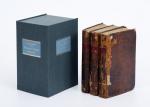
Forster, The Arabian Nights, in Five Volumes.

1. [Arabian Nights] Forster, Edward / [Provenance: Daniel Callaghan of Lotabeg].

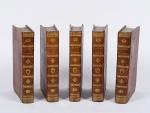
The Arabian Nights, in Five Volumes. [Including “The History of Aladdin, or the Wonderful Lamp” / The History of Ali Baba and of the Forty Robbers, killed by one Slave” / etc.] Translated by The Reverend Edward Forster [based on the French version of Antoine Galland]. With [24] Engravings, from Pictures by Robert Smirke.

First Edition [Large Paper Quarto Edition]. Five Volumes (complete set with all engravings). London, Printed for William Miller, 1802. Quarto (21.5 cm x 27.5 cm). Volume I: LXI, (7), 385 pages with 5 copper-engravings including Errata-Leaf and “Directions for placing the Plates” for all four volumes / Volume: 432 pages with 5 copper-engravings / 405 pages with 5 copper-engravings / 461 pages with 5 copper-engravings / 474 pages with 5 copper-engravings. Hardcover / Original, early 19th century full leather with gilt lettering and date on lower spine [″London, 1802”]. Beautiful, richly ornamented master-bindings. All Volumes in strong, protective collector’s Mylar, which invites the reader/collector to use the work without fear of handling. Armorial Bookplates / ExLibris of Daniel Callaghan, Esquire of Lotabeg (MP for Cork City 1830-1849) to all five pastedowns (Motto: “Fidus et Audax”). Marbled endpapers a little dusty but beautiful. Volume 1, 2 and 5 with some weakening to the spine (slightly cracked), but holding and still firm overall. All plates present. As known and always found with this scarce edition, the original, titled tissue-guards all in place, have created stronger signs of foxing to the plates but in sharp contrast the text in all the five Volumes in bright and clean condition with only occasional faint staining. Endpapers with some minor browning. Very good+ condition overall with some rubbing and minor bumping to the Volumes but really only minor signs of external wear. Extremely sought after publication, not to be confused with the later, much more common Octavo Editions !

EUR 1.000,-- 
Show details   Add to cart

Beaulieu, Le Robinson de douze ans.

4. Beaulieu, Mad. Mallès de / [Robinson Crusoe].

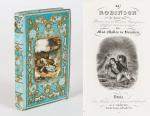
Le Robinson de douze ans – Histoire intéressante d’un jeune Mousse Français abondonné dans une ile déserte. Ornée de Gravures par Mme Mallès de Beaulieu, Auteur des Coules d’une Mère à sa Fille.

Paris, P.-C. Lehuby, no date (approx. 1818). Small – Octavo. Engraved frontispiece, Titlevignette, 288 pages with two further engravings (4 in total). Hardcover. Original, blue paper-covered boards, extensively decorated with gilt floral motifs and an inset illustration of the young Robinson and his dog on a beach. Very good condition. Interior remarkably clean. Fine example of a so-called Robinsonade, a fashionable adaptation of the original Robinson Crusoe story, in this case based on another “Robinsonade”, this is a somewhat modified and inspired version of Johann David Wyss’ famous publication “The Swiss Family Robinson”, which he published initially “to teach his sons about family values, good husbandry, the uses of the natural world and self-reliance” (Wikipedia). In her publication “History and the Construction of the Child in Early British Children’s Literature”, Jackie C. Home writes that “The Bibliothèque Nationale de France online catalogue lists 35 French language editions of Mallès de Beaulieu’s novel, published between 1818 and 1923, suggesting that the novel was one of the most popular titles fro children in nineteenth-century France.”

EUR 275,-- 

Show details   Add to cart

Letters written by the late Right Honourable Philip Dormer Stanhope

9. Chesterfield, Philip Dormer Stanhope, 4th Earl of.

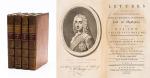
Letters written by the late Right Honourable Philip Dormer Stanhope, Earl of Chesterfield, to his son, Philip Stanhope, Esq.; Late Envoy Extraordinary at the Court of Dresden: together with other several pieces on various subjects. Published by Mrs. Eugenia Stanhope, from the originals now in her Possession

The Third Edition. In Four Volumes (complete set). London, J. Dodsley in Pall-Mall, 1774. Octavo. Collation: Volume I: Engraved frontispiece of Stanhope, XVI, 352 pages / Volume II: (2), 355 pages / Volume III: (2), 376 pages / Volume IV: (2), 364 pages. (Collation complete). Hardcover / Original 18th century full calf with gilt lettering on original spinelabels. Very good condition with only minor signs of external wear. Smaller dampstain to lower first and last two pages of two volumes only. The bindings a little shaky but holding. Provenance: From the library of Robert Doyne, with his Exlibris – bookplate to the front pastedown of all four volumes. While he died already in 1733 and these books were published in 1774, it is very likely that the bookplates were still applied by his librarian or family / Sir Robert Doyne (1651-1733) was member of the Irish House of Commons for New Ross from 1692 to 1695, and later a distinguished judge who served as Chief Baron of the Irish Exchequer from 1695 to 1703 and Chief Justice of the Irish Common Pleas from 1703 to 1714. In the latter year like all the senior judges in Ireland appointed under Queen Anne he was removed by the new administration; while allegations of corruption were made, the removal seems to have been a simple matter of politics. Although the Irish House of Commons passed a resolution that he had acted corruptly no further action seems to have been taken against him and he lived in peaceful retirement for many years. (Wikipedia)

EUR 680,-- 

Show details   Add to cart

[de Man, Collection of five books from the library of Paul de Man and Pat de Man

13. [de Man, Paul] Durling, Robert M. / Rosiek, Jan / Weiss, T.[Theodore Russell Weiss] / Hughes, Langston / Levin, Harry.

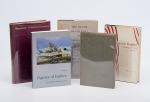
Collection of five books from the library of Paul de Man and Pat de Man. Three of the books inscribed/signed by the author’s. The Collection includes: 1. Robert M. Durling – The Figure of the Poet in Renaissance Epic. [Inscribed by Durling: “For Paul de Man – with fond regards – Bob”] / 2. Jan Rosiek – Figures of Failure – Paul de Man’s Criticism 1953-1970 [Unsigned / Not inscribed] / 3. T. Weiss – The Catch – The Twayne Library of Modern Poetry [Inscribed by Weiss: “To Pat + Paul, for real friendship + a book of their own soon. Ted”] / 4. Edward J. Mullen – Langston Hughes in the Hispanic World and Haiti [Inscribed by Langston Hughes: “Ma cheri Pat, may this slight token of appreciation for your past (and hopefully) future, intellectual ministrations to your petit frère recall to you fond memories of your peregination. Love, Langston – Chritmas, 1979 (Late, as usual)”] / 5. Karry Levin – Grounds for Comparison [Unsigned / Not inscribed].

Cambridge (Mass.) / Aarhus / New York and others, Harvard University Press / Archon Books / Twayne Publishers / Aarhus University Press, 1951 – 1992. 8°. Volume I.: VIII, 280 pages / Volume II: 247 pages / Volume III: 77 pages / Volume IV: 193 pages / Volume V: 423 pages. Three Volumes in original Hardcover with original dustjacket in protective Mylar / One Volume in Softcover / One Volume in Hardcover. Very good condition. From the library of Paul de Man. Especially the Durling – Volume of interest. Inscribed by the author: “For Paul de Man with fond regards – Bob”.

EUR 780,-- 

Show details   Add to cart

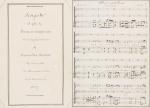
Mendelssohn Bartholdy, Collection / Sammelband of original, printed scores.

34. Mendelssohn Bartholdy / Jakob Ludwig Felix.

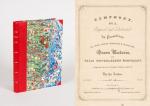
Collection / Sammelband of original, printed scores. The Volume contains the following scores: I. “Symphony No. 3” – Composed and Dedicated by Permission to her most gracious Majesty Queen Victoria, by Felix Mendelssohn Bartholdy, arranged as a Piano Forte Duett, by the author. Op. 56 (67 pages) London, Published by J.J.Ewer & Co., [c. 1860] / II. “Overture to Melusine”. Arranged for Piano Forte, composed by Felix Mendelssohn Bartholdy. Op. 32 (17 pages) London, Cramer, Addison & Beale, [c. 1839] / III. “Caprice”, for the Piano Forte, composed by Felix Mendelssohn Bartholdy. (15 pages) London, Cramer, Addison and Beale, [c. 1840] / IV. “Fantasia” on a Favourite Irish Melody for the Piano Forte. Composed by F. Mendelssohn Bartholdy (Op. 15) – 8 pages, London, Cramer, Addison & Beale, [c. 1840] / V. “Two Musical Sketches” for the Piano Forte. Composed by F. Mendelssohn Bartholdy. 7 pages – London, Cramer, Addison & Beale, [c. 1840] / VI. “Capriccio for the Piano Forte. Composed & Dedicated to Miss Honoria Taylor. By F. Mendelssohn Bartholdy (Op. 16) No. 2; 4 pages – London, Cramer, Addison & Beale, [c. 1840] / VII. “The Rivulet” Rondino for the Piano Forte. Composed and Dedicated to Miss Susan Taylor, by F. Mendelssohn Bartholdy (Op. 16) – No. 3; 4 pages – London, Cramer, Addison & Beale, [c.1840] / VIII. “Twenty-Seven Melodies” by Felix Mendelssohn Bartholdy, arranged for the Piano – Forte from his Ops. 8 and 9. In Four Books:– Book I, II, III and IV (13, 13, 13, 13 pages) – London, Ewer & Co., [c. 1840] All the four books have separate titlepages / IX. “Six two-part Songs, for Female Voices with Accompaniments of the Piano – Forte, composed by Felix Mendelssohn Bartholdy (Op. 63) – 29 pages; London, J.J.Ewer * Co., [c. 1840] / X. “The Garland”, by Thomas Moore Esq. Set to Music by Felix Mendelssohn Bartholdy. 5 pages; London, J.J.Ewer & Co., [c. 1840] //

London, Ewer / Addison / Beale and others, [c.1840 – 1863]. Folio. c 180 pages. Modern Hardcover, beautiful half morocco with gilt lettering on spine and marbled paper covered boards. Original Softcover, engraved scores bound in. Very good condition with only minor signs of external wear. Only three of the scores with some tears, one with a dampstain ! Overall an extremely attractive compilation of Mendelssohn’s work in a recent mster-binding. Highly collectable and a beautiful gift ! Ask for multiple images.

EUR 380,-- 

Show details   Add to cart

Montague / Dorgan - Typescript Draft MS for a book of poetry by Theo Dorgan. With occasional manuscript corrections

36. [Montague, John] Dorgan, Theo.

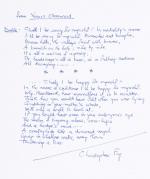
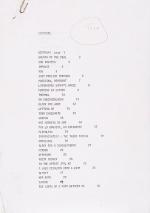
Typescript Draft MS for a book of poetry by Theo Dorgan. With occasional manuscript corrections / suggestions / annotations by Dorgan’s early mentor John Montague, the Typescript MS was held among the private papers of John Montague in his West Cork Home. The typescript includes poems like “Closed Circuit”, “The Promised Garden”. Montague is approving several of the poems by simply applying a tick. John Montague made suggestions in pencil on the structure of “Elegy for a Schoolfriend” and more in depth-suggestions on “Nasty Archer”, “Her Body”,″The Width of a Room Between Us”, “Return”, “Reconciliation”, “Sunday Afternoon”. When asked about helping to date this early draft of his poetry, Theo Dorgan immediately gets back to us and he places it from memory into the early 1980’s. Theo Dorgan was surprised and seemingly chuffed that John Montague held on to this Manuscript and he recalls: “These poems, some in revised versions, make up the backbone of my first published collection, ‘The Ordinary House of Love’.” Dorgan continues: “I’m happy to say that most of them survived Montague’s eagle eye, which was of course a great comfort to me at the time. Still is!” Some of these poems selected had previously been published as broadsheets etc. but the skeleton of the Draft hints already at readying it for publication. Theo Dorgan graciously gives us even more information: “Some of the poems in the eventual book go back to when I was a student, others were definitely written in the second half of the 80s. The bulk of it, however, is in this MS. I base my estimation in part on the fact that what you have is a typescript produced, it appears, on the IBM golfball machine that was the pride and joy of Triskel Arts Centre. That machine was bought in 1980 or 1981, I’m fairly sure of that. I was Literature Officer there, then.” Theo Dorgan was part of John Montague’s circle of mentored poets, even though in an email-exchange with him about this typescript he mentions that “John Montague worked far more with Thomas McCarthy, Maurice Riordan and Gregory O’Donoghue than he did with me, and in many ways Gregory O’Donoghue was at that stage the most accomplished of us all – the only one included in JM’s Faber Book.” What followed then in our conversation with Theo Dorgan is a great example why manuscripts, letters, autographs, typescripts and the connections we often make with documents from the past have such meaning in explaining our emotional ties with people who matter to us on our way of forming personality. They are memories transforming into images, floods of empathy and nostalgia for personal moments lost but treasured because they helped us form our values. Presented with the old typescript, Theo Dorgan’s emotionality is tangible and he confesses more in an internal dialogue with himself and John Montague than with us: “I’m sorry to say that the reason John Montague worked with those others more than he did with me is because, in my shameful, youthful arrogance, I much preferred to trust my own judgement, and also, I suspect, because I was closest to John in temperament and feared coming unduly under his influence. That said, there was no-one whose good opinion of a poem I valued more, and we were close all our lives after. Very likely it was a case of old stag/young stag ! Montague taught us by indirection, he made his extensive library of modern and contemporary poetry available to us without stint, would wait for us to find an affinity (as, e.g. mine with Robert Graves and Galway Kinnell) and would then, in a long, ongoing conversation, help us to understand what it might mean for our own poems that we felt such affinities. A guided companionship in reading and making, if you will.”

Ireland, c.1981-1982. A4. 43 pages typescripts. Paperclipped. Very good condition with only minor signs of external wear. Some fingerstaining and residue of rust from the paperclip. Wonderful and extremely valuable document of not only a collaboration between two of Ireland’s landmark writers but moreover witness to the becoming, the birth of a true poet. Also included (from a different source) is a second printing of the first edition of the subsequent publication “The Ordinary House of Love” – signed by Theo Dorgan. Right at the beginning of the printed version, instead of a dedication to John Montague, Theo Dorgan placed a quote from Montague’s poem “Wine Dark Sea”: ‘For there is no sea / it is all a dream there is no sea / except in the tangle / of our minds; / the wine dark / sea of history on which we all turn / turn and thresh / and disappear.’ (Collected Poems, page 255). Provenance of the annotated typescript: From the private collection of John Montague’s papers in his recently sold West Cork Home.

EUR 2.800,-- 

Show details   Add to cart

Ann Radcliffe - The Mysteries of Udolpho - A Romance; interspersed with some pieces of Poetry.

41. Radcliffe, Ann.

The Mysteries of Udolpho – A Romance; interspersed with some pieces of Poetry.

First Dublin Edition / First Irish Edition. 3 Volumes [complete set]. Dublin, , by Hillary and Barlow, for Messrs. P. Wogan, W. Jones, and H. Colbert, 1794. Small Octavo (17.5 cm x 11 cm). Collation complete: Volume I: 310 pages / Volume II: 321 pages / Volume III: 357 pages. [Few pages with misprinted numerals, as often the case, but all pages in order and complete]. Original, unaltered, 18th-century full leather with gilt lettering on original spinelabels. Very rare, complete set of the first Dublin Edition. Very good- condition with stronger signs of external wear but all three Volumes in firm, original condition. Lesions to the leather-covered-boards and some stronger rubbing to extremeties. Interior with only very few problems. All three Volumes used to have two endpapers before and after the text and some of these endpapers are torn or missing. Textblock in general very good with some very minor and only occasional staining only. In Volume I, tear to corner of page 101/102 and 135/136. Faded stain to only the outer margins of pages 239 to 310 (text never affected). Volume II with small tear to pages 21/22 / Volume III with lesion to page 281/282 and tear to corner 305. These all sound worse than they are and the set is still in very good- condition. From the library of the Meade family in Ballymartle, the titlepage of each Volume bears the name of Helena Meade. An extremely rare and highly collectable set of one of the rarest titles in english literature.

EUR 1.900,-- 

Show details   Add to cart

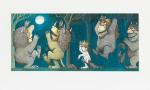
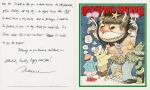
Small Collection / Small Archive of two very rich and personal, handwritten & signed letters on cards by Sendak, together with a wonderful collection of fourteen (14) loose gicleé prints

45. Sendak, Maurice (1928 – 2012).

Collection / Archive of two very rich and personal, handwritten & signed letters on cards by Sendak, plus a rare, multi-folded, advertising-leporello of Maurice Sendak’s publications, together with a wonderful collection of fourteen (14) loose gicleé prints of original drawings by Maurice Sendak in colour or black and white: ‘A Kiss for Little Bear’ x 2 (26.5 cm x 34.5 cm) / ‘Zlateh the Goat’ x 2 (24 cm x 30 cm and 37.5 cm x 30 cm) / ‘Mr. Rabbit and the Lovely Present’ x 1 (33.4 cm x 41.5 cm) / Lullabies and Night Songs’ x 2 (35 cm x 26.5 cm and 44.5 cm x 33.5 cm) / ‘Hector Protector’ x 1 (46 cm x 26 cm) / ‘In the Night Kitchen’ x 4 (50 cm x 36 cm) / Higglety Pigglety Pop x 2 (28 cm x 35.5 cm). The two cards are addressed to “Minnie” [that is “Minnie Kate”] and were written at Christmas 1986 and Christmas 1987. According to a colleague in the trade, who helped us to identify the recipient “Minnie”, Minnie Kate, together with her mother, maintained a long friendship with Maurice Sendak by sending him colored stones or rocks that they sourced from local beaches in the northwest of the United States (Washington Statel). Most of Maurice Sendak’s correspondence with Minnie Kate and her mother, is preserved at the Rosenbach Museum & Library, Philadelphia. Both cards are similar in content. One of the cards featuring Sendak’s art from the cover of Nutcracker and addressed to Minnie, reading in part “I worked all year on a picture-book – a Grimm tale (my first book in 8 years !!). I am in love with it and it gets published next year….my wild things celebrate their 25th anniversary. I hope i enjoy it all. Am hoping for a quiet year ahead illustrating a Grimm tale and staying put – I am tired of travelling and theatre projects. And look forward to creeping back into my old role as book illustrator” / “The rocks arrived while I was away working in England. They are wonderful, of course, and very much appreciated. Thank you again and again. My animals. I have but one. My darling Golden Retriever, Io, had to be put to sleep 2 weeks ago. She was 15 1/2 and I held her and stayed with her to the end. It is so sad, naturally, but the memory fills me with a kind of joy. I have a 3 1/2 year old German Shepherd named Runge after a German painter (19th century). It was anything but a lazy year – too full! This coming year will be lazy-ish”.

Letters: 4 pages on two cards / Gicleé prints: 15 sheets (unsigned). [New York], 1986 – 1987. Very good condition.

EUR 1.280,-- 

Show details   Add to cart

Taylor, Collection of six (6) items/original, vintage and personal materials

48. Taylor, Tom / [Abraham Lincoln].

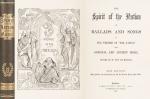
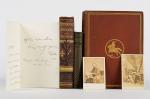
Exquisite collection of six (6) items/original, vintage and personal materials by/of Tom Taylor. The collection includes a 2 1/2 page, signed manuscript letter [MLS] by Tom Taylor to an unknown recipient , discussing a memorial he sent to Robert Browning’s patron, John Kenyon and mentioning former Prime Minister Lord Aberdeen [George Hamilton-Gordon, 4th Earl of Aberdeen]. The collection also includes two vintage 19th century cabinet photographs [Carte de Visite’s] of Tom Taylor, a later edition of Ballads and Songs of Brittany and two beautifully inscribed and signed presentation copies of his major works: 1. The first edition of Ballads of Brittany – London/Cambridge, MacMillan and Co.,1865 with many illustrations by Tissot, Tenniel etc. (This first edition is signed and inscribed by Tom Taylor to Emilia Ventana at Xmas 1864, before the publication of the book commenced) and 2. Tom Taylor’s Historical Dramas. London, Chatto & Windus, 1877. Signed and inscribed by Tom Taylor to Marie de Beauvoisier in March 1879.

London / Cambridge etc., Chatto & Windus / Routledge & Sons / etc., c. 1850-1879. Octavo. Ballads and Songs of Brittany (1865 edition): Frontispice, XXII, 239 pages / Ballads and Songs of Brittany (Later Routledge edition): XVI, 176 pages / Tom Taylor’s Historical Dramas: VIII, 466, 32 pages. / Manuscript Letter: 2 1/2 pages. Original Hardcover / The manuscript letter in a Folder, it includes an A4 manuscript leaf from a 19th century autograph-collector describing the letter by Taylor. / The two vintage cabinet photographs of Taylor included in the Folder with the autograph. Very good condition with only minor signs of external wear.

EUR 1.000,-- 

Show details   Add to cart

Viereck, Collection of Manuscript Material by the author Georg Sylvester Viereck.

51. Viereck, George Sylvester / [Frederick Franklin Schrader] / [Mentioning of Oscar Wilde / Lord Alfred Douglas].

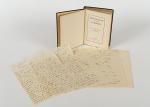
Collection of early Manuscript Material (which is a Manuscript Ballad / Poem), a two-page Manuscript Letter (which is a MLS mentioning Oscar Wilde, Lord [Alfred] Douglas, Viereck’s literary tastes etc.) and the personal copy of “House of the Vampire”, all by the controversial german-american author George Sylvester Viereck. The collection includes: 1. One six-page, hitherto unpublished Manuscript – Ballad [Poem], called “Die Ballade vom Sündigen Glück” [Translates: “The Ballad of sinful Pleasure”]/ 2. A lengthy and extremely insightful Two-Page Manuscript Letter, signed in New York, 1902, which accompanied and talks about the enclosed Six-Page Manuscript – Ballad [The letter and Poem was not conclusively but very likely addressed by Viereck to Frederick Franklin Schrader, then editor of the New York Dramatic Mirror and shortly thereafter co-founder with George Sylvester Viereck of “The Fatherland” / 3. The collection also includes Viereck’s personal copy of his publication “The House of the Vampire” with handwritten, manuscript entry of his name, address in New York City as well as a pasted statement on the endpaper by the author Viereck: “Concerning “The House of the Vampire” : This book went through several editions when it was first published and was dramatized. It played for eight weeks in New York and for two years on the road under the management of the Shuberts. Critics have compared it to such books as Dr.Jekyll and Mr.Hyde, Lady Into Fox, and Dorian Gray”]. The two-page letter is of great value and touches on Viereck’s admiration for Schrader and his “Blatt” [Newspaper]. Viereck is advertising himself to Schrader by introducing himself as a critical admirer with substantial references (Viereck details his working for numerous newspapers in America). Viereck mentions his secessionist tendencies and name-drops Oscar Wilde, Rosetti and Lord Douglas (whom he claims to know personally). This amazing, autographed/signed Manuscript-Material was created by Viereck directly during his transition from writer to propagandist and is an example of his early, bullish personality, which wants to be heard, which needs attention and it is here, in 1912, where his career begins to develop. This large Archive of manuscript material [8 pages in total] is stunning and unpublished (see partial Transcription of the original german material on our website). Viereck’s close friends included Nikola Tesla and even Theodore Roosevelt was among his acquaintances.

New York, Moffat, Yard & Company, 1902-1912. Play and Letters: 20.3 cm x 25.3 cm / Book: 13 cm x 19,5 cm. Pagination: Balld (Poem): 6 pages / Manuscript Letter (MLS): 2 pages / Book: 190 pages. Original Hardcover / Blue publisher’s cloth with gilt lettering on spine in protective collector’s mylar / The play protected in clear folder. The manuscript pages overall in excellent condition besides page IV of the play which has two abrasions with small parts of the text missing only. The book in excellent condition with only minor signs of external wear. Viereck’s usual vanity made him add the lovely littel note of critical success. The personal copy of this controversial author’s most interesting book is a unique possibility for each collector of unusual Vampire material. Extraordinary collection !

EUR 2.800,-- 

Show details   Add to cart

Pages from a Diary Written in Nineteen Hundred and Thirty. [Signed / Inscribed by George Yeats

52. Yeats, William Butler / [George [Georgie] Yeats / Mrs. Eva Hempel / Eduard Hempel].

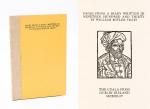
Pages from a Diary Written in Nineteen Hundred and Thirty. [Signed / Inscribed by George Yeats to Mrs. [Eva] Hempel, wife of german ambassador to Ireland during World War II].

No.8 / 200 copies, of the original limited edition. Dublin, The Cuala Press, 1944 [September 1944]. Octavo. 58 pages. Original Hardcover. Inscribed by George Yeats on the front free endpaper: “Mrs. Hempel from George Yeats, April 1944”. This has to be of course “April 1945”. The impossibility of signing/inscribing a book in April 1944 if it was only published in September 1944 is easily explained with the classic everyday-mistake of still writing the previous year in the first few months of the following year. A stunning association. The signature and inscription is a solid match to George Yeats’ autographs in her later hand and William Butler Yeats and George Yeats were frequent visitors to the Hempel’s in Dublin. In addition, the low number of the edition (8/200) suggests this being one of the reference copies given to George Yeats, who contributed heavily to the volume and even added an explanatory note (in print) verso the titlepage. This copy is near fine, bound in the publisher’s quarter buckram over yellow, paper-covered boards. The books pages remained unopened. Eva Hempel’s husband Eduard Hempel is one of the most controversial figures in modern Irish history, excoriated by some as ‘Hitler’s man’, defended by others such as the country’s first President, Eamon De Valera. Certainly, Hempel presented William Butler Yeats in 1938 with a copy of ‘Germany Speaks’ whose inscription described an ‘unforgettable afternoon’ spent together by Yeats and Hempel. Eduard Hempel and his wife were accepted socialites in the Dublin world of World War II, famously receiving a condolence call by de Valera upon the death of Hitler. Eduard Hempel and his wife Eva were granted asylum in Ireland after world war II and stayed way beyond the end of World War II.

EUR 380,-- 

Show details   Add to cart

Page: 1
: